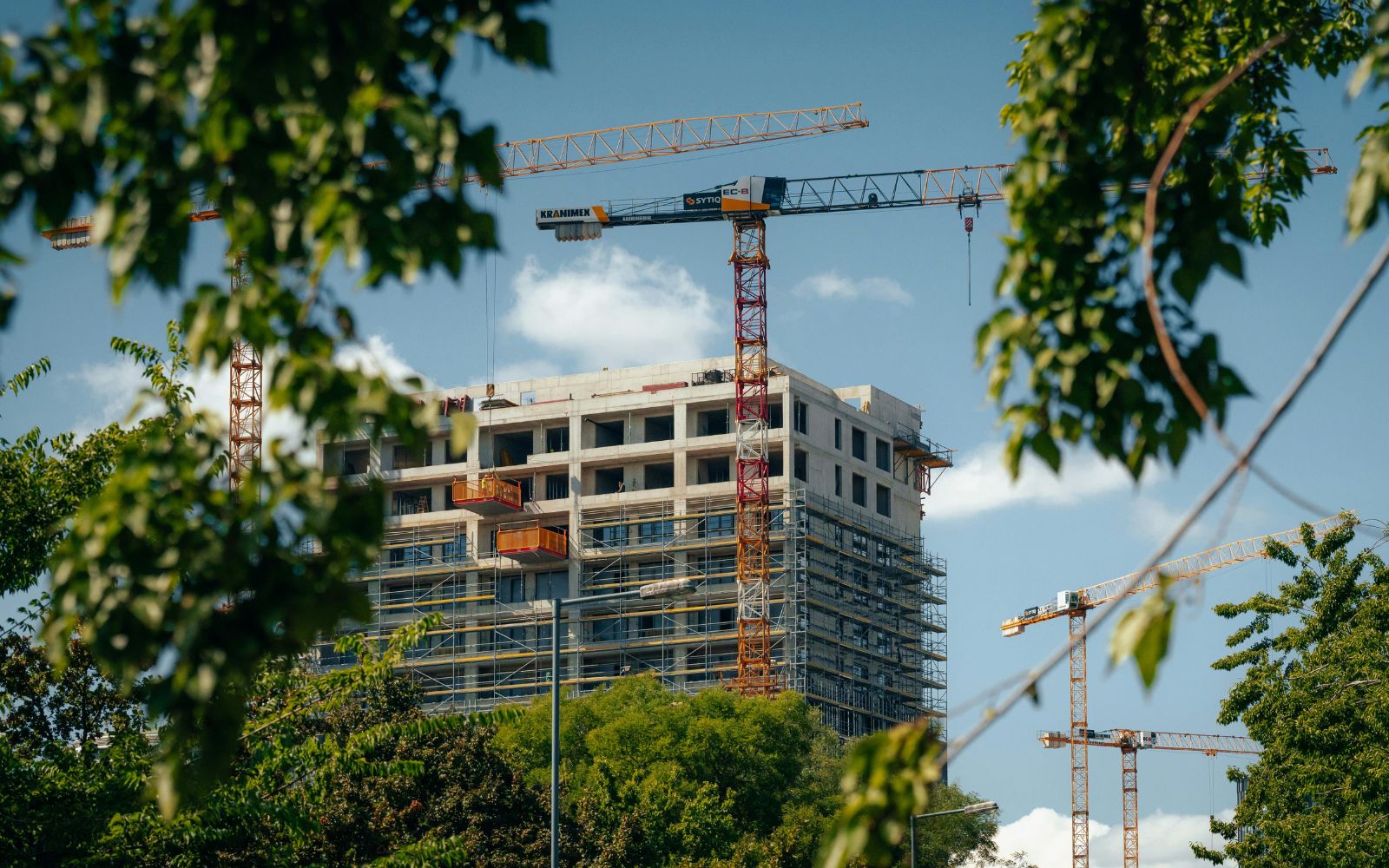
Full building reconstruction for a Texas HOA can run anywhere from a few hundred thousand dollars for targeted exterior work to north of $25 million for large multifamily projects. What pushes the number around isn’t finishes, it’s how far water has traveled, how much of the envelope has failed, whether residents stay in place during the work, and how honest the reserve study has been about what’s actually coming.
This guide walks through what really drives those costs, when patching stops working, how reserves and insurance shape the budget, and what Texas HOA boards should expect before kicking off a reconstruction project.
Why HOA Reconstruction Costs Have Become a Major Concern in Texas
Full building reconstruction rarely starts with something dramatic. It rarely begins with a collapse or a hurricane on the news. It starts quietly.
A property manager notices the same unit leaks every time it rains hard. Residents stop ignoring the hairline crack on the third-floor balcony. An engineer cuts open a section of stucco for testing and finds black, soaked sheathing behind it, damage that’s been working its way through the wall for years. That’s usually the moment the conversation shifts from repair to reconstruction.
For HOAs across Texas, this conversation is happening more often. Aging multifamily stock, climbing material prices, deferred maintenance from leaner years, and tighter code requirements have all pushed reconstruction budgets well past what most boards expected even a few seasons ago.
And HOA reconstruction doesn’t price out as a residential remodel. A condo association has to plan around occupied units, resident communication, scaffolding logistics, structural engineering, ADA considerations, insurance coordination, and reserve funding all at once. Those layers can take a project from a manageable repair into a multimillion-dollar lift surprisingly fast.
The Community Associations Institute reports that more than 77 million Americans live in HOA communities, and aging infrastructure ranks among the largest financial pressures associations face nationwide. Boards that delay major repairs almost always end up paying more later; water intrusion and envelope failure don’t stay in one place.
The National Institute of Building Sciences has shown that every dollar spent on mitigation and resilience saves multiple dollars in future recovery costs. That math applies directly to multifamily reconstruction, where catching a problem early often prevents the kind of full-scale deterioration that drains a reserve account.
For Texas HOA boards, property managers, and building owners, getting in front of reconstruction costs early can mean the difference between a planned capital project and an emergency special assessment that sets the community on fire.
Cost of Full Building Reconstruction for HOA Communities
The honest answer to what does full building reconstruction cost for our HOA?” is that it depends on more variables than any single number can capture. Damage scope, property type, accessibility, envelope condition, and whether residents stay in place all of that moves the number.
What we can do is share realistic ranges. Texas multifamily reconstruction has climbed steadily because labor shortages, material volatility, and stricter standards keep tightening the market. Balconies are one of the sharpest examples of that pressure, and we break down balcony structural failure reconstruction costs for HOAs in a dedicated guide covering what drives the price and who ultimately pays.
| Reconstruction Scope | Typical Cost Range |
| Exterior envelope restoration | $40–$120 per sq ft |
| Balcony reconstruction | $8,000–$40,000 per balcony |
| Full siding replacement | $15–$45 per sq ft |
| Waterproofing reconstruction | $10–$35 per sq ft |
| Window system replacement | $900–$2,500 per opening |
| Full multifamily reconstruction | $1M–$25M+ |
Boards often run these numbers against the cost-per-square-foot calculators they find online and walk away confused. That’s because those calculators are built for new residential construction, not occupied multifamily reconstruction.
A single condo building in reconstruction can require engineering analysis, invasive testing, code upgrades, temporary weatherproofing, scaffolding or swing-stage access, resident coordination, and phased scheduling, all before any visible reconstruction work begins.
Communities with aging stucco, failed waterproofing membranes, deteriorated balconies, or long-term water intrusion tend to land at the higher end of these ranges. The reason is simple: hidden damage spreads behind finished surfaces, and you don’t know what you have until you open the wall.
That’s why associations searching for experienced HOA reconstruction specialists in Texas usually learn that pricing has less to do with cosmetic finishes and more to do with how deeply moisture and movement have already worked through the structure.
What Increases the Cost of Full Building Reconstruction for HOA Communities?
A handful of specific factors push HOA reconstruction past standard repair pricing. In most projects, the visible damage is only a small piece of what’s actually wrong.
Water Intrusion and Building Envelope Failure
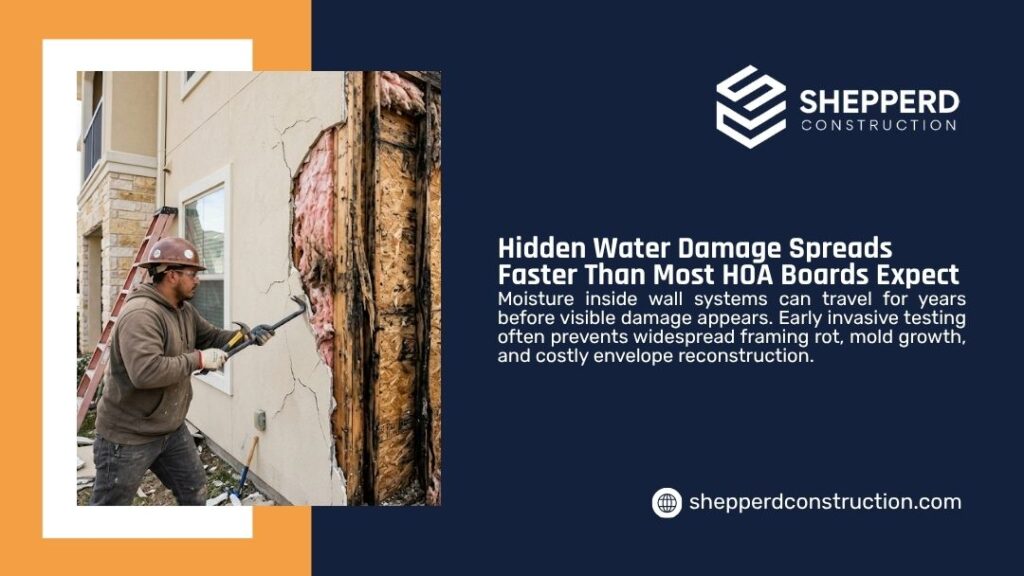
Water is the single most destructive force acting on multifamily buildings. Once moisture gets behind the envelope, it can spread for years before residents see a stain.
Failed flashing, cracked stucco, dried-out sealants, poorly installed windows, roof-to-wall transitions that were never detailed correctly, any of these can let water into hidden structural areas. Given enough time, you get framing rot, mold, corroded fasteners, and waterlogged insulation. Suddenly, the problem isn’t a leak. It’s the wall.
Communities that delay corrective work almost always watch costs spiral, because the project grows from isolated repairs into large-scale envelope replacement. Property managers who learn to spot the early signs that water damage requires reconstruction tend to keep long-term costs significantly lower than communities that keep funding patchwork.
Deferred Maintenance
Deferred maintenance is one of the largest financial risks an HOA can carry. A small waterproofing issue can stay quiet for several seasons. But once moisture starts cycling through wall systems, balconies, or roof assemblies repeatedly, deterioration accelerates fast.
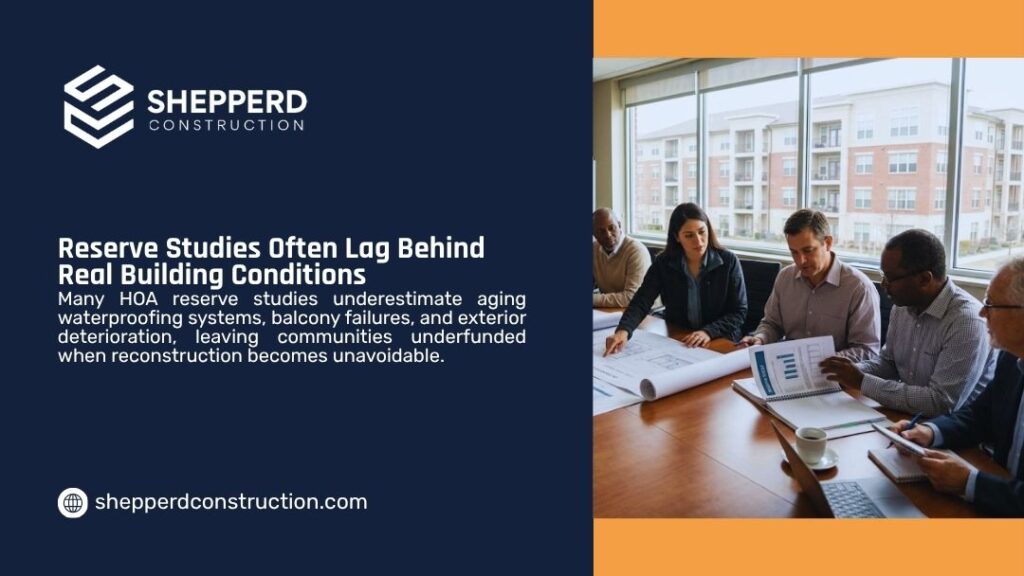
This shows up most in older condo and townhome communities, where the original reserve study underestimated the future. A lot of associations are still working with budgets structured for routine maintenance, not for the building-envelope reconstruction those same buildings now need.
Occupied Building Logistics
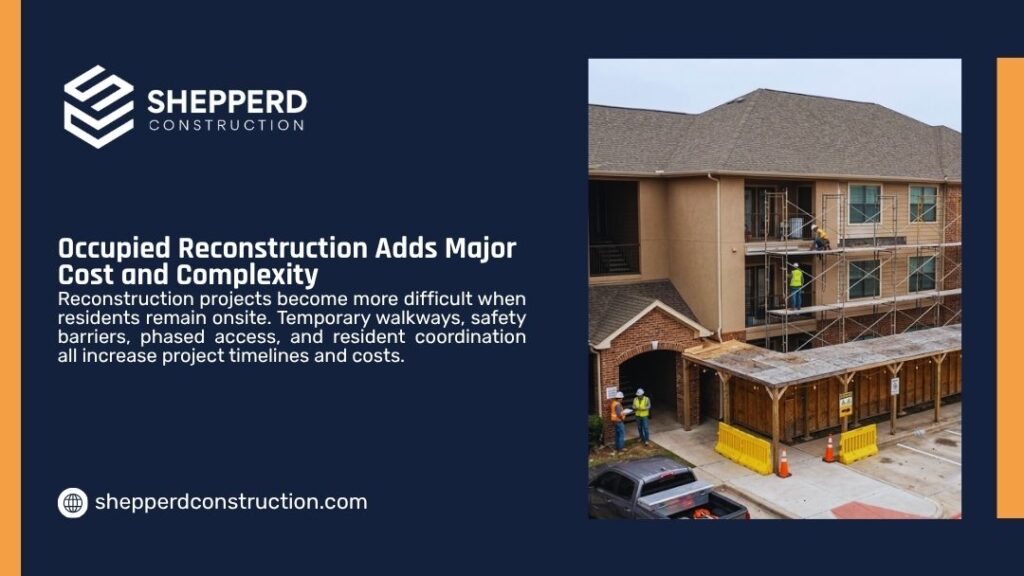
Unlike most commercial construction, HOA reconstruction usually happens with residents still living in the building. That changes everything.
Crews have to coordinate parking restrictions, controlled access, resident safety barriers, temporary walkways, noise windows, weather protection, and emergency egress. Phased reconstruction usually stretches the timeline but keeps the community livable through the process. Occupied work is harder than the line items make it look. You can’t just shut down a wing for a month.
Texas Climate Exposure
Texas weather punishes buildings. Extreme heat, UV exposure, hail events, heavy rainfall, wind-driven moisture, and constant thermal cycling all wear down exterior systems faster than spec sheets predict. Buildings put up during the rapid-growth waves of the 2000s and 2010s often show premature envelope failures because waterproofing details, drainage, or assembly choices weren’t always installed the way they were designed.
That’s a big part of why reconstruction contractors across Dallas, Austin, Fort Worth, and San Antonio keep seeing demand climb for large-scale exterior restoration work.
Repair Vs Full Reconstruction: When Is Repair No Longer Enough?
Most HOA boards start with isolated repairs, and that’s reasonable. The upfront number feels manageable. Sometimes that approach actually works. But recurring leaks, structural movement, or widespread envelope failure eventually pull the rug out from under it. There’s a point where repair stops solving the underlying problem and starts hiding it.
The decision usually comes down to three questions: scope, recurrence, and structural impact. If multiple elevations continue to leak after repeated repairs, the envelope is likely compromised at a systemic level.
If balconies show widespread cracking, rust expansion, or movement, partial repair won’t restore long-term safety. And if engineers find moisture damage inside framing across multiple units, reconstruction is usually the only financially honest path forward.
Communities working through when repair is no longer enough for a commercial building often find that delayed reconstruction quietly multiplies long-term costs. Patches reduce symptoms. They don’t stop water from working its way through a failing wall assembly.
HOA Fees, Reserve Funds, and Special Assessments
One of the biggest misconceptions about HOA reconstruction is that monthly fees are quietly stockpiling enough money to cover whatever comes up. They usually aren’t.
Reserve funding levels swing wildly between communities. Some associations run disciplined reserve studies and adjust contributions year over year. Others have postponed dues increases for so long that the reserve account is nowhere near where it needs to be when reconstruction lands. Here’s how the funding usually breaks down.
| HOA Funding Source | Primary Purpose |
| Monthly HOA fees | Routine operations and maintenance |
| Reserve funds | Long-term capital repairs |
| Special assessments | Emergency or underfunded repairs |
| Insurance proceeds | Covered losses and disaster events |
Average HOA fees vary by region, building type, amenities, and reserve strategy. Condo fees usually run higher than single-family community fees because multifamily buildings carry more shared maintenance and structural exposure.
Communities with aging infrastructure tend to see fees climb regardless, because waterproofing, roofing, balconies, and cladding all eventually need replacement. That’s why reserve studies matter so much.
The Foundation for Community Association Research has flagged underfunded reserves as one of the leading financial risks facing associations today. Boards that defer contributions almost always end up issuing painful special assessments when the building finally calls in its bill.
How Insurance Impacts Reconstruction Costs
Insurance is a major part of how HOA reconstruction gets funded, and a major source of misunderstanding. That funding relationship also raises the question of whether a carrier’s preferred vendor actually protects your building, or whether an independently retained contractor gives the board more leverage over scope and cost. Storm damage may qualify for insurance proceeds when wind, hail, or a covered weather event caused the failure. Construction defects, deferred maintenance, and slow deterioration usually create much messier coverage conversations. That distinction matters a lot.
Communities working through construction defect vs storm damage in Texas almost always discover that carriers dig hard into maintenance history, engineering reports, and prior repair records before approving a major claim. Even when insurance does contribute, policies tend to exclude key categories.
| Common Insurance Gaps | Potential Impact |
| Code upgrades | Additional out-of-pocket cost |
| Long-term deterioration | Coverage denial |
| Improper installation | Litigation exposure |
| Deferred maintenance | Reduced reimbursement |
| Design defects | Limited recovery |
Engineering assessments often become the linchpin of claim evaluation, because carriers want documentation of source and extent. That’s one of the main reasons experienced reconstruction contractors work so closely with forensic engineers on large multifamily projects; the documentation built during reconstruction often becomes part of the claim itself.
What’s Actually Happening in the Texas Market in 2026
The numbers behind Texas reconstruction don’t get talked about enough at HOA meetings, but they explain almost everything boards are seeing.
Insurance pressure is real, and it’s not slowing down. Texas has been hit harder than most states by property insurance volatility. According to the Federal Reserve Bank of Dallas, homeowners’ insurance premiums in Texas have climbed roughly 60% since 2019, and commercial multifamily premiums have followed a similar curve as carriers reprice exposure to hail, wind, and water claims. For HOAs, this shows up as higher master policy premiums, higher deductibles, and tighter scrutiny of any water-related claim.
The multifamily inventory is aging into its repair window. Census Bureau ACS year-built data supports the broader point that Texas has a large stock of housing built before 2010. For HOA boards, that matters because many condo, townhome, and apartment communities are now old enough for original sealants, waterproofing details, balcony coatings, roofing assemblies, and exterior cladding systems to require serious inspection, renewal, or reconstruction planning.
Construction costs haven’t come back down. ABC’s analysis of federal Producer Price Index data found that overall and nonresidential construction input prices were still more than 40% above February 2020 levels in 2025, while AGC reported another 3.3% rise in nonresidential construction materials and services from December 2024 to December 2025.
Skilled labor is genuinely scarce. The Texas Workforce Commission has flagged construction trades as one of the state’s most undersupplied labor markets, particularly in waterproofing, exterior envelope work, and skilled multifamily reconstruction. That scarcity directly affects how quickly reconstruction projects can mobilize and how much they cost.
Put it all together, and you get the market conditions Texas HOAs are actually navigating: more aging buildings, more aggressive insurance underwriting, sustained material costs, and a tight labor pool, all at the same time.
Why Building Envelope Systems Matter So Much
Most expensive HOA reconstruction projects trace back to one thing: building envelope failure. The envelope is the system that keeps water, air, and weather outside the structure. It includes:
- Roofing assemblies
- Waterproofing systems
- Exterior cladding
- Windows and doors
- Sealants and flashing
- Drainage systems
- Balcony waterproofing
When one part of the envelope fails, water rarely stays where it got in. Water travels. It moves through framing, insulation, sheathing, floor assemblies, and structural connectors. By the time someone notices an interior symptom, the deterioration is almost always wider than the visible damage suggests.
That’s why an engineering assessment requiring full reconstruction so often comes as a shock; the visible damage was a fraction of what was actually there. And it’s why reconstruction planning has to start with diagnosis, not estimates.
Cost Per Square Foot for HOA Reconstruction in 2026
Reconstruction cost per square foot tracks property type, structural complexity, accessibility, and how far envelope deterioration has progressed. Here are the broad ranges most Texas multifamily projects are landing in for 2026.
| Property Type | Estimated Reconstruction Cost |
| Condo communities | $200–$400+ per sq ft |
| Townhome communities | $150–$300+ per sq ft |
| Apartment complexes | $220–$700+ per sq ft |
| Commercial mixed-use | $240–$870+ per sq ft |
Boards often try to compare these against new-construction costs to build a house per sq ft, numbers they find online. The comparison doesn’t hold. Multifamily reconstruction includes occupied work, structural coordination, engineering oversight, waterproofing, code upgrades, resident communication, and phased scheduling, none of which apply to a new build on an empty lot.
Material pricing also stays volatile. Roofing systems, waterproofing membranes, exterior cladding, and labor availability all keep moving in Texas, so pricing snapshots taken six months apart can look very different.
Common Reconstruction Projects for HOA Properties
Large reconstruction rarely involves just one repair category. Most HOAs going through major reconstruction are dealing with several overlapping envelope and structural issues at once.
Balcony Reconstruction
Balconies are some of the most serious safety concerns in any multifamily community. Water intrusion, rust expansion, failed coatings, structural movement, and framing deterioration can quietly weaken a balcony for years before replacement becomes unavoidable.
Property managers who learn to read unstable condo balcony warning signs usually find that visible cracking is just the surface of deeper structural deterioration underneath the finish. Balcony reconstruction costs swing widely depending on access, waterproofing scope, and code upgrade requirements.
Roof Replacement
Roofs eventually fail even with good maintenance. Once leaks start affecting insulation, framing, or interior finishes, reconstruction usually expands well past the roof itself. Communities working through when condo roofs require full replacement typically find that targeted patching has stopped resolving anything, and the system needs to come off.
Mold and Interior Damage
Long-term moisture exposure almost always creates indoor air quality problems. Mold inside wall cavities, floors, and insulation expands the reconstruction scope significantly because contaminated material has to be removed under controlled conditions. Boards weighing that scope should review what triggers a full mold tear-out, since the answer largely determines where the budget lands. Associations dealing with mold discovered after roof leaks frequently uncover hidden framing damage that runs well past the original leak.
Window and Waterproofing Failures
Improperly installed windows and failed waterproofing details are some of the most common sources of persistent moisture intrusion in Texas multifamily buildings. As sealants give out and drainage details fail, water keeps finding the same path into the wall.
That pattern is what drives so many large exterior reconstructions; isolated sealant repairs stop being enough, and the envelope has to come off in sections.
How Property Managers Can Control Reconstruction Costs
Property managers can’t stop a building from aging. But proactive planning can take a real bite out of long-term reconstruction exposure. Early engineering evaluations are still the best tool available. Communities that investigate recurring leaks, balcony movement, or waterproofing concerns early almost always avoid the bigger reconstruction bill later.
Reserve studies need to evolve with actual building conditions. Associations relying on reserve assumptions from a decade ago are usually badly underestimating what’s coming.
Managers running large reconstruction projects as property managers tend to see better outcomes when communication starts early and stays consistent. Residents put up with disruption far better when timelines, safety procedures, and project phases are spelled out clearly and updated honestly.
Contractor selection matters more than most boards think. Large HOA reconstruction takes contractors who actually know occupied construction, building-envelope systems, forensic coordination, and phased scheduling. The lowest bid rarely reflects the full long-term cost; it just reflects the parts the bidder remembered to include.
Choosing the Right Reconstruction Contractor for HOA Projects
Not every contractor can handle complex multifamily reconstruction. Large HOA projects need more than standard construction capability. If you’re a board working through how to choose a reconstruction contractor for large projects in Texas, look closely at a few things.
| Contractor Qualification | Why It Matters |
| Occupied-project experience | Reduces resident disruption |
| Building-envelope expertise | Prevents recurring failures |
| Engineering coordination | Improves reconstruction accuracy |
| Communication systems | Keeps residents informed |
| Safety planning | Protects residents and crews |
| Project management depth | Maintains schedules and budgets |
Reconstruction tied to construction defects, water intrusion, or structural deterioration usually involves coordination between engineers, consultants, attorneys, property managers, and ownership groups. That’s not a skill set every contractor has.
The communities that come out of reconstruction in good shape almost always pick contractors who can handle technical execution and resident communication at the same time. One without the other doesn’t work.
Reconstruction Timelines for HOA Communities
One of the toughest parts of HOA reconstruction is what happens to expectations. Boards usually hope reconstruction will move fast once contracts are signed. The reality is that large multifamily reconstruction unfolds in phases, and the front end of the project, the part nobody sees, tends to be the longest.
The investigation phase often includes engineering reports, invasive testing, moisture mapping, structural evaluations, and cost analysis. After that comes design development, bidding, permitting, and material procurement. Only then does active reconstruction start.
Weather, resident access, hidden damage discoveries, and material lead times can all push timelines. A moderate exterior reconstruction might run for several months. Larger multifamily communities can be in phased reconstruction for over a year, depending on scale. Which is exactly why communication and project management are non-negotiable in occupied work.
Texas Reconstruction Trends Affecting HOA Costs in 2026
A handful of statewide trends keep shaping HOA reconstruction pricing across Texas. Insurance pressure is at the top of the list. Carriers keep raising deductibles, tightening underwriting, and scrutinizing water-related claims more aggressively than they did even two years ago.
Skilled labor is still tight. Qualified waterproofing installers, envelope specialists, and experienced multifamily crews are in high demand across every major Texas market.
Material volatility is still real, too. Roofing systems, waterproofing assemblies, sealants, framing, and specialty exterior products all keep moving on supply-chain pressure.
Meanwhile, a lot of Texas multifamily built during the rapid-growth waves of earlier decades is now squarely in the age range where major exterior reconstruction is the next chapter. That combination keeps pushing demand for experienced reconstruction contractors across Dallas, Austin, Fort Worth, and San Antonio.
Frequently Asked Questions
How much does HOA reconstruction usually cost?
The cost of full building reconstruction for HOA communities can range from a few hundred thousand dollars to several million, depending on building size, structural condition, waterproofing damage, and reconstruction scope.
What do HOA reserve funds cover?
Reserve funds are meant to support long-term capital repairs, roofing, exterior reconstruction, balconies, waterproofing systems, and structural improvements.
Are HOA fees monthly or yearly?
Most are monthly. Some associations use quarterly or annual schedules.
Can insurance pay for full reconstruction?
Insurance can contribute when a covered storm event causes damage. Deferred maintenance and construction defects are much more complicated coverage situations.
What happens if an HOA does not have enough reserves?
Associations without adequate reserves usually rely on special assessments, financing, phased reconstruction, or delayed repairs.
What is included in HOA fees?
HOA fees typically cover maintenance, landscaping, insurance obligations, reserve contributions, and shared property operations.
How long does full reconstruction take?
It varies a lot. Building size, engineering needs, weather, permitting, and occupied-construction logistics all shape the timeline.
The Cost of Waiting Is Almost Always Higher Than the Cost of Acting
Most HOA boards don’t see reconstruction coming until it’s already here. The leak comes back after every storm. Residents start asking pointed questions at the annual meeting. The carrier pushes back on a claim. The reserve study suddenly looks optimistic instead of conservative. By the time the board agrees the building needs reconstruction, the building has usually been telling them for two or three years.
Here’s the part that doesn’t get said enough: the financial risk of waiting is almost always larger than the financial risk of acting. Every season, a failing envelope keeps failing, and the water moves further into the structure. Patches get more expensive. Insurance gets harder to negotiate. Special assessments get larger and angrier. And the contractor who finally takes on the project has to charge for the years of damage nobody addressed.
If your community is seeing repeat leaks, balcony movement, recurring stains, or insurance pushback on water claims, those aren’t isolated problems. They’re early signals, and the cost of responding to a signal is always smaller than the cost of responding to a failure.
Shepperd Construction has spent more than a decade rebuilding Texas multifamily properties under exactly these conditions: aging envelopes, complicated insurance situations, occupied buildings, and HOA boards trying to do right by their residents without burning the reserve account. We’ve seen which decisions save money and which ones don’t.If you’re a board member, property manager, or owner trying to figure out where your building actually stands, reach out. A grounded conversation early is worth more than a perfect estimate later.