
An engineering assessment does not always end with a simple repair plan. In certain conditions, structural risk, code failure, or systemic deterioration pushes the recommendation toward full reconstruction. This article explains when does an engineering assessment require recommending full reconstruction, how engineers reach that conclusion, and what property owners and managers should expect next.
When does an engineering assessment require recommending full reconstruction?
Engineers do not casually recommend tearing down and rebuilding portions of a structure. Full reconstruction is disruptive, expensive, and complex. Before that recommendation is ever made, owners benefit from understanding how to tell when damage crosses the line from a repairable defect into reconstruction territory. So, when does an engineering assessment require recommending full reconstruction? It happens when the structure no longer performs safely, economically, or in compliance with governing codes, and when repair would only postpone inevitable failure.
In Texas, expansive soils, moisture intrusion, wind events, and aging construction often combine to create systemic deterioration. FEMA Building Science publications consistently emphasize the importance of maintaining continuous load paths and limiting excessive structural movement to prevent collapse and life-safety risk (see FEMA P-154, Rapid Visual Screening of Buildings). When those thresholds are crossed, an engineer may determine that patchwork solutions simply won’t restore structural reliability.
So here’s what happened in many real-world cases: a building begins with minor distress, localized cracking, or façade separation. Over time, water infiltration degrades framing members. Steel corrodes. Foundations shift. By the time a foundation structural engineer completes the assessment, the damage isn’t isolated anymore. It’s systemic.
And that’s when does an engineering assessment require recommending full reconstruction rather than structural foundation repair alone.
What an Engineering Assessment Actually Measures
A professional evaluation goes far beyond visual observation. A foundation repair engineer or structural engineer reviews load calculations, soil reports, material strength, construction sequencing, and long-term performance.
According to the National Institute of Standards and Technology, performance-based structural evaluation methods are used in engineering to predict how buildings perform under loads and to assess their resilience and capacity to remain functional under future demands. Engineers evaluate whether the original detailed design can still support intended loads. They consider moisture migration, settlement rates, and lateral resistance.
An assessment typically determines whether the building can return to safe service with corrective intervention or whether the entire structural system must be replaced as part of a broader restoration project.
If the structural capacity falls below required safety factors, or if code compliance cannot be achieved through reinforcement alone, that’s when does an engineering assessment require recommending full reconstruction.
Indicators That Suggest Reconstruction Might Be Necessary
Cracking alone rarely triggers demolition. But progressive differential settlement, repeated foundation movement, or structural framing deformation may signal deeper failure. When those signs appear in multifamily buildings, the step-by-step foundation reconstruction process typically moves from soil and structural investigation into phased stabilization and rebuild work. In structural condition assessments, widespread or progressive distress often indicates a system-level issue, especially when deformation or compromised load paths are observed. Here’s what engineers typically evaluate in those scenarios:
| Structural Condition | Assessment Implication | Likely Recommendation |
| Hairline cosmetic cracks | Surface distress | Local repair |
| Moderate slab settlement | Soil instability | Targeted foundation repair |
| Widespread framing decay | Moisture intrusion systemic | Reconstruction of affected sections |
| Load path compromise | Safety hazard | Full reconstruction |
If the structural system no longer distributes loads as originally intended, repair may not restore long-term stability. That tipping point defines when does an engineering assessment require recommending full reconstruction.
Repair Versus Reconstruction Outcomes
The difference between a structural engineer vs foundation repair company often becomes clear at this stage. A contractor may focus on surface correction, while a foundation structural engineer evaluates the entire load-bearing system.
A repair approach assumes the underlying structure remains fundamentally sound. Reconstruction assumes the integrity of the system has deteriorated beyond practical rehabilitation.
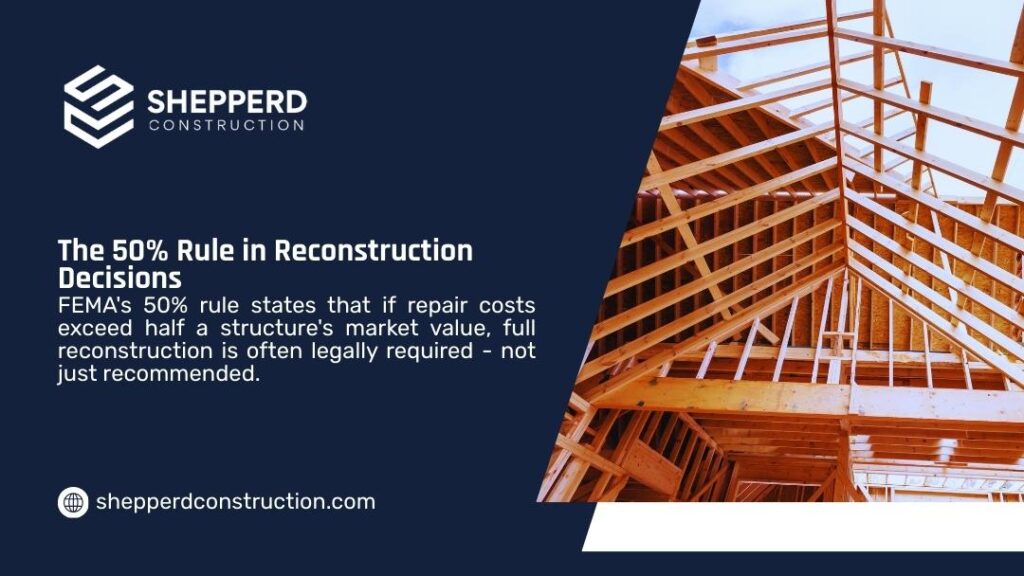
HUD uses replacement-cost thresholds in multiple programs to define ‘substantial rehabilitation, for example, criteria tied to a percentage of replacement cost. In practice, when repair or rehabilitation can’t restore compliance or becomes uneconomical, owners may pursue reconstruction instead, depending on the program and funding rules. Consider the comparison below:
| Evaluation Factor | Repair Strategy | Reconstruction Strategy |
| Damage Scope | Localized | Systemic |
| Remaining Life | Acceptable | Severely reduced |
| Code Compliance | Achievable | Not feasible |
| Long-Term Cost | Predictable | More stable over the lifecycle |
When repair would only delay future failure or create recurring risk, that’s when an engineering assessment requires recommending full reconstruction.
Structural Foundation Failures and the Reconstruction Threshold
Foundation movement in Texas is not uncommon. Expansive clay soils contribute to slab displacement and pier instability. But here’s the problem: not every shifting slab needs replacement.
Structural foundation repair can stabilize many systems. However, when soil heave compromises framing alignment across multiple load points, the building envelope itself may distort.
At that stage, a home renovation engineer may conclude that lifting and patching will not restore the building’s geometry. Reconstruction becomes the only path to long-term serviceability.
So when does an engineering assessment require recommending full reconstruction in foundation cases? When structural movement alters framing integrity beyond correction, and when reinforcing would cost nearly as much as rebuilding.
Litigation, Risk, and Code Compliance
In construction defect matters, assessments face heightened scrutiny. Engineers must document causation, quantify damage, and evaluate future risk exposure.
Forensic evaluation principles emphasize that reconstruction recommendations arise from evidence, not assumptions. As one forensic engineering resource explains:
“In many failure investigations, the evidence drives the conclusion. When load paths, material continuity, or foundational support can’t be restored, the structural evidence leads an engineer toward full rebuilding.”
— Garrett Forensics, Structural Failure Investigation Overview (https://garrettforensics.com/how-structural-engineers-help-uncover-the-cause-of-building-failures/)
When structural capacity falls below allowable stress limits outlined in International Building Code standards, engineers cannot ethically recommend partial fixes if life-safety risk remains.
And that is another clear example of when does an engineering assessment require recommending full reconstruction.
In defect-related matters, engineering assessments carry additional scrutiny. Engineers must document causation, extent, and future risk. Courts and insurers require clear justification.
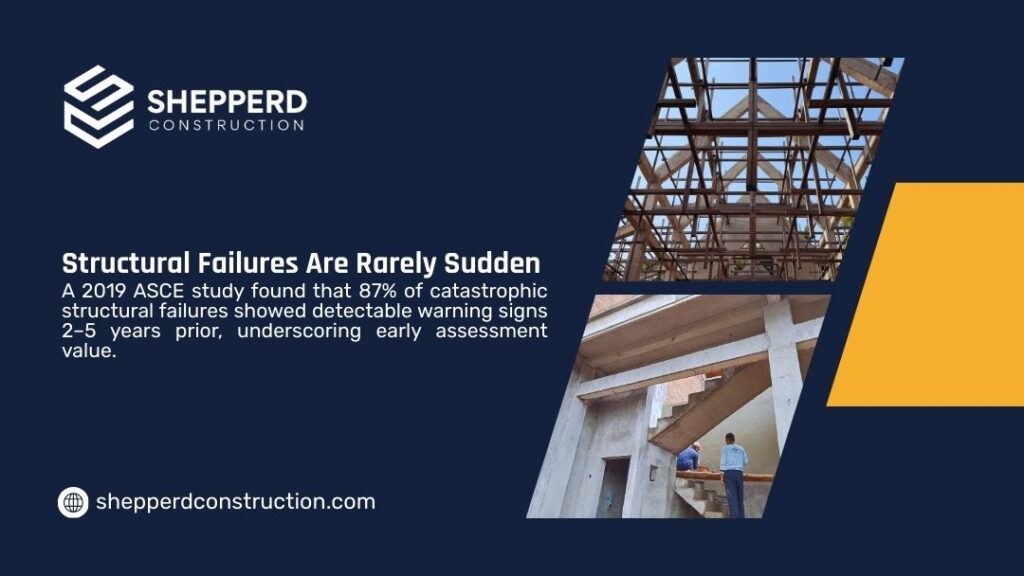
FEMA guidance emphasizes documented inspection findings and identification of hazardous conditions, and it describes using capacity degradation (strength/stiffness loss) to support decisions that can include demolition when repair/upgrade is impractical.
When structural capacity falls below allowable stress limits defined in International Building Code standards, engineers cannot ethically recommend partial correction if risk persists. And that’s another example of when does an engineering assessment require recommending full reconstruction.
What Happens After Reconstruction Is Recommended
Once an engineer issues that recommendation, the next phase involves contractor selection and execution planning. A complex restoration project requires experienced teams familiar with forensic documentation and occupied property conditions.
For example, property owners in Central Texas often turn to Reconstruction Contractors Austin for envelope replacement and structural rebuilds. In North Texas, experienced Reconstruction Contractors Dallas manage multifamily reconstruction following systemic damage. Those overseeing HOA properties frequently consult Reconstruction Contractors for Home Owner’s Associations (HOA) to coordinate resident communication and phased reconstruction.
Each region presents distinct soil, moisture, and regulatory challenges. That is why firms with defined Reconstruction Areas of Service bring consistency across projects.
If you need a clearer understanding of capabilities, explore Shepperd Construction provides insight into how reconstruction aligns with engineering findings. They explain the integration of investigative support and reconstruction execution.
Understanding the Decision Framework
To simplify the evaluation process, engineers typically weigh structural severity against economic feasibility and code compliance.
| Severity Level | Code Risk | Financial Impact | Recommendation |
| Low | Minimal | Minor repair cost | Repair |
| Moderate | Manageable | Targeted investment | Rehabilitation |
| High | Non-compliant | High recurring cost | Full reconstruction |
| Critical | Immediate safety threat | Life-safety exposure | Immediate reconstruction |
The threshold appears when continued use exposes occupants to unacceptable risk or when repair fails to restore structural reliability.
So, when does an engineering assessment require recommending full reconstruction? When structural safety, code compliance, and long-term performance cannot be guaranteed through repair alone.
Why This Distinction Matters
Owners sometimes ask, do I need a structural engineer for foundations if a contractor can provide a quote? The answer lies in scope. A foundation repair company may address symptoms. A structural engineer evaluates the root cause.
Full reconstruction decisions carry financial, legal, and operational consequences. That’s why they stem from professional analysis rather than contractor preference.
The distinction between structural foundation repair and complete replacement determines whether a building remains viable for decades or continues a cycle of recurring distress.

Moving Forward with Confidence
An engineering assessment is not merely a report. It is a roadmap. When that roadmap points toward full reconstruction, it reflects careful evaluation of structural integrity, risk exposure, and long-term feasibility.
Understanding when does an engineering assessment require recommending full reconstruction empowers property managers, HOAs, and building owners to act decisively rather than reactively.
If your property faces systemic structural concerns and you need experienced guidance, reviewing completed restoration work and speaking directly with reconstruction specialists can clarify next steps. A detailed consultation through Shepperd Construction may help you evaluate your situation with precision and professionalism.
Because when reconstruction is truly necessary, doing it right the first time protects both the structure and the people who rely on it.