If you’ve found mold in my condo walls after a roof leak, you’re probably not looking at a simple wipe-down or a one-room maintenance issue. In most condo cases, visible mold is only the part that finally made itself known. The bigger concern is what happened before that moment: water entered the assembly, traveled through concealed spaces, stayed trapped, and gave mold spores enough time to establish themselves inside materials that were meant to stay dry.
That difference matters. A surface stain can be cleaned. A moisture-driven wall-cavity problem often calls for inspection, containment, material removal, and, in some situations, reconstruction.
This guide explains what may be happening behind the walls, how quickly mold can develop after a roof leak, what health and property risks come with it, how liability often works in condo settings, and when the issue moves out of the cleanup category and into something more serious.
Found Mold in My Condo Walls After a Roof Leak: What’s Actually Happening?
Here’s what tends to get missed in condo buildings. Water from a roof leak rarely behaves in a neat, vertical line. It follows gravity, but it also follows pathways. It can run along framing, drift through insulation, soak gypsum board, and migrate into corners or cavities well beyond the original entry point. That’s why the area where mold shows up is not always the place where the roof first failed.
So when you say you’ve found mold in my condo walls after a roof leak, the likely sequence is straightforward. Moisture entered the wall or ceiling assembly, drying did not happen fast enough, and mold found a food source. Drywall is especially vulnerable because the paper face supports microbial growth once it stays damp. Insulation can hold moisture quietly. Wood framing can remain wet far longer than most owners expect.
By the time discoloration appears, the real timeline is already behind you. In other words, the mold you see today may reflect moisture conditions that began days or weeks ago. In multi-unit properties, the issue may also extend into adjacent assemblies, shared cavities, or common-element transitions. That is one reason condo mold cases can become complicated quickly.
What Is Mold and Why Does It Grow After a Roof Leak?
Mold is not unusual by itself. Mold spores exist in ordinary indoor and outdoor air all the time. The question is not whether spores are present. The real question is whether conditions allow them to colonize. Once a roof leak introduces moisture into enclosed materials, those conditions can line up very fast.
Mold growth depends on a short list of factors: moisture, a surface it can feed on, moderate temperature, and time. A brief splash on a countertop is one thing. Water trapped behind finished walls is another. Inside those concealed spaces, air movement is limited, drying is slower, and the moisture can remain in contact with paper-faced drywall, dust, framing, and other organic residue long enough for growth to begin.
That is why roof-leak mold cases deserve more attention than ordinary household spots of mildew in open areas. The concern is not just that mold formed. The concern is that it formed in a concealed assembly where it may continue to spread without a clear visual warning.
How Fast Does Mold Grow After Water Damage in Walls?
How Fast Does Mold Grow After Water Damage in Walls?
Mold develops faster than most property owners assume. Once materials remain wet, the window for prevention narrows quickly. In practice, the first 24 to 48 hours matter a great deal.
| Time After Leak | What Typically Happens Inside the Assembly |
| First 24–48 hours | Moisture activates dormant mold spores and creates growth conditions |
| 3–5 days | Early-stage growth can begin on drywall paper, dust, and insulation surfaces |
| 1–2 weeks | Colonization often spreads deeper behind finishes and along concealed pathways |
| 3+ weeks | Material breakdown, odor, and broader contamination become far more likely |
What makes this difficult is visibility. Early-stage mold on drywall rarely announces itself with dramatic black patches right away. Sometimes the first clues are faint staining, a stale smell, or subtle wall changes. In many condo units, the problem remains out of sight until paint shifts, seams swell, or the odor becomes too obvious to dismiss.
Signs of Mold in Condo Walls (Even If You Can’t See It)
Visible growth is only one clue, and often not the first one. A lingering mildew smell is frequently the earliest warning in concealed mold cases. It tends to stay put. It doesn’t behave like a temporary odor from a damp towel or an open window after rain. It hangs in the room, especially near affected walls, closets, or ceiling transitions.
You may also notice the wall itself behaving differently. Paint can blister. Drywall seams may telegraph through the finish. Corners may discolor. Baseboards can swell slightly. A wall that once felt firm may feel a little soft or cool to the touch. None of those conditions proves mold by itself, but taken together, they point toward a moisture problem that deserves investigation.
Then there is indoor air quality. People sometimes describe the room as heavy, stale, or irritating before they can point to anything visible. In enclosed condo environments, mold spores can circulate through the unit and, depending on construction, may migrate through shared pathways. That is why the problem can feel larger than the original stain on the wall.
What Does Mold Look Like on Walls, Drywall, and Ceilings?
One reason owners hesitate is simple: mold does not always look the way they expect. Not every mold issue appears as the stereotypical black patch. Some look dusty. Some look chalky. Some look like faint spotting. Some resemble a shadow beneath paint.
| Type | Appearance | Common Locations |
| Black mold (e.g., Stachybotrys chartarum) | Dark green to black staining, blotchy or wet-looking in active moisture areas | Drywall seams, ceiling corners, and around leak paths |
| White mold | Powdery, chalk-like, or pale fuzzy growth | Wood framing, insulation-facing surfaces, closets, and less-ventilated cavities |
| Mildew | Flat, lighter discoloration that may appear gray, white, or yellowish at first | Painted finishes and more superficial damp surfaces |
Early mold on walls may show up as speckling, uneven color, or a dull patch that refuses to clean off cleanly. The key point is this: what appears modest on the surface can be much more developed on the back side of the drywall or inside the adjoining cavity.
Health Effects of Mold Exposure in Condos
Mold exposure does not affect everyone the same way. Some people notice very little at first. Others react quickly. The difference usually comes down to exposure duration, spore concentration, ventilation conditions, and individual sensitivity.
| Exposure Level | Common Effects | Who Is Most Affected |
| Low exposure | Mild irritation, sneezing, occasional headaches | General occupants |
| Moderate exposure | Persistent coughing, sinus pressure, fatigue | Children, older adults, and people with allergies |
| High exposure | Respiratory issues, asthma flare-ups, chronic inflammation | Immunocompromised occupants and those with preexisting conditions |
What makes condo environments tricky is containment. They feel self-contained, but the air pathways often are not. Shared building systems, adjacent cavities, or repeated moisture intrusion can keep the environment from fully recovering even after the obvious wet spot dries. That is why a mold issue in a condo should be assessed as a building-system problem, not merely a housekeeping issue.

Is Mold From a Roof Leak Dangerous?
It can be. The danger is not only about whether the mold is visible or whether it matches a commonly feared label. The larger concern is sustained moisture inside building materials. Once that moisture sits long enough, mold can continue to develop in places the owner cannot monitor easily.
At first, the issue may look small. A stain. A patch of bubbling paint. A slightly sour smell after rain. But the real risk comes from duration and spread. Roof-leak mold is often more serious than surface bathroom mildew because the source is concealed, the drying is slower, and the damage can reach multiple layers of the wall or ceiling assembly.
In condo properties, the problem can also cross boundaries. Water does not care about ownership lines on a plat map. It can move through shared roofing transitions, parapet conditions, balcony interfaces, window perimeters, or poorly sealed penetrations. That is one reason roof-leak mold should never be treated casually.
How to Detect Mold Inside Walls (Not Just Surface Mold)
A visual check is only a starting point. If the concern is mold inside walls, the investigation has to go beyond what a flashlight can show. Good assessment work focuses on moisture patterns, not just visible staining.
| Method | What It Helps Reveal |
| Moisture meter | Elevated moisture levels in concealed or finished materials |
| Thermal imaging | Temperature anomalies that may indicate hidden moisture paths |
| Air sampling | Whether mold spores appear elevated in the indoor environment |
| Controlled physical inspection | Confirmation inside cavities where surface evidence is limited |
The important question is not simply Is there mold? The better question is How far did the moisture travel, what materials were affected, and is the source fully understood? That distinction separates a real investigation from a cosmetic response.
Why Condo Mold Cases Often Need Building Envelope Investigation, Not Just Cleanup
In reality, condo mold after a roof leak often points to a larger building-envelope issue. The roof may be the obvious suspect, but water can also enter at flashing transitions, parapets, drainage failures, balcony interfaces, penetrations, cladding joints, or poorly sealed wall components. If the path of entry is misunderstood, mold may be cleaned, and damaged drywall may be replaced, yet the building remains vulnerable to another event.
That is why technically complex condo cases often involve more than a mold vendor. They may require a contractor who understands reconstruction, moisture intrusion, exterior assemblies, and the difference between a one-time event and a repeating building-system failure. In that setting, the real value is not just removing damaged material. The real value is identifying the source accurately and repairing it in a way that prevents the problem from cycling back.
Mold From Water Damage vs Construction Defect: Why It Matters
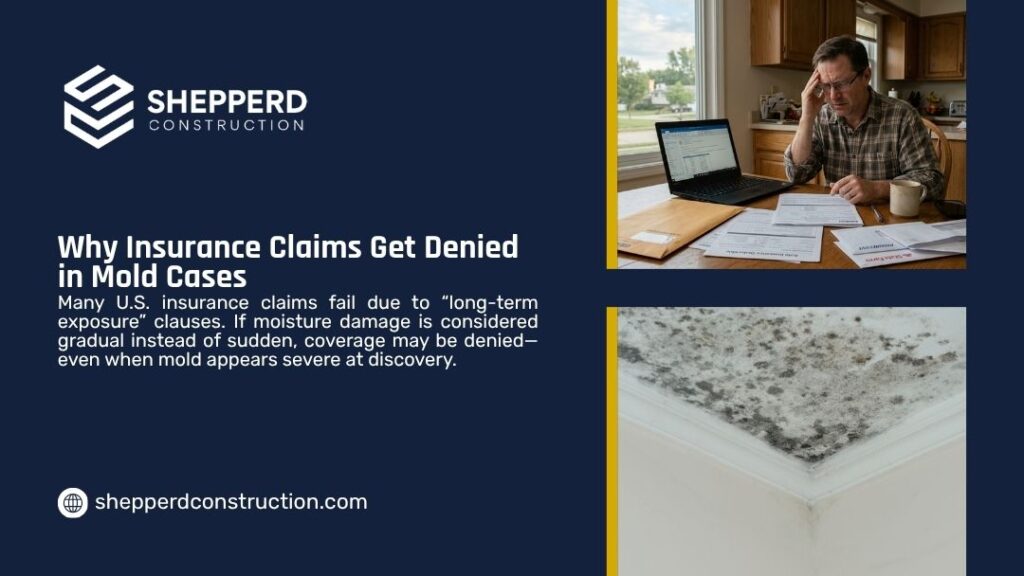
Understanding where the problem started changes everything, from insurance claims to repair strategy. Water damage from a sudden event, like a storm, is often treated differently from a long-term issue caused by poor installation, design flaws, or aging materials. One is typically insurable. The other may fall under construction defect or deferred maintenance.
This distinction also determines how repairs are approached. If the issue is tied to a systemic failure, such as improper flashing, drainage issues, or envelope breakdown, simply removing mold won’t solve the problem.
In many cases, identifying the root cause requires coordination between engineers, contractors, and sometimes legal teams. That’s why projects involving mold from water damage often go beyond basic remediation and move into structured reconstruction planning.
A deeper understanding of construction defect vs storm damage highlights how insurers separate damage caused by faulty design or workmanship from damage caused by weather events. This distinction directly affects claim outcomes, coverage eligibility, and liability, making an accurate assessment essential in property evaluations.
Who Is Responsible for Mold in a Condo? HOA vs Owner
Condo responsibility is rarely simple. Most of the confusion comes from the fact that the water source, the damaged materials, and the ownership boundaries do not always line up neatly. Roof assemblies are commonly treated as shared or common elements.
Interior finishes are often treated as part of the unit. Mold inside wall cavities can sit somewhere in between, especially when the leak began in a common element but damaged privately owned interiors.
| Area Affected | Typical Responsibility |
| Roof system | Usually HOA |
| Exterior envelope | Usually HOA |
| Interior drywall and finishes | Often, the unit owner, unless tied directly to common-element failure obligations |
| Mold inside wall cavities | Often case-specific and document-driven |
What changes outcomes is documentation. When was the leak first reported? How quickly was the source addressed? Was the condition sudden or ongoing? Did delayed action allow damage to spread? In many condo disputes, those details matter as much as the mold itself.
The complication arises when mold develops due to delayed repairs or ongoing leaks. In such situations, determining who is responsible for reconstruction after a disaster in an HOA often depends on how quickly the problem was addressed and whether proper maintenance responsibilities were fulfilled. Liability can shift based on response time, documentation, and adherence to maintenance obligations set by the HOA.
Can You Remove Mold Yourself or Do You Need Professional Remediation?
Small surface mold can sometimes be cleaned. But once mold reaches drywall or internal cavities, the situation changes.
| Scenario | Approach |
| Minor surface mold (less than 10 square feet) on hard, non-porous surfaces | Basic cleaning |
| Mold in drywall | Professional remediation |
| Widespread growth (more than 100 square feet) | Reconstruction likely needed |
When mold is tied to water damage, especially from a roof leak, it usually requires more than a surface fix.
How Mold Remediation Works
Mold remediation is not a single-step process. It’s a controlled sequence designed to remove contamination while preventing further spread. It begins with a detailed assessment. The goal is to understand how far the mold has traveled, not just where it’s visible.
| Stage | What Happens |
| Inspection (Assessment) | Identify the moisture source and affected areas |
| Containment | Isolate space to prevent airborne spread |
| Removal (Remediation) | Extract contaminated materials (drywall, insulation) |
| Filtration (Air cleaning) | Clean air using HEPA systems |
| Restoration (Repair) | Rebuild affected areas |
What separates proper remediation from surface cleaning is containment and verification. Without those steps, mold spores can simply relocate rather than be removed.
When Mold Damage Requires Full Reconstruction
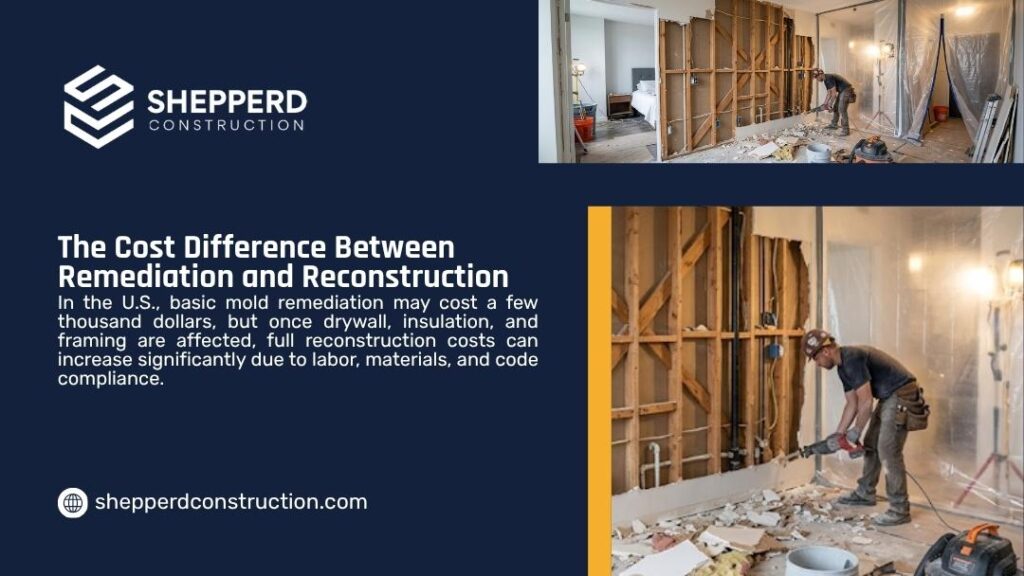
There’s a point where cleaning and remediation no longer solve the problem. That point is usually reached when structural materials are compromised or moisture has penetrated deeply into the building system. If your inspection turns up either condition, review the broader criteria for when damage requires structural reconstruction rather than remediation alone. We cover this decision in depth in our guide on mold remediation versus full building reconstruction, which walks through the specific triggers that move a condo from cleanup to rebuild.
| Condition | Why Reconstruction Is Needed |
| Saturated drywall and insulation | Materials cannot be salvaged |
| Repeated roof leaks | Ongoing failure of the building envelope |
| Mold inside the framing | Structural components affected |
| Large-scale contamination | Remediation alone is insufficient |
In these situations, understanding whether water damage requires reconstruction comes down to whether both the visible damage and the underlying cause are fully resolved. When structural materials, moisture buildup, or hidden issues remain unaddressed, the problem is more likely to return over time.
What Documentation Helps in HOA, Insurance, and Reconstruction Decisions
A mold problem after a roof leak becomes far easier to manage when the paper trail is strong. Owners and property managers who document early usually have a clearer path through responsibility questions, repair planning, and claim discussions.
| Documentation Item | Why It Matters |
| Photos of staining, visible mold, and active leaks | Creates a visual timeline of the condition |
| Dates of discovery and reporting | Helps establish response speed and notice |
| Maintenance records and prior leak history | Shows whether the problem was isolated or recurring |
| Inspection findings and moisture readings | Supports repair scope and responsibility decisions |
| Communication with HOA, management, and contractors | Clarifies who knew what and when |
In complex condo cases, documentation does more than support reimbursement. It helps distinguish between a sudden event, chronic deferred maintenance, and a larger reconstruction problem.
How to Prevent Mold After a Roof Leak
Prevention starts with moisture control, and timing is everything. If materials are dried promptly and the source is corrected completely, the odds of serious mold growth drop sharply. But prevention is not a single act. It is a chain of decisions that all have to go right.
| Prevention Step | Why It Matters |
| Immediate drying (24–48 hrs) | Stops mold growth before it starts |
| Ventilation improvement | Reduces humidity levels |
| Roof repair verification | Prevents repeat leaks |
| Moisture monitoring | Detects hidden issues early |
The key takeaway is timing. The faster the materials dry, the lower the chance that mold will develop. Once mold has formed, prevention alone is no longer enough.
How Long Does Mold Remediation Take?
Timeframes vary because the visible stain is rarely the whole scope. The size of the area matters, but access, moisture history, testing, drying conditions, and coordination with HOAs or insurers matter too. In condo projects, the process can slow down simply because multiple parties need to review the same condition before work begins.
| Severity | Typical Duration |
| Localized issue | 1–3 days |
| Moderate wall contamination | 3–7 days |
| Extensive structural impact | 1–3 weeks or longer, depending on drying and rebuild needs |
After remediation, additional time may be required for drying, testing, and reconstruction work.
When It’s Time to Bring in a Reconstruction Contractor
There is a clear dividing line between a cleanup issue and a reconstruction issue. You cross that line when the project is no longer just about removing mold, but about correcting the failure that allowed moisture to enter and rebuilding what the water compromised.
If the roof leak affected multiple layers, if the wall cavity stayed wet for too long, if framing or insulation was involved, or if the event reflects a repeating envelope condition, then cleanup alone will not close the loop. That is where a reconstruction contractor brings more value than a basic mold-removal service. If you are weighing your options, it helps to know which contractor actually rebuilds after damage versus who only handles cleanup and drying. If the claim runs through your insurer, start by comparing carrier-recommended vendors with independent contractors, since the referral list is built around claim cost rather than the long-term condition of your building.
A reconstruction-first approach is especially important in condos, HOAs, multifamily properties, and commercial settings, where the work often touches shared assemblies, liability questions, and long-term performance concerns. In those cases, the best outcome comes from understanding the building as a system, not treating the mold as an isolated stain.
What You Should Do Right Now
If you’ve found mold in my condo walls after a roof leak, the next few steps can change the entire outcome. First, make sure the moisture source has actually stopped. Not slowed down. Not patched temporarily. Stopped. Without that, any cleanup effort is just a pause in the cycle.
Document the condition carefully. Photograph the visible damage, note dates, record when the leak was first noticed, and keep copies of every communication with the HOA, property manager, or contractor. That record becomes more valuable than most owners realize.
Do not start tearing into walls casually. Opening wet assemblies without containment can scatter mold spores and complicate the repair. The smarter move is to get a technically sound assessment that looks at both contamination and source.
And if the condition appears to involve concealed spread, repeated roof leakage, or damaged building components, treat it as a reconstruction question, not merely a cleanup question. That is usually the point at which a more experienced contractor earns the difference.
FAQs about Mold in Condo Wall After a Roof Leak
What are the 10 warning signs of mold toxicity?
Persistent headaches, fatigue, coughing, sinus issues, skin irritation, difficulty breathing, dizziness, eye irritation, memory issues, and sensitivity to odors are commonly reported signs.
Is mold common in condos?
Yes, especially in buildings with shared roofing systems, aging infrastructure, or ventilation limitations.
Does a roof leak cause mold?
Yes. Roof leaks introduce moisture into enclosed spaces, creating ideal conditions for mold growth.
Will insurance cover ceiling mold removal?
It depends on the cause. Sudden damage is often covered, while long-term issues may not be.
What kills mold after a water leak?
Professional remediation using containment, removal, and filtration is the most effective approach.
How to tell if you are sick from mold exposure?
Symptoms that persist indoors and improve when you leave the environment may indicate mold exposure.
What kills mold spores instantly?
No method guarantees instant elimination, but HEPA filtration and proper remediation significantly reduce airborne spores.
What are the three stages of mold toxicity?
Initial exposure causes mild irritation, prolonged exposure leads to respiratory symptoms, and chronic exposure may result in more serious health effects.
Can mold spread from condo to condo?
Yes. Mold spores can travel through shared air systems, wall cavities, and structural pathways.
Can mold inside walls be removed without cutting drywall?
In most cases, no. Mold inside walls usually requires the removal of affected materials.
Does mold go away if the area dries out?
Drying stops growth, but existing mold does not disappear on its own.
When should you call a reconstruction contractor instead of a mold company?
When structural materials are affected or moisture has spread inside walls, reconstruction is often required.
What This Means Moving Forward
Finding mold in my condo walls after a roof leak is not just a maintenance inconvenience. It is evidence that water has already moved through parts of the building you cannot fully see. Once that happens, the real task is no longer just removing what is visible. It is understanding the source, the travel path, the affected materials, and whether the building assembly itself has been compromised.
Some situations remain relatively contained. Others point to a wider roofing or envelope issue that calls for a more disciplined response. The difference usually comes down to investigation quality and whether the repair addresses the cause rather than the symptom. That is where a reconstruction-minded approach stands apart. Instead of treating mold as an isolated surface issue, it evaluates the event the way complex condo projects should be evaluated: as a moisture intrusion problem with structural, ownership, and long-term performance implications. And that is exactly the kind of problem Shepperd Construction is built to solve.