
Here’s what every property owner, technical stakeholder, and insurance claimant needs to know about engineering report requirements for insurance reconstruction approval. This article explains what an engineering report includes, why it matters to insurance claims, how it affects reconstruction decisions, and what documentation insurers typically require for approval so property damages are covered properly and efficiently.
Engineering report requirements for insurance reconstruction approval
This section starts by defining what an engineering report is, why insurers and reconstruction specialists depend on it, and the specific documentation standards that influence whether insurance reconstruction gets approved or hits snags.
Insurance companies often demand evidence-based reports prepared by licensed professional engineers because an engineer’s inspection report significantly influences the evaluation of structural damage, its cause, and the necessity of reconstruction.
A sealed structural engineer’s report or engineering report typically includes on-site observations, load and failure analyses, testing results, a technical rationale for the conclusions, and professional signatures that insurers regard as defensible and objective.
These reports form the foundation for whether a claim is accepted or denied, especially when claims involve complex structural damage or reconstruction rather than simple repairs.
Why Engineering Reports Matter for Insurance Reconstruction Approval
This part explores how engineering reports affect the claims process and what insurers look for when making reconstruction decisions.
Structural Analysis and Root-Cause Demonstration
An engineering report isn’t a check-box summary. It must define the root cause of the damage, not just describe visible issues, so that the insurance company understands whether the damage arose from a covered peril (e.g., storm damage) instead of wear and tear. Professional structural engineers document evidence like load paths, material failures, moisture penetration, and other indicators to support claim validity.
Insurance Claims Depend on Technical Credibility
Insurance adjusters routinely rely on engineering documentation because they lack the in-depth technical training that a licensed structural engineer possesses. When a licensed engineer’s inspection report is included with the claim, insurers view it as expert evidence that supports both cause and scope of claimed damage. This can significantly affect reconstruction approval timelines and outcomes.
Forensic vs. Standard Structural Reports
Not every engineering report serves the same purpose. In insurance reconstruction cases, the distinction between a standard structural engineer report and a forensic engineering report can influence how an insurance company evaluates the claim and whether reconstruction receives approval.
| Aspect | Standard Structural Report | Forensic Structural Engineering Report |
| Primary Purpose | Evaluate structural condition and safety | Determine the cause of damage for claims or disputes |
| Typical Use Case | Routine inspections, maintenance evaluations | Insurance claims, litigation, and construction defect investigations |
| Level of Analysis | Visual inspection and condition summary | Detailed investigation, including testing and failure analysis |
| Focus of Findings | Identifies structural deficiencies or safety concerns | Establishes the root cause, such as storm damage, defect, or deterioration |
| Documentation Depth | General recommendations for repair | Evidence-based conclusions with photos, testing data, and technical explanation |
| Role in Insurance Reconstruction | May support repair decisions | Often required for insurance reconstruction approval when the cause is disputed |
In insurance claims, the engineering report requirements for insurance reconstruction approval often favor forensic-level documentation because insurers must clearly understand the cause and scope of structural damage before authorizing large reconstruction budgets.
What Goes Into an Engineering Report for Reconstruction Approval
This section outlines typical content that insurers expect, and that professional engineers should include:
Project Overview & Scope of Inspection
An engineer’s report normally begins with clearly stated objectives, scope, dates of inspection, and site conditions. Insurance reviewers use this to understand the context behind every technical decision.
Technical Findings & Material Evidence
Detailed, documented observations, photographs, diagrams, measurement data, and testing results are crucial. These become part of the evidentiary basis for insurers to evaluate damage severity and necessary corrective work.
Analysis and Technical Rationale
This part explains why each item is classified as damage that requires reconstruction, including load calculations, performance criteria, or building code compliance analysis.
Conclusions & Professional Opinions
Licensed engineers summarize their findings and offer professional opinions on reconstruction needs. This influences whether insurance policies cover the claim.
Supporting Documentation Evidence
Insurance carriers often require supporting documentation alongside an engineering report before approving reconstruction. These documents help validate the structural engineer’s findings and ensure the claim evaluation process relies on verifiable evidence.
In Texas, for example, legal guidelines require specific forms and supporting evidence when submitting engineer evaluations to regulatory bodies, and this practice also informs insurer expectations in reconstruction claims.
| Supporting Document | Purpose in Insurance Review |
| Site Photographs | Provide visual proof of structural damage and site conditions during the inspection. |
| Structural Drawings | Show original design intent and help engineers identify deviations or failures. |
| Moisture or Material Tests | Confirm hidden damage such as water intrusion or material deterioration. |
| Building Plans & Specifications | Allow insurers to compare existing construction against engineered design standards. |
| Inspection Logs & Field Notes | Record observations made during the structural engineer inspection report process. |
| Repair Scope Documentation | Helps insurers understand the recommended reconstruction work and cost implications. |
These documents strengthen the credibility of a structural engineering report and help the insurance company determine whether the damage requires repair or full insurance reconstruction approval.
Engineering Report Elements vs. Common Insurance Requirements
Insurance carriers review engineering documentation against specific technical expectations. The following table outlines the typical elements included in an engineering report and explains why insurers rely on each component when evaluating reconstruction approval.
| Component | What Engineers Provide | Why Insurance Companies Want It |
| Site Inspection | Detailed field observations | Establishes baseline condition of damage |
| Load & Structural Analysis | Calculations and failure models | Shows the necessity of reconstruction |
| Photographs & Diagrams | Contextual evidence | Visual justification of the claim |
| Test Results | Lab/field testing data | Confirms cause, limits dispute |
| Professional Seal | Engineer’s formal attestation | Adds credibility and liability |
| Supporting Docs | Plans, specs, & test certificates | Helps insurer verify findings |
When these elements are clearly documented within an engineering report, insurance adjusters can more confidently determine whether structural damage truly requires reconstruction and whether the claim meets policy coverage standards.
Common Reasons Engineering Reports Are Needed for Insurance Reconstruction
Insurance companies typically request an engineering report when structural damage or complex building conditions make it difficult to determine the exact cause of loss or the scope of necessary repairs.
| Scenario | Why a Report Is Necessary |
| Storm or wind damage | To differentiate covered peril vs. ordinary wear |
| Structural failure | Proves cause and necessity of broad structural repair |
| Code compliance gaps | Shows deficiencies that require reconstruction |
| Complex multi-unit properties | Helps adjusters scope repairs accurately |
In situations like these, the engineering report requirements for insurance reconstruction approval help insurers validate claims while ensuring reconstruction decisions are based on technical evidence rather than assumptions.
How to Increase Insurance Approval Odds with Better Engineering Reports
Thankfully, it’s not guesswork. Reports that align with insurer expectations share common qualities:
Reports that are clear, technically defensible, and produced by licensed engineers reduce back-and-forth, speed up approvals, and lower dispute risk. When a structural engineer inspects and documents damage with reasoned conclusions supported by photos, test data, and professional rationale, insurers can more easily justify approving reconstruction scopes.
This makes collaboration between claimants, engineers, and reconstruction professionals, including experienced specialists used in challenging repair scenarios such as those handled by Shepperd Construction, more effective. When the insurer sees a report that aligns with the required engineering report specifications and documentation standards, reconstruction approval becomes more straightforward.
What Happens When Engineering Reports Don’t Meet Requirements
Engineering report requirements for insurance reconstruction approval exist to ensure that insurers receive credible, technically sound documentation before approving major structural work. Because that documentation gets read by the carrier, it is worth knowing who your reconstruction contractor actually represents when the report’s findings are translated into a repair scope. When a report fails to meet those requirements, the claims process often slows down or becomes disputed.
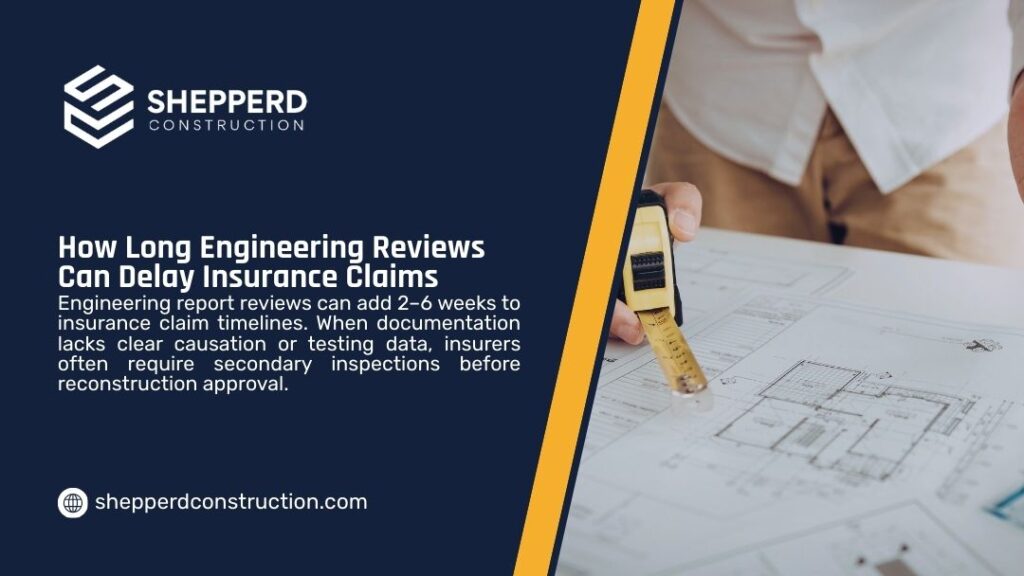
Insurance companies rely on a structural engineer’s report to confirm three things: the cause of damage, the scope of structural impact, and whether reconstruction is necessary instead of simple repair. If any of these elements are unclear, the insurer may request additional documentation, conduct another inspection, or challenge the claim.
In practice, poorly prepared reports create delays, extra inspections, and sometimes claim denials. Missing calculations, unclear causation analysis, or a report that lacks a professional engineer’s seal can weaken the credibility of the entire claim. Below is a quick overview of the most common issues and their consequences.
| Problem in the Engineering Report | What the Insurance Company May Do | Impact on Reconstruction Approval |
| Missing structural analysis or calculations | Request additional engineering review | Delays claim processing |
| No licensed engineer seal or signature | Reject the report as non-compliant | Reconstruction approval may stall |
| Unclear cause of damage | Order an independent engineer inspection | Potential dispute over coverage |
| Incomplete site documentation | Ask for supplemental inspections | Slower approval timeline |
| Weak explanation of the need for reconstruction | Reduce the scope of approved repairs | Partial claim payout |
| Poor photo or evidence documentation | Question the validity of findings | Increased claim scrutiny |
When engineering report requirements for insurance reconstruction approval are not met, the claim often shifts from a straightforward evaluation to a prolonged review process. That extra scrutiny can add weeks or even months before reconstruction work receives approval.
For property owners, HOAs, and commercial building managers, ensuring that the structural engineer inspection report meets all technical and regulatory expectations from the start can significantly reduce those delays.
Engineering Reports, Insurance Reconstruction, and Reconstruction Contractors
When reconstruction is approved, it often transitions to the execution phase, where experienced firms step in to implement complex reconstruction work. Whether you need a trusted team in conducting thorough assessments or managing full projects, this plays into decisions about which reconstruction professionals to engage once the engineering report requirements for insurance reconstruction approval are satisfied, especially for large properties and multi-unit facilities where precision and documentation matter most.
Engaging specialized firms experienced in handling detailed construction scopes and collaborating closely with engineers and insurers helps to ensure reconstruction work aligns with the expectations once an engineer’s report is accepted.
Relevant reconstruction partners in Texas include trusted regional experts, such as those covering Austin, Dallas, Fort Worth, and San Antonio, who understand not just rebuilding but also the documentation rigors insurers often demand.
Engineering Report Essentials for Insurance Reconstruction Approval
Properly prepared engineering reports are not optional when reconstruction approval is at stake; they are essential. Insurance claims evaluators depend on professional reports to determine whether damage is covered, what work is required, and how much should be paid. The more credible and technically solid your engineering report is, the smoother the approval process moves.
If you need reconstruction support that integrates well with insurer expectations and engineering standards, experienced reconstruction contractors with deep technical understanding and documentation discipline can make a significant difference.
Take the Next Step to Ensure Smooth Insurance Reconstruction Approval
When it comes to complex structural issues and insurance claims that hinge on technical evidence, having both a defensible engineering report and a capable reconstruction execution partner matters greatly.
Make sure your documentation is thorough and that your team knows how to handle reconstruction scopes accurately and efficiently. If you’re navigating multi-unit reconstruction, defect repair, or large-scale property restoration, expert support and correct engineering documentation can mean the difference between approval and denial.
To explore trusted resources and connect with experienced reconstruction partners who understand the full process from engineering report to approved reconstruction work, consider contacting professionals in your region who specialize in these scopes.