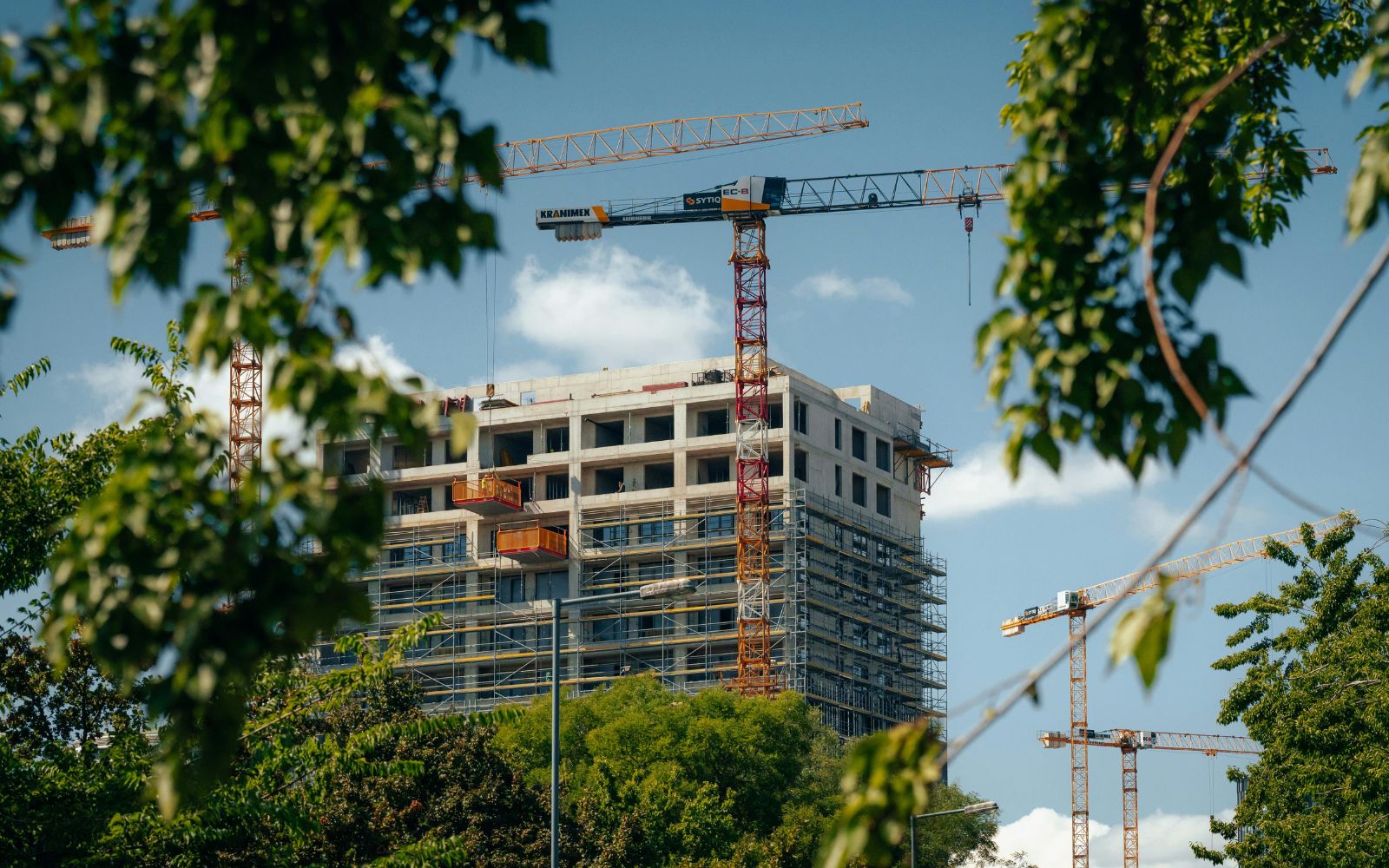
Recurring garage flooding in condo complexes usually points to drainage failures, waterproofing breakdowns, or hidden structural deterioration, not just clogged drains. This guide explains why condo parking garages flood during heavy rain, what warning signs property managers and HOA boards should watch for, when reconstruction becomes necessary, and how long-term waterproofing and drainage failures are typically repaired.
Parking Garage in My Condo Complex Floods Every Time It Rains: What’s Actually Happening?
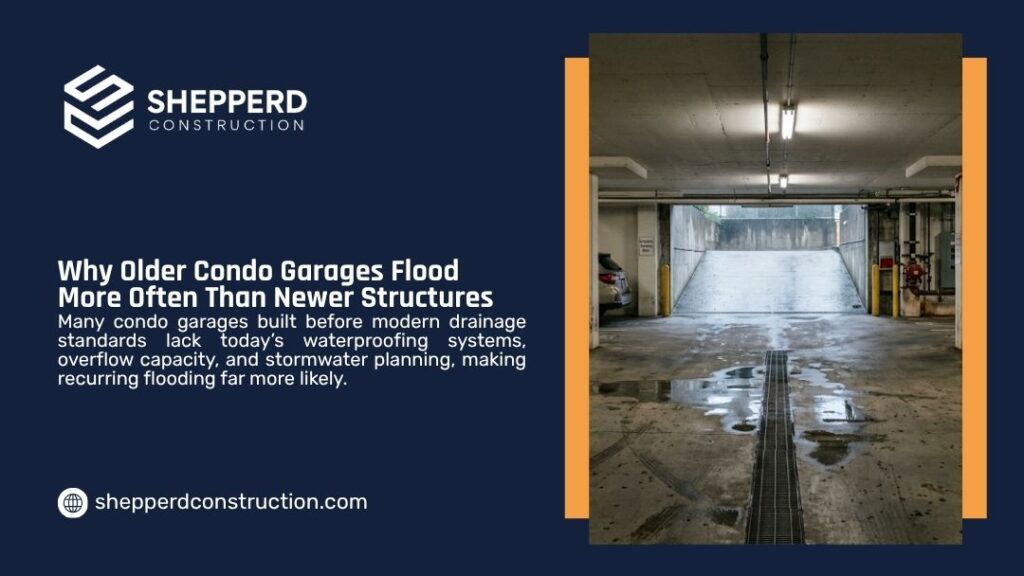
A parking garage in a condo complex floods every time it rains because water is finding a path into the structure faster than the building can redirect or remove it. In many condo communities, especially older developments, parking structures sit partially or fully below grade. That makes them naturally vulnerable to stormwater pressure, poor drainage flow, and groundwater intrusion.
In Texas, heavy rainfall events have become more intense over the last several decades. According to the EPA, extreme precipitation events in the South have increased substantially since the mid-20th century. That matters because older parking structures were often designed around rainfall assumptions that no longer match today’s weather patterns.
Water rarely enters a garage from one obvious location. Instead, it moves gradually through weak points in the structure. Failed waterproof membranes, drainage backups, settlement cracks, expansion joint failures, deteriorated sealants, and improperly sloped surfaces all create pathways for water intrusion.
According to the National Institute of Building Sciences, Water intrusion is one of the most destructive forces affecting buildings because damage often develops silently behind walls, slabs, and coatings before becoming visible.
At first, residents may only notice damp concrete or isolated puddles after storms. Months later, those same areas can develop rust staining, surface deterioration, musty odors, ceiling discoloration, spalling concrete, mold contamination, and structural cracking. And that’s why recurring garage flooding should never be treated as a cosmetic problem.
The Most Common Causes of Garage Flooding in Condo Complexes
Most flooded parking garage conditions don’t come from one failed component. They come from a combination of drainage failures and waterproofing deterioration that’s been building up over the years, sometimes quietly, sometimes right in front of everyone.
| Cause | What Happens | Long-Term Risk |
| Failed waterproof membrane | Water penetrates slab surfaces | Structural deterioration |
| Clogged trench drains | Stormwater backs into the garage | Recurring standing water |
| Improper grading | Water flows toward the building | Drainage overload |
| Expansion joint failure | Water enters through the movement joints | Internal slab damage |
| Concrete cracking | Moisture penetrates structural surfaces | Corrosion and spalling |
| Stormwater overload | Drainage system exceeds capacity | Flooding during heavy rain |
One of the most commonly missed problems is failed waterproofing beneath traffic coatings. The surface might look completely intact. No cracks. No obvious damage. But underneath the coating, the membrane has separated from the substrate, and water has been moving beneath the surface for months, sometimes longer, before anyone knows.
The International Concrete Repair Institute identifies moisture intrusion as one of the leading contributors to concrete deterioration in parking structures, because repeated wet-dry cycles accelerate corrosion within reinforced steel. Once that starts, it doesn’t stop on its own.
The deterioration spreads. Costs rise. And the community that spent three years addressing a drainage problem eventually discovers they’ve been managing the symptom of a structural failure.
Why a Flooded Parking Lot Becomes a Structural Problem
Concrete looks permanent. It isn’t, not when water gets access to what’s inside it. Reinforcing steel embedded in concrete slabs starts corroding the moment sustained moisture reaches it. As rust forms, the steel expands, placing internal pressure on the surrounding concrete. That pressure has to go somewhere. Eventually, it shows up as cracking, then spalling, then sections of concrete breaking away entirely. If you’re seeing flaking or exposed rebar overhead, our breakdown of how serious concrete spalling on a parking structure is walks through what the damage signals and what to do next. That’s not a maintenance issue anymore. That’s a structural repair.
In garages where standing water returns after every storm, this process moves faster than most boards or property managers realize. Water doesn’t need a large opening. It finds microscopic pores in the concrete surface, follows the path of least resistance, and reaches the steel well before the damage becomes visible from the garage floor.
| Structural Concern | Why It Matters |
| Reinforcing steel corrosion | Weakens structural integrity |
| Hydrostatic pressure | Pushes water through walls and slabs |
| Mold growth | Creates indoor air quality concerns |
| Expansion joint deterioration | Accelerates water intrusion |
| Concrete spalling | Creates falling debris hazards |
According to the American Society of Civil Engineers, aging concrete structures often require condition surveys, concrete repair, and rehabilitation when deterioration, cracking, or reinforcement corrosion appears, all issues that can become more serious when parking garages face repeated water intrusion.
By the time flooding becomes a predictable weekly complaint from residents, the hidden deterioration has often been developing for years beneath the surface.
How to Stop a Garage From Flooding: What Actually Works
Property managers often ask how to stop the garage from flooding without shutting down the property for months. The answer depends on what is causing the water intrusion in the first place.
Some parking structures need relatively straightforward drainage improvements. Others require full reconstruction of waterproofing systems and deteriorated concrete assemblies.
A professional evaluation usually focuses on drainage flow, surface grading, waterproofing integrity, concrete condition, moisture migration, expansion joints, structural movement, and signs of structural movement near slab edges or elevated sections.
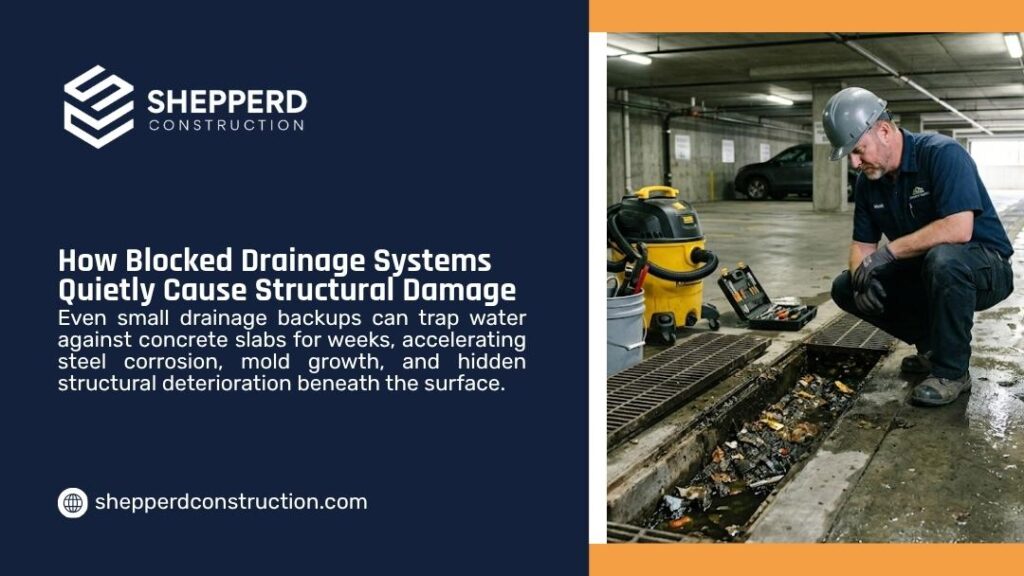
In many multifamily communities, trench drains clog gradually over time with debris, sediment, leaves, and construction residue. Once drainage slows, even moderate rainfall can overwhelm the system.
For more severe conditions, reconstruction contractors may recommend new waterproof traffic coatings, drainage redesign, concrete rehabilitation, expansion joint replacement, crack injection systems, structural slab repair, and sump pump upgrades. This is often where communities realize simple patch repairs no longer solve the issue.
How to Keep the Garage From Flooding During Heavy Texas Storms
Texas weather places unusual stress on multifamily drainage systems. Sudden downpours can dump several inches of rainfall within hours, overwhelming older stormwater infrastructure. Here’s the thing. Many condo developments across Dallas, Austin, Fort Worth, and San Antonio were built decades ago under drainage assumptions that no longer reflect today’s climate patterns.
Parking structures lack updated drainage systems, proper grading, waterproof membrane maintenance, and drainage redundancy. Flood conditions become more likely during every major storm.
That’s why many property managers eventually move beyond temporary mitigation and begin evaluating long-term reconstruction planning through experienced Texas reconstruction contractors who understand multifamily water intrusion systems.
Emergency mitigation can reduce immediate damage during a major storm. But if flooding returns every single time it rains, even moderate rain, that’s not a weather problem. That’s a building problem.
When Repair Is No Longer Enough
Some garage flooding issues can be resolved through maintenance and localized repairs. Others signal larger structural or waterproofing failures that continue worsening beneath the surface. Repeated standing water usually means the original problem was never fully resolved.
Signs reconstruction may be necessary, including:
- Flooding returns after nearly every rainstorm, even smaller ones
- Water is dripping through ceiling joints or leaking through garage walls
- Concrete is cracking in patterns that suggest structural movement
- Rust streaks appear near beam edges or column bases
- Spalling concrete is creating debris near the ramp entrance
- Drainage systems keep failing within months of being cleared
- A musty odor persists in the garage even in dry weeks
This is where forensic evaluations become essential. Reconstruction teams work alongside engineers to determine whether the underlying issue involves waterproofing failure, construction defects, structural settlement, drainage design failure, deferred maintenance, or storm-related deterioration. And sometimes the answer is all of the above.
Who Is Responsible When a Condo Parking Garage Floods?
Responsibility depends heavily on HOA governing documents, maintenance obligations, insurance language, and the source of the water intrusion itself. In many condo communities, underground parking garages fall under common element responsibility, meaning the HOA typically oversees repairs and maintenance. However, liability can become complicated if flooding relates to:
- Construction defects that predate the current board’s tenure
- Deferred maintenance over multiple ownership cycles
- Storm events that exceed insurance coverage thresholds
- Developer-related issues are still within warranty or litigation periods
- Improper prior repairs that may have worsened the underlying condition
Documentation matters enormously here. Photographs taken immediately after flooding events, engineering reports, moisture mapping results, a complete repair history, and drainage evaluation records can all become critical if insurance disputes or legal questions arise later.
Property managers who have dealt with recurring flooding often discover it intersects with larger building envelope concerns, roofing, balconies, and exterior walls, affecting more of the structure than the garage alone.
What Property Managers Should Do After Repeated Garage Flooding
When a parking garage in a condo complex floods every time it rains, property managers should avoid relying solely on cleanup vendors or temporary drainage clearing.
The first priority should be identifying why the flooding continues. That process often includes drainage inspections, moisture testing, waterproofing evaluations, concrete assessments, structural reviews, and historical repair analysis.
The second priority involves planning for long-term asset preservation. Communities that delay reconstruction frequently face higher repair costs later because water intrusion rarely remains isolated. It spreads gradually into adjacent structural systems.
This becomes especially challenging for HOAs managing aging multifamily buildings with deferred maintenance concerns.
How Reconstruction Contractors Actually Fix Recurring Flooding
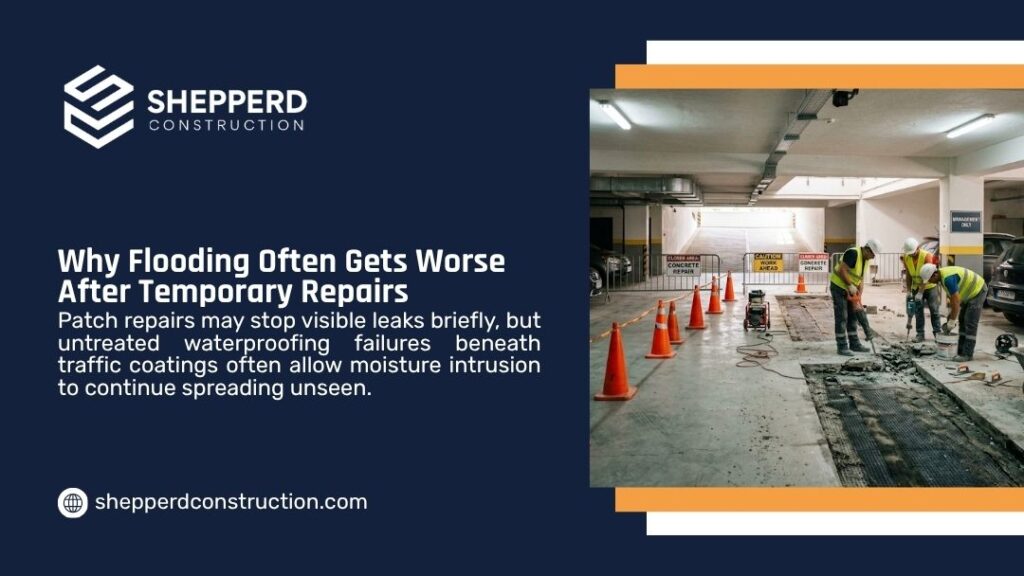
Long-term solutions usually require more than sealants or temporary patchwork. Experienced reconstruction contractors begin with investigative testing to determine how water is moving through the structure.
That process may involve moisture mapping, infrared analysis, drainage testing, core sampling, waterproofing inspections, and structural evaluations. Once the source becomes clear, repair strategies may include:
- Replacing waterproof membranes
- Rebuilding expansion joints
- Installing new drainage systems
- Correcting grading slopes
- Removing deteriorated concrete
- Removing and replacing deteriorated concrete sections before corrosion spreads further
- Rehabilitating reinforcing steel
- Applying traffic coating systems
This is especially important for large multifamily communities where recurring garage flooding affects resident safety, property value, insurance exposure, and long-term maintenance budgets.
Communities facing significant deterioration often require specialized support from firms experienced in HOA reconstruction services and complex building-envelope rehabilitation.
Warning Signs Your Garage Flooding Problem Is Getting Worse
Water intrusion doesn’t stay consistent. It tends to intensify as drainage systems age and deterioration spreads, often faster than annual inspection schedules can track.
| Warning Sign | What It Often Indicates |
| Standing water after small storms | Drainage capacity failure |
| White chalky staining on concrete surfaces | Active moisture migration |
| Rust streaks near column bases or beam edges | Reinforcing steel corrosion |
| Cracks in ceiling slabs above garage level | Structural movement |
| Musty odor that persists between storms | Hidden moisture or mold growth |
| Concrete flaking near ramp entrances | Spalling deterioration |
One particularly serious indicator: cracking near balcony slab edges or elevated parking decks. Structural movement in those locations can signal deterioration within the full parking structure assembly, not just surface-level wear.
Communities dealing with visible cracking or instability often encounter issues aligned with unstable condo balconies and structural concerns, where underlying structural weaknesses can pose safety risks if not addressed early.
How to Choose a Contractor for Condo Parking Garage Reconstruction
Not every contractor understands below-grade waterproofing systems, parking structure assemblies, or what it means to run a major reconstruction project inside a building where residents are still living. That last part matters more than most boards realize.
A contractor without multifamily reconstruction experience may resolve one visible symptom while missing the drainage pathway, the membrane failure, or the expansion joint condition that’s driving the entire problem. Communities sometimes discover this after a second round of flooding follows a repair that costs significant money.
What to look for in a reconstruction contractor for this type of work:
- Direct experience with multifamily and below-grade parking structures
- Building-envelope expertise across multiple systems
- Waterproofing knowledge specific to traffic-bearing assemblies
- Demonstrated ability to coordinate with forensic engineers
- Clear communication systems for HOA boards and residents
- Large-scale, occupied-building reconstruction history
That combination, technical depth plus community communication, is what separates firms that fix the problem from firms that manage it temporarily.
Frequently Asked Questions
Why does my condo parking garage flood every time it rains?
Most recurring flooding comes from drainage failures, waterproofing deterioration, structural cracking, clogged trench drains, or hydrostatic pressure affecting below-grade structures. The real cause is usually a combination of these, not a single failure point.
Is the HOA responsible for garage flooding?
In most condo communities, parking garages qualify as common elements maintained by the association. Actual responsibility depends on governing documents, the source of the flooding, and whether the issue involves construction defects, deferred maintenance, or weather events.
Can parking garage flooding damage the structure itself?
Yes, and it often does before anyone realizes it. Repeated moisture exposure corrodes reinforcing steel, weakens concrete, degrades coatings, and can create long-term structural deterioration that develops silently behind slab surfaces.
How do you stop garage flooding permanently?
Permanent solutions require identifying the root cause through drainage analysis, waterproofing evaluations, and engineering assessments. Temporary patch repairs don’t address how water is entering the structure; they only affect where it’s appearing.
Does insurance cover flooded parking garages?
Coverage depends heavily on policy language, maintenance documentation, storm conditions, and whether the damage resulted from a sudden event or long-term deterioration. Many policies treat recurring water intrusion differently from storm damage.
When does garage flooding require reconstruction?
When flooding returns repeatedly regardless of previous repairs, when waterproof systems have failed across large areas, when concrete deterioration is spreading, or when structural conditions have been affected.
What Happens Next Matters Most
A parking garage in a condo complex floods every time it rains for a reason. Water always follows a path, and repeated flooding usually means the structure’s drainage or waterproofing systems are no longer performing the way they were designed to. The longer the moisture intrusion continues, the more expensive the repairs often become.
For HOAs, property managers, engineers, and building owners, early investigation can help prevent far more serious structural deterioration later. Whether the issue involves failed waterproofing, drainage overload, expansion joint deterioration, or larger reconstruction needs, long-term solutions require more than surface-level repairs.
That’s why many multifamily communities across Texas turn to experienced reconstruction professionals like Shepperd Construction, who understand building-envelope failures, moisture intrusion, and complex structural rehabilitation.
Property owners evaluating recurring garage flooding issues can learn more about Shepperd Construction’s experience with multifamily and commercial reconstruction projects or connect directly to discuss site-specific conditions.
If your garage is flooding every time it rains and nothing has been fixed permanently, that’s worth a real conversation, not another cleanup estimate.