
By Brett Grobarz, Vice President of Sales, Shepperd Construction
A homeowner reports a ceiling stain. Another reports cracked stucco near a balcony. A third says the breezeway floods every time it rains. Each report lands on a property manager’s desk, and each one raises the same question for the volunteer board behind that manager: if we get this wrong, are we personally on the hook?
This guide is for Texas HOA property managers and the boards they support. It explains how association type, governing documents, and repair decisions can affect liability questions. It is general information, not legal advice; association counsel should review questions about a specific property or board member.
Can Texas HOA Board Members Be Personally Liable for Repair Decisions?
Possibly, but there is no single liability rule for every Texas association. The answer can depend on whether the property is a condominium or a property owners’ association, how the association is organized, what its governing documents say, and the specific conduct at issue.
A repair dispute may involve the association’s maintenance obligations, a director’s actions, or both. A repair problem or an imperfect result does not by itself establish an individual director’s liability. For a specific concern, the board should consult its attorney.
For a property manager, the practical priority is to make sure repair reports are reviewed, responsibility is checked against the governing documents, and the board’s decision process is recorded. That process supports informed decisions; it does not guarantee protection from a claim.
Where a Texas HOA’s Repair Duties Come From
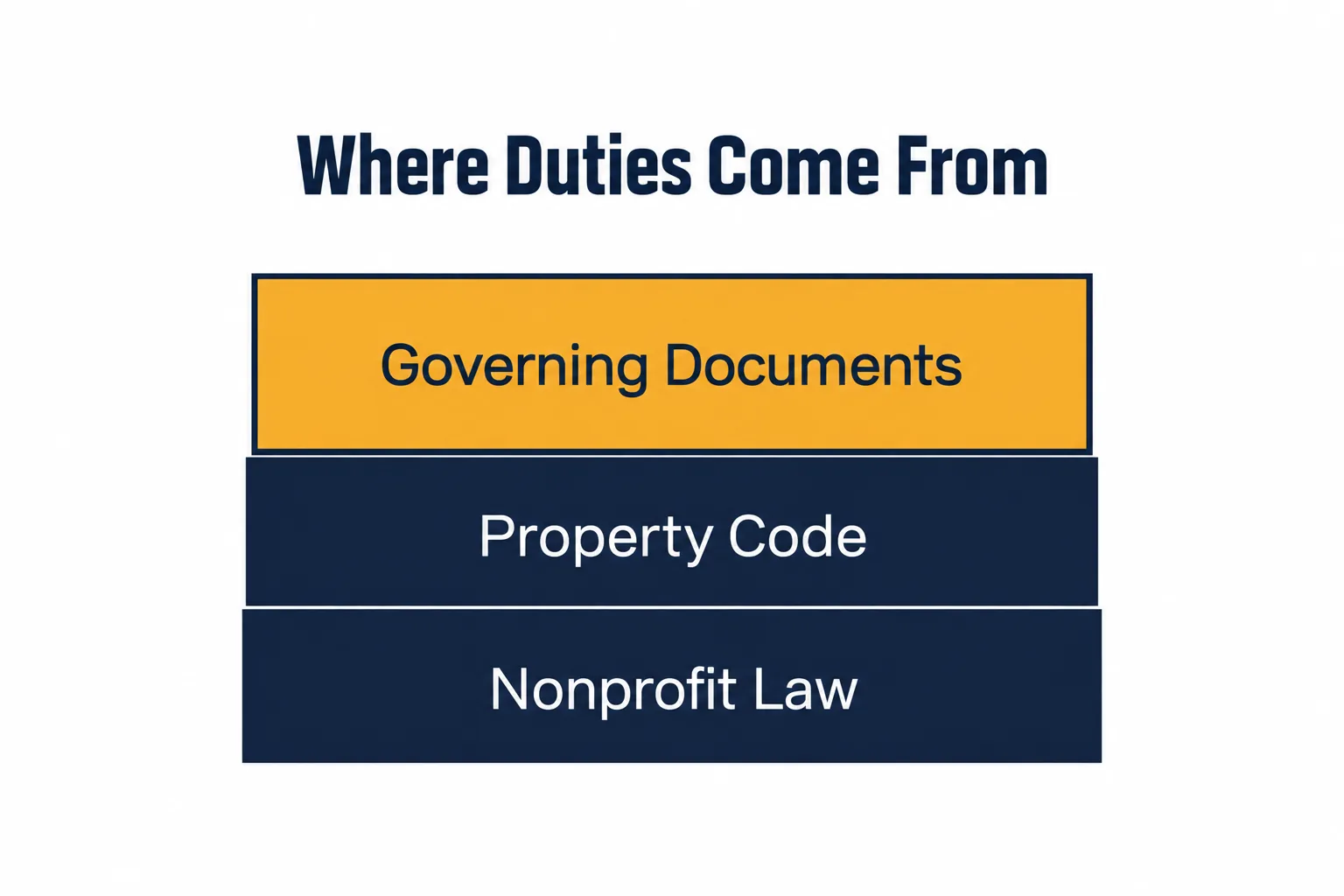
Before asking whether a board met its duty, you need to know what the duty is. In Texas, the answer comes in layers:
- The declaration (CC&Rs), bylaws, and plats. These define what the association maintains and what owners maintain. Start with the documents that govern the specific property.
- The Texas Property Code. Condominiums are governed by Chapter 82, the Texas Uniform Condominium Act. Many residential property owners’ associations are subject to Chapter 209, depending on whether the association and property meet the law’s requirements.
- Nonprofit corporate law. Many Texas HOAs are organized as nonprofit corporations, so the Texas Business Organizations Code may also shape director duties.
The governing documents and applicable statutes determine the association’s responsibilities. A board should confirm those duties before approving work or deciding that a repair belongs to an individual owner.
What Repairs Is an HOA Responsible For in Texas?
It depends on the documents, but common patterns look like this:
| Association type | Commonly maintains |
|---|---|
| Condominium associations | The common elements: roofs, exterior walls, structural components, and shared building systems, subject to the declaration. |
| Single-family HOAs | Common areas and amenities (entrances, pools, clubhouses, shared landscaping) rather than individual homes, unless the documents say otherwise. |
For condominiums, Texas Property Code §82.107 sets a default division: the association maintains, repairs, and replaces common elements, while unit owners are generally responsible for their units, subject to the declaration and statutory exceptions. This default does not automatically decide responsibility in every community. See our guide on who is responsible for water damage and roof repairs in a condo.
Texas Board Duties Depend on the Association’s Legal Structure
If an association is governed by Texas nonprofit-corporation law, Business Organizations Code §22.221 states that directors must act in good faith, with ordinary care, and in a manner they reasonably believe is in the corporation’s best interests.
Whether that provision governs a particular association, and how it applies to a specific decision, should be confirmed with counsel. See the Texas Business Organizations Code’s director standard.
Three practical takeaways follow:
- Informed decisions matter. A board that investigates a repair concern, gathers appropriate professional input, weighs options, and records its reasoning can show how it reached its decision.
- Professional input can help. Directors are not expected to be engineers or contractors. A forensic engineer can assess building conditions; a reconstruction contractor can provide construction input, a repair scope, and cost information. Neither replaces legal advice.
- A later repair issue does not automatically prove a breach of duty. The board’s conduct, applicable law, and the facts at the time all matter.
Situations That May Raise Personal-Liability Questions
For condominiums governed by Chapter 82, §82.103(a) addresses board members’ fiduciary role. Subsection (f) separately limits monetary-damages liability for acts or omissions in that role, subject to stated exceptions. These condominium-specific provisions should not be treated as a universal rule for every Texas POA. See the Texas Property Code, Chapter 82.
For other associations, the governing law may differ. Conduct such as a conflict of interest, bad faith, or acting outside board authority may raise legal questions, but none of the examples below automatically establishes an individual director’s liability.
Ignoring Known Defects and Deferring Maintenance
Repeated reports of leaks, cracking, or failed sealants should be logged and reviewed. If the association may be responsible, the board should decide whether to investigate, take temporary protective measures, or schedule repairs. A delay does not by itself establish individual liability; the reason for the delay and the board’s response matter.
Deferral can be a reasonable budget choice. A deferral made without assessing the problem or documenting the options can be harder to explain later. Storm damage shows how a small delay can expand the repair scope; see what happens if an HOA delays roof replacement after storm damage.
Conflicts of Interest on Repair Contracts
Awarding repair work to a director’s own company, a relative, or a business associate can raise conflict-of-interest questions. Disclose any relationship and follow the association’s governing documents and applicable law. Recusal may be prudent, but it is not a substitute for following the required approval process.
Acting Outside the Board’s Authority
Governing documents often cap what the board can spend or commit without owner approval. Before approving major repairs or a special assessment, check the required voting, notice, and approval procedures with association counsel or the property manager.
Board Members Doing Repairs Themselves
Volunteers who climb onto a roof, patch a balcony, or reframe a wall may face safety, workmanship, and insurance questions. The association should confirm who is authorized to perform the work and whether they have appropriate qualifications and coverage. Hiring a contractor does not transfer the board’s legal duties.
A qualified contractor can provide a defined scope, project documentation, and insurance information for review. The association should assess those materials and the contract with its advisers.
Inconsistent Handling of Owner Repair Requests
Answering some owners within days and others within months invites complaints of selective treatment, even when the delay has an innocent explanation. A written intake and response process helps the association track each request and explain why it moved at a particular pace.
Volunteer Liability Protections Depend on Eligibility and Facts
Unpaid status alone does not establish that a board member is protected from liability. Any protection under Texas or federal volunteer laws depends on the association’s legal status, the person’s role, the conduct at issue, and statutory exceptions. Boards should ask association counsel which protections, if any, apply before relying on them.
Do HOA Board Members Need Liability Insurance?
Insurance does not prevent a claim, and coverage depends on the policy, the insured parties, exclusions, limits, and facts. These policies address different risks:
Related readingQuestions to Ask a Reconstruction ContractorRead the guide →| Coverage | What it may address (subject to the policy) |
|---|---|
| Property insurance | Physical loss to insured buildings and common elements. |
| Commercial general liability (CGL) | Covered bodily injury or property-damage claims. |
| Directors and officers (D&O) | Certain claims involving board decisions, subject to the policy’s terms and exclusions. |
For condominiums governed by Chapter 82, §82.111 requires specified property and commercial general liability coverage to the extent reasonably available. This is not a blanket insurance rule for every HOA, and §82.111 does not require D&O coverage. The association should have its broker explain required coverage and ask about D&O limits, exclusions, defense costs, and how the policy coordinates with indemnification provisions.
A Repair Decision Process for HOA Boards
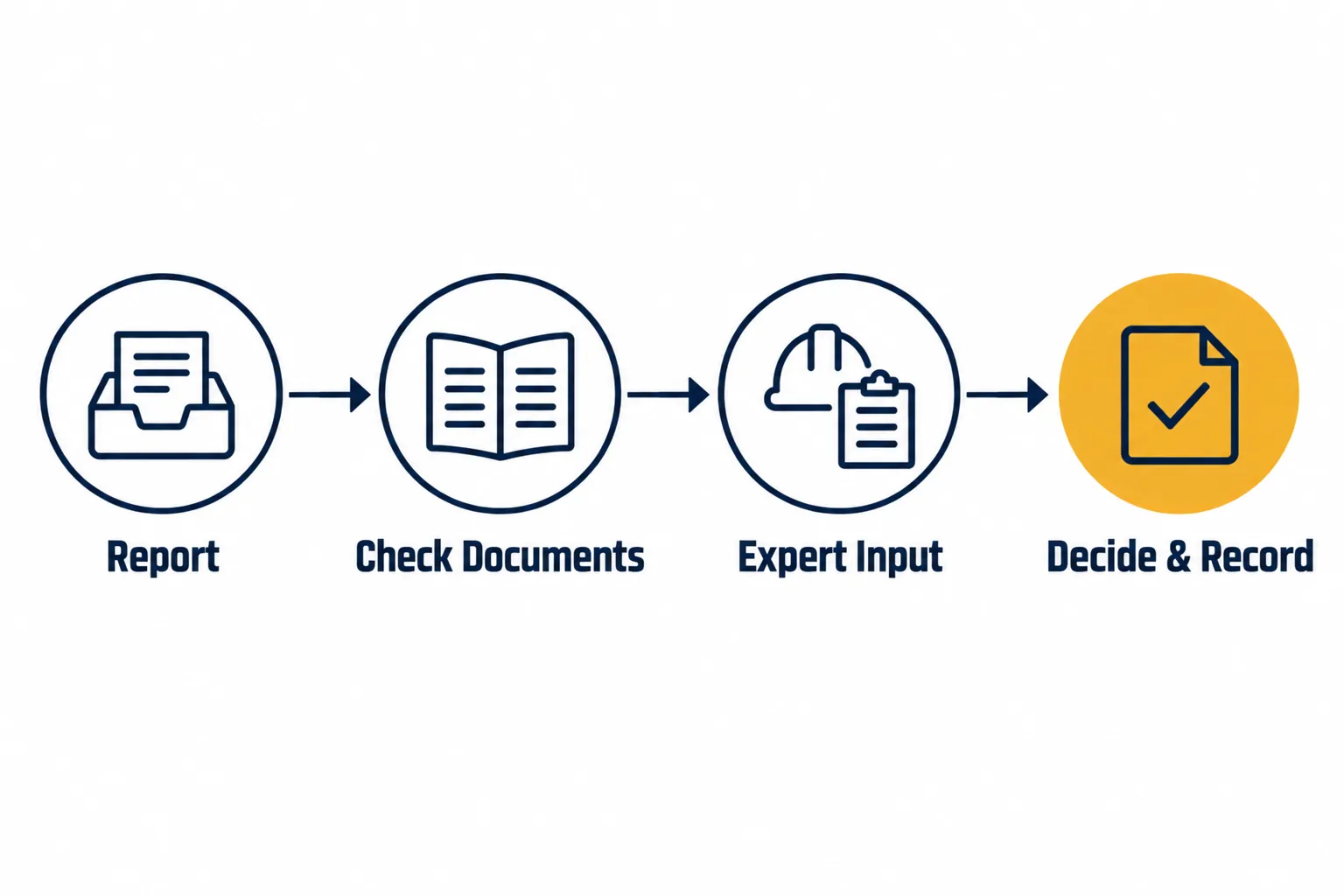
The most reliable protection is a repeatable process. Property managers can adapt this framework:
- Log each repair report. Capture the date, location, owner’s description, and available photos.
- Confirm responsibility. Review the governing documents and ask counsel about unclear or disputed items.
- Arrange a technical assessment when needed. Engage a forensic engineer when the cause is unclear, or the issue may involve structural or concealed conditions.
- Get a defined scope and cost information. Ask a qualified reconstruction contractor to document the proposed work. Building repair costs may depend on access, hidden damage, and phasing around occupied units.
- Follow required procedures. Check the governing documents for bidding, voting, owner-approval, and notice requirements.
- Record the board’s decision. Note the options considered, professional input, and reasons for the selected approach.
- Communicate and track the work. Share timelines and disruptions with owners, then document progress and closeout.
This process helps the board make and explain an informed decision. It does not guarantee immunity from legal claims.
Building-Envelope Problems That Can Expand the Repair Scope
A handful of envelope components can make repair decisions more complex:
- Roof membranes, flashing, and penetrations. Small breaches at curbs, vents, and parapets can allow water to travel beyond the visible leak.
- Sealants and window or door perimeters. Worn joints can create paths for water intrusion.
- Balconies, breezeways, and elevated walkways. Water trapped at deck-to-wall transitions can deteriorate concealed materials.
- Stucco, masonry, and siding drainage details. Failed flashing or drainage components can allow water into wall cavities.
Unresolved water intrusion can lead to wet insulation, interior damage, and deterioration of framing or other components. When leaks recur, document their locations and timing and consider an assessment before selecting another repair.
From a design-and-build perspective, many recurring leaks trace to the gap between design intent and how a detail was built. A flashing that looks right on the drawings may have been lapped the wrong way in the field. An assessment can help identify the source before the association chooses its next repair.
How a Reconstruction Contractor Supports the Repair Process
A reconstruction contractor can support the association’s work with:
- Investigative testing to help identify water-intrusion paths and concealed damage.
- Cost-of-repair estimates to support budgeting and owner communication.
- Preconstruction planning for occupied buildings, including phasing, resident access, and difficult-access work at height.
- Coordination with forensic engineers and attorneys while staying within the contractor’s role: the contractor supports testing and construction; engineering and legal conclusions belong to the respective professionals.
- Project communication and records from the site visit through closeout.
Shepperd Construction brings more than eleven years of reconstruction and building-envelope work across Texas to these projects, working alongside engineers and property managers. See our HOA reconstruction services or read our guide to choosing a reconstruction contractor for an HOA.