
Industry reports also show that the average water damage claim exceeds $15,400 per incident (III data), which explains why even a small leak can escalate quickly if not addressed properly. Water leaking through roof into my condo unit doesn’t just leave stains; it brings confusion, stress, and a lot of unanswered questions. Who’s supposed to fix it? Who pays for the damage? And more importantly, is this a simple repair or something deeper? This guide walks through the real answers, not the vague ones.
Water Leaking Through Roof Into My Condo Unit: First Steps That Actually Matter
When water leaks through the roof into a condo unit, most people freeze for a second. That’s normal. But hesitation is what makes the situation worse.
Start with containment. Buckets, towels, anything that keeps water from spreading. Then step back and look at the bigger picture. Is it dripping from one spot or spreading across the ceiling?
Here’s what most people overlook: evidence. Take photos immediately. Not just one or two, but a sequence. Capture the ceiling, the walls, and the floor if needed. If the leak worsens, that timeline becomes your strongest argument with insurance or your condo association.
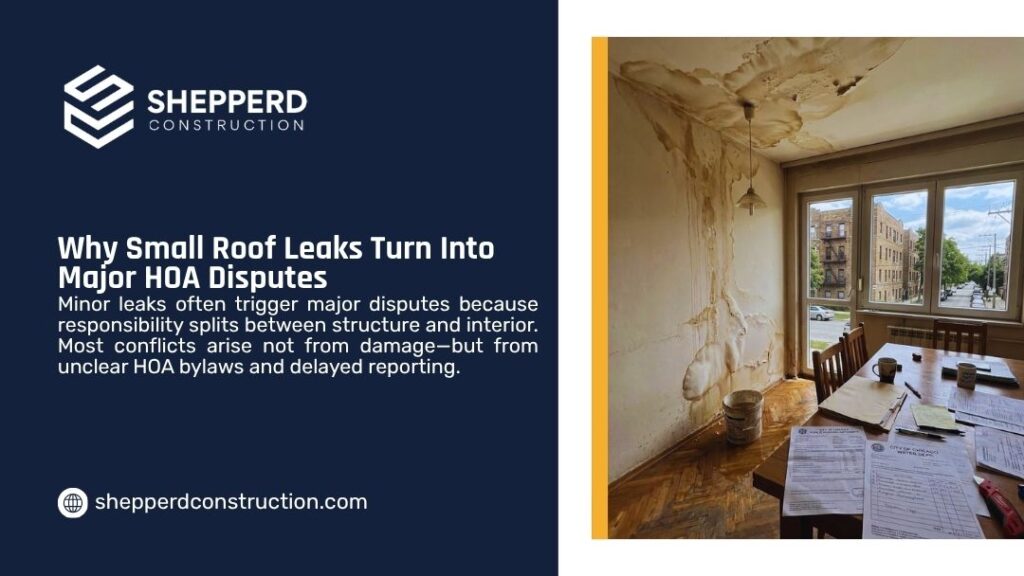
And don’t wait to notify the HOA. Even if you’re unsure about responsibility, reporting early protects you later. Silence tends to work against condo owners in these situations.
Who Is Responsible for a Roof Leak in a Condo? (HOA vs Owner vs Neighbor)
Responsibility for a roof leak in a condo rarely sits with one party alone. It depends on where the failure starts, how the building is defined legally, and whether negligence played a role. In most cases, the roof is considered a shared component, but once water enters a unit, the situation splits into layers.
What often surprises people is how quickly responsibility shifts. The same leak can involve the HOA for structural repair, the owner for interior damage, and even another unit if the source isn’t actually the roof.
| Factor | HOA | Condo Owner | Neighbor (Upstairs Unit) |
| Roof structure | Responsible | Not responsible | Not responsible |
| Interior ceiling damage | Sometimes | Often responsible | Rarely |
| Leak from plumbing | Not usually | Sometimes | Often responsible |
| Maintenance failure | Responsible | If delayed reporting | If negligence proven |
| Insurance involvement | Master policy | HO-6 policy | Personal liability coverage |
Notice: Condo bylaws differ widely from one another. For the ultimate decision of liability, always refer to your particular Declaration of Condominium (CC&Rs).
Understanding Condo Association vs Unit Owner Responsibility
The dividing line between the condo association and the unit owner is defined in governing documents, not assumptions. Terms like common elements and limited common elements carry weight here.
The roof, exterior walls, and structural systems usually fall under HOA responsibility. Inside the unit, paint, drywall, and flooring are typically the owner’s domain.
But here’s where it gets complicated. Some associations follow what’s called bare walls coverage, while others include partial interior coverage. That difference alone can change who pays for thousands of dollars in damage.
Responsibility Breakdown
| Area of Property | Typical Responsibility |
| Roof/exterior | HOA |
| Structural framing | HOA |
| Interior drywall | Condo owner |
| Flooring/finishes | Condo owner |
| Shared plumbing systems | HOA (varies by documents) |
The key takeaway is simple: responsibility is defined before damage happens, not after.
When HOA Is Responsible for Roof Leaks
The HOA steps in when the issue ties back to the building itself. If the roof fails due to age, poor maintenance, or installation issues, the association is responsible for repairing the source.
This includes situations where water leaking through roof into my condo unit originates from worn-out materials or neglected upkeep. Associations are expected to maintain common elements in a condition that prevents this kind of failure.
However, many HOAs stop short of covering interior repairs unless their policy explicitly includes it. That gap is where most disputes begin.
When the Condo Owner Is Responsible
A condo owner becomes responsible when the damage is limited to the interior or when delays make things worse. Insurance adjusters often look at response time.
If a leak is reported late or ignored, the argument shifts. What could have been minor damage becomes preventable loss. That’s when liability leans toward the owner.
Owners are also responsible for personal property and interior finishes unless their policy or HOA coverage states otherwise.
When Another Unit Is Responsible (Upstairs Leak Scenarios)
Not every ceiling leak comes from the roof. Water travels. It moves along beams, pipes, and insulation before showing up in unexpected places.
If the source comes from an upstairs unit, whether from plumbing failure or overflow, the responsibility often shifts to that unit owner. This becomes clearer when negligence is involved, such as unaddressed leaks or faulty fixtures.
These cases usually involve multiple insurance policies, which is why documentation matters early.
Is HOA Responsible for Water Damage and Roof Repairs?
The HOA’s responsibility usually covers the cause, not always the consequences. They repair the roof. They address the structural issue. But interior damage inside a unit sits in a gray area. Some associations cover it under master policies, while others expect unit owners to rely on personal insurance.
Another factor is how the HOA defines original condition. Some will restore units only to their original build standard, not upgrades or renovations. This distinction becomes critical in older buildings or properties that have undergone renovations over time.
It’s also important to understand that liability can vary by state. For example, in states like California (Davis-Stirling Act) and Florida (Florida Condominium Act), condo statutes often define maintenance responsibility for common elements more clearly, while in Texas (Texas Uniform Condominium Act (TUCA)), the governing documents tend to carry more weight than state law itself. That means two buildings in the same city can operate under very different rules depending on how their declarations are written.
Does Condo Insurance Cover Water Damage From Roof Leaks?
Condo insurance, often called an HO-6 policy, typically covers interior damage, but with conditions. If water leaks through the roof into my condo unit suddenly, coverage is more likely. If the leak develops over time due to neglect, claims may be denied.
Another limitation is coverage caps. Many policies include limits on water damage, especially if mold develops. It’s also worth noting that insurance doesn’t always move quickly. Claims can take time, and in the meantime, damage continues to evolve. Understanding these gaps ahead of time can prevent surprises later.
Insurance Coverage Comparison
| Coverage Type | Covers | Doesn’t Cover |
| Condo Insurance (HO-6) | Interior damage, personal items | Structural roof failure |
| HOA Insurance (Master Policy) | Roof, shared structures, common areas (pool, lobby), exterior wall | Personal property |
| Overlap Cases | Sometimes shared liability (e.g., pipe bursting in a wall affects both) | Depends on policy wording |
Common Causes of Condo Roof Leaks (And Why They Keep Happening)
Roof leaks don’t appear without warning. They follow patterns tied to building age, design, and maintenance practices. Before looking at solutions, it helps to understand what’s actually causing the problem.
Common Causes of Condo Roof Leaks
| Cause | Description | Long-Term Impact |
| Aging materials | Roofing systems reaching the end of their lifespan | Increased frequency of leaks |
| Poor maintenance | Minor issues left unaddressed | Accelerated deterioration |
| Construction defects | Improper installation or design flaws | Recurring water intrusion |
| Drainage issues | Blocked or ineffective water flow | Standing water, structural stress |
| Weather exposure | Repeated storms, heat cycles | Material fatigue |
Most leaks are not isolated events. They are symptoms of systems under stress.
When a Roof Leak May Be Part of a Construction Defect Case
Not every roof leak comes down to age or maintenance. In some buildings, especially newer construction, the issue traces back to how the system was built in the first place.
In large condo communities, we often see leaks tied to improper flashing installation, failed waterproofing transitions, and incorrect slope or drainage design. These aren’t maintenance problems. They’re construction defects.
And here’s where it matters. If water leaking through roof into my condo unit is tied to a defect, responsibility may shift beyond the HOA. In some cases, developers, contractors, or manufacturers may be involved. This is why many projects don’t move straight into repair. They go through an investigation first.
Why Forensic Investigation Matters Before Repair
One of the biggest mistakes property owners make is fixing the symptom before understanding the cause. In complex buildings, leaks rarely come from a single failure point. Water moves. It travels across membranes, behind walls, and along structural paths.
That’s where forensic engineers come in. On larger HOA and multi-unit projects, engineers are brought in to identify the true source of water intrusion, document failures for insurance or legal claims, and determine whether the issue is isolated or systemic.
In many reconstruction projects, we’ve seen cases where a simple leak turned out to be a building-wide envelope failure. Fixing it early without proper analysis would have meant doing the same work twice.
Condo Roof Leak Interior Damage: When It Becomes a Bigger Problem
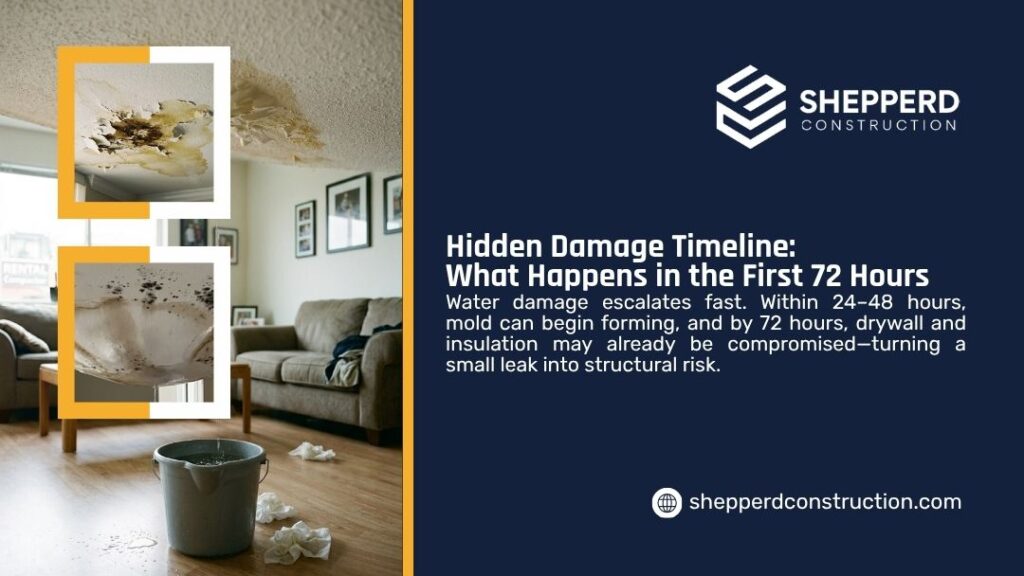
At first, it’s just a stain. Then the paint bubbles. Then the drywall softens. Give it time, and mold starts to form. The EPA notes that mold can begin developing within 24–48 hours of moisture exposure.
That’s the visible part. What you don’t see is often worse. Water can sit inside walls, soak insulation, and weaken structural components. This is where things shift from minor repair to something more serious. If mold has already taken hold, it helps to know what pushes remediation into full reconstruction before you approve any scope of work.
If you’re unsure whether your situation has crossed that line, understanding how to know if water damage requires reconstruction can help clarify the next steps and what level of repair may be necessary.
Repair vs Reconstruction: When a Simple Fix Isn’t Enough
Not every leak needs reconstruction. But some do, and recognizing the difference early matters. A repair addresses the visible issue. Reconstruction addresses the system failure behind it.
| Factor | Repair | Reconstruction |
| Scope | Localized fix | System-wide solution |
| Cost | Lower upfront | Higher but long-term stable |
| Longevity | Temporary | Long-term |
| Recurring risk | High if root cause remains | Significantly reduced |
| Structural involvement | Minimal | Often extensive |
When leaks repeat or spread across multiple units, repair alone rarely solves the issue. If moisture has already spread into structural systems, patchwork repairs won’t solve the problem. They hide it.
In larger condo buildings, recurring leaks often point to deeper issues, especially with the building envelope. That’s when reconstruction becomes necessary. You can see how this plays out in complex properties when considering when repair is not enough for a commercial building, where underlying issues go beyond surface fixes and require more comprehensive solutions to restore proper function and long-term stability.
Water Leak in Condo: Who Pays in Real-Life Scenarios
Real situations rarely follow clean rules.
Real Scenarios vs Who Pays
| Scenario | Who Typically Pays |
| Roof system failure | HOA |
| Leak from upstairs condo | Neighbor (if caused by their negligence, like leaving the tap running) / their insurance |
| Pipe inside the shared wall | Depends on governing documents (If it serves multiple units, then the HOA is responsible, or if it serves only one unit, then the owner) |
| Interior damage after a roof leak | Owner/insurance/shared |
How to Protect Yourself as a Condo Owner
Protection starts with awareness. Know what your policy covers before you need it. Understand your HOA’s responsibilities. Keep records of maintenance requests and communications.
When water leaks through the roof into my condo unit, timing matters. Acting early protects your position and limits escalation. Owners who document thoroughly and respond quickly tend to avoid the most costly outcomes.
How to Choose the Right Reconstruction Contractor for Complex Damage
Complex damage requires more than general contracting. Look for experience with multi-unit properties and building envelope systems. Projects involving HOAs, engineers, and insurance require coordination, not just labor.
A qualified contractor understands how to work alongside forensic engineers and navigate the technical side of reconstruction. That level of experience becomes critical when multiple stakeholders are involved.
When evaluating options, understanding how to choose a reconstruction contractor for large projects comes down to factors like experience with similar-scale work, proper licensing, clear timelines, and transparent cost structures.
Why Complex Condo Leaks Require More Than Basic Repairs
Condo buildings function as interconnected systems. A failure in one area often signals stress in others. Water leaking through roof into my condo unit may appear isolated, but it rarely is.
Leaks often expose weaknesses in waterproofing systems, drainage design, or structural components. Addressing only the visible issue leaves the underlying problem unresolved. That’s why repeat leaks happen.
In some cases, the difference between a storm-related issue and a construction defect becomes critical. This is where understanding construction defect vs storm damage determination for insurance purposes plays a role in how projects move forward.

When You Should Contact a Reconstruction Specialist in Texas
There’s a point where standard repairs stop making sense. If leaks persist, affect multiple units, or involve structural components, it’s time to involve specialists. Reconstruction requires a different level of analysis, one that looks beyond surface damage.
In Texas markets, especially in larger metro areas, experienced reconstruction teams understand local building conditions, climate impact, and regulatory requirements. Reaching out early often prevents long-term complications and repeated costs.
Construction Defect vs Normal Roof Leak: Why It Changes Everything
At first glance, most leaks look the same. Water shows up, damage spreads, and repairs begin. But the cause matters.
A normal roof leak usually comes from wear and tear, aging materials, weather exposure, or maintenance gaps. These are straightforward to address. A construction defect is different. It originates from how the building was designed or built.
That distinction affects who is responsible, how insurance responds, and whether legal action is involved. In larger condo projects, identifying this difference early often determines whether the solution is a simple repair or a coordinated reconstruction effort involving engineers and multiple stakeholders.
FAQs
Who is responsible for the water leaking through roof into my condo unit?
In most cases, the HOA is responsible for the roof since it is a common element. However, interior damage inside your unit may still fall on you or your insurance, depending on the governing documents.
Does condo insurance cover water leaking through roof into my condo unit?
Condo insurance often covers interior water damage if the leak is sudden. Long-term leaks caused by neglect may not be covered.
Is the HOA responsible for water damage inside my unit?
Sometimes. The HOA usually fixes the roof, but interior damage may only be covered if the policy includes it. Many associations limit coverage to structural components.
What should I do first if my condo ceiling is leaking?
Contain the water, document the damage with photos, and notify your condo association immediately. Early action protects your claim and limits damage.
Can a leak from another condo unit look like a roof leak?
Yes. Water from upstairs units often travels through walls and ceilings, making it appear like a roof issue when it isn’t.
When does a condo roof leak require reconstruction instead of repair?
If water has affected structural elements or continues to return after repairs, reconstruction may be necessary to address the root problem.
Does HOA insurance cover roof leaks completely?
HOA insurance typically covers the roof itself, but not always the interior damage within individual units.
What to Do Next If Water Is Leaking Through Your Condo Roof
Water leaking through roof into my condo unit isn’t something you ignore and hope it resolves. Start by controlling the immediate damage. Document everything. Notify your HOA.
Then take a step back and assess the bigger issue. If the problem runs deeper than surface damage, getting the right expertise involved early can save time, money, and repeat repairs.If you’re dealing with a situation that doesn’t seem straightforward, reach out to the Shepperd Construction team. They can help you understand what’s really happening, and what should happen next. Because fixing what you see is one thing. Fixing what caused it is something else entirely.