
If you manage a Texas HOA or multifamily property, asphalt shingle roofing affects reserve planning, resident communication, and the cost of a future replacement. This guide compares 3-tab, architectural, and luxury shingles, explains the complete roof assembly, and shows how Texas heat, hail, and installation quality affect service life.
Asphalt Shingle Roofing at a Glance
The table below is a planning aid only. Actual performance and cost depend on the selected product, installation system, roof exposure, existing conditions, and maintenance.
| Shingle type | Construction | Approximate planning life | Relative initial cost | Common planning consideration |
|---|---|---|---|---|
| 3-tab | Single-layer strip shingle | About 15–20 years under favorable conditions | Lower | Like-for-like replacement and visual matching |
| Architectural | Laminated dimensional shingle | About 20–30 years under favorable conditions | Moderate | Common option for sloped HOA and multifamily properties, subject to site-specific review |
| Luxury/designer | Heavier, multilayer shingle | Product-specific; verify current manufacturer data | Higher | Appearance-driven communities where slate or shake aesthetics matter |
Impact resistance is a performance characteristic, not a fourth shingle type. Certain architectural and designer products may be available with impact-resistance classifications.
What an Asphalt Shingle Roof System Includes
Most modern asphalt shingles use a fiberglass mat saturated and coated with asphalt, then surfaced with ceramic-coated mineral granules for color and UV protection.
The shingle is the visible roof covering, not the complete roof system. A typical assembly also includes the roof deck or sheathing, underlayment, drip edge, starter shingles, valley and penetration details, flashing, hip and ridge caps, and balanced ventilation.
When you weigh repair against replacement across a multi-building community, you are evaluating that whole assembly, not a brand of shingle. Two proposals for the same roof can differ dramatically when their included assemblies, deck allowances, access requirements, protection measures, and phasing are different.
For a component-by-component overview, review the Asphalt Roofing Manufacturers Association roof-system guide.
Are Asphalt Shingles Right for a Texas HOA or Multifamily Property?

Asphalt shingles are generally used on steep-slope roofs. A multifamily or commercial property may also contain low-slope roof areas that require another system, such as TPO, modified bitumen, or standing-seam metal. Confirm the roof type, slope, existing assembly, local code, and manufacturer requirements before selecting a product.
For HOA and townhome communities, product selection should also account for governing documents, visual continuity, reserve planning, hail and wind exposure, budget, and the practical requirements of phased work in occupied areas. Shepperd also provides multifamily reconstruction services for properties where roofing conditions are connected to broader building-envelope or interior repairs.
3 Asphalt Shingle Types for Texas Properties

3-Tab (Strip) Shingles
Single-layer, flat, uniform. They are usually the lightest and least expensive option, but wind performance, warranty terms, and available impact-resistant options vary by product and installation system.
Plenty of older builder-grade multifamily stock in Texas still wears them, and they still make sense for like-for-like replacement or for matching an existing phase where the architectural committee requires visual continuity.
Architectural (Dimensional) Shingles
Architectural shingles use laminated layers that create shadow lines and a wood-shake appearance. They are generally heavier than 3-tab products and can offer stronger wind or impact options, but performance varies by product and installation system.
For HOA and multifamily reroofing, architectural shingles may be a practical baseline, but the existing design, governing documents, code, appearance requirements, budget, and complete product system should control the selection.
Impact resistance is a separate question from wind resistance. UL 2218 uses Classes 1 through 4, with Class 4 the highest classification in that test. A Class 4 label does not guarantee that a roof will avoid hail damage or that an insurer will offer a credit; confirm the current product documentation and policy terms.
Luxury (Designer) Shingles
Luxury or designer shingles use additional laminated material and are made to resemble slate or wood shake. They generally cost more, and their weight, warranty terms, and installation requirements vary by product; verify the current product data before specifying them.
Because of the weight, confirm deck condition and structural capacity before specifying them on an existing building. Best fit: communities where exterior appearance drives property value.
Roof Assembly Components That Control Performance
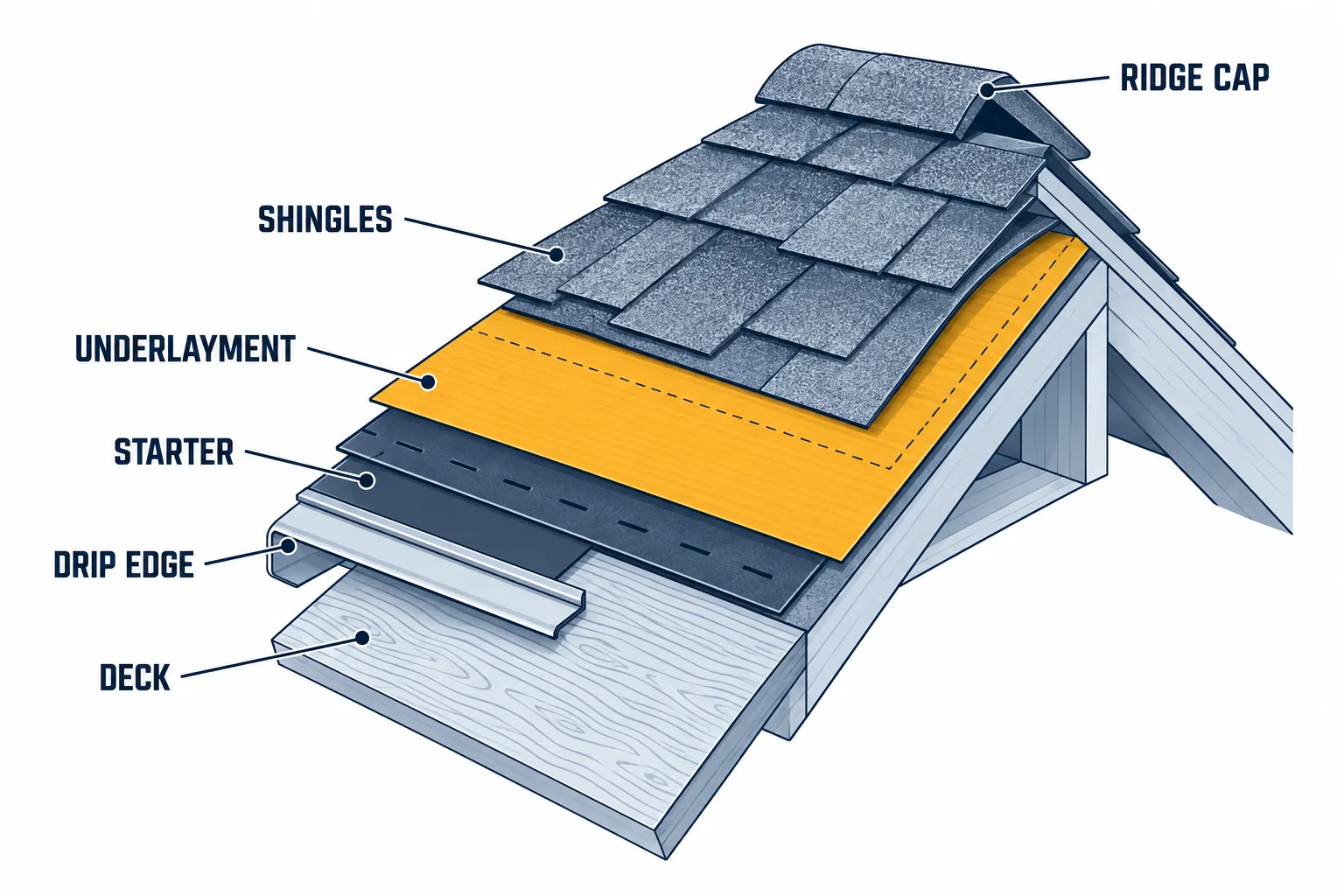
- Deck and fastener attachment. A new roof covering cannot correct deteriorated sheathing or inadequate fastening; identify those conditions and include them in the repair scope.
- Underlayment, felt or synthetic, as the secondary water barrier.
- Drip edge at eaves and rakes, integrated with the underlayment and flashing details where required.
- Self-adhered membrane at valleys, eaves, and vulnerable penetrations where required by the design, manufacturer, or code.
- Starter strips at eaves and rakes, so the first course resists wind uplift.
- Flashing at walls, chimneys, skylights, and vents, with proper step and counter flashing.
- Ridge cap and balanced ventilation, sized to the adopted code and the attic volume.
A roof covering can look intact while water enters at flashing, underlayment laps, valleys, or penetrations, so leak investigations should evaluate the full assembly.
Wind, Hail, and Impact Ratings Explained
Do not treat every roofing “class” as the same rating. ASTM D3161 and ASTM D7158 address wind resistance, while UL 2218 addresses impact resistance. Under ASTM D7158, products may be classified D, G, or H, but the mph values associated with those classes depend on the standard edition and the applicable wind map; use the current product documentation and local code.
Two checks matter here: identify the test standard, then verify that the proposed product is being installed as the tested system. A wind or impact result belongs to the tested product system and installation details, not to a shingle viewed in isolation. Changing the starter strip, ridge cap, fastener pattern, or required accessories can affect tested performance and warranty coverage.
Coastal and other high-wind locations may require different attachment and uplift design. Verify the property’s local code, building geometry, roof slope, and tested assembly before carrying a specification from one building to another.
For a plain-language explanation of roof wind and impact protection, review IBHS Roof 101.
Asphalt Shingle Roof Replacement Cost in Texas
Roofing is priced by the square, a unit of 100 square feet of roof surface, not 100 square feet of living area. Shingle type is only one cost input; on large or occupied properties, access, tear-off, deck condition, phasing, protection, and disposal can materially affect the total.
Pitch, number of stories, tear-off layers, deck repair, site access and staging, and the number of flashings and penetrations can move the total more than the shingle style alone. On HOA and multifamily work, also budget for phasing, resident notification, vehicle protection, parking control, and debris management.
When one bid is far below the others, review its exclusions and allowances. Common differences include deck repairs, flashing replacement, starter strips, ridge accessories, disposal, site protection, and temporary weather protection.
For residential planning only, published Texas guides commonly show roughly $4–$8 per roof square foot installed for asphalt shingles, with premium and impact-resistant products often higher.
This is an external planning range, not a Shepperd quote, and occupied HOA or multifamily work can vary substantially because of access, phasing, protection, deck repairs, permits, and disposal. Confirm current local pricing before using the range in a reserve study or board proposal.
Asphalt Shingle Lifespan and Maintenance in Texas
A “30-year” or “lifetime” shingle label describes a limited warranty category, not a promise that the roof will remain in service for that entire period. Heat, UV, thermal cycling, and hail all shorten real-world performance, and poor attic ventilation accelerates granule loss.
Approximate Planning Ranges
| Product category | Planning range |
|---|---|
| 3-tab shingles | Approximately 15–20 years under favorable conditions |
| Architectural shingles | Approximately 20–30 years under favorable conditions |
| Luxury or designer shingles | Product-specific; use current manufacturer documentation |
| Impact-resistant products | May improve resistance to tested impact conditions, but do not assume a longer service life |
These are planning ranges, not guarantees. Published Texas guidance varies, and actual service life depends on product, installation, ventilation, maintenance, heat, UV exposure, hail, wind, roof slope, and building conditions. Use the current manufacturer data sheet and a condition assessment for capital planning.
Walk the roofs for the signals: granules collecting at downspouts, curling or cupping tabs, backed-out fasteners, failed seal strips, deteriorated pipe boots. For an HOA or multifamily roof program, schedule condition inspections based on roof age and exposure, then document the roof after significant hail or wind events with dated photos, leak locations, repairs, and warranty records.
Keep gutters and valleys clear, put pipe boots on a replacement schedule instead of waiting for a call, and repair small flashing issues before water reaches the deck, framing, insulation, and the units below.
Age plus documented condition should drive the capital plan; age alone produces either premature spending or an emergency assessment.
When a Roof Leak Signals a Wider Building-Envelope Problem
By the time a roof gets attention, water damage may already be visible inside the building. A patch will not resolve moisture that has reached sheathing, framing, insulation, or drywall; those conditions need to be mapped before the repair scope is finalized.
Responsibility for the roof, interior finishes, and any insurance claim depends on the declaration, bylaws, policy language, and facts. Counsel and the carrier should answer coverage questions; the contractor’s role is to document conditions and execute the approved scope.
Repeat leaks across multiple buildings can indicate a shared detailing, drainage, or installation condition rather than isolated storm damage. When that pattern appears, place investigative testing, moisture mapping, and repair-cost documentation before finalizing the reconstruction scope.
Documenting the condition before pricing gives the owner, engineer, and counsel a clearer repair scope and a budget tied to observed conditions. As a reconstruction contractor, Shepperd can coordinate that work with forensic engineers and the owner’s advisers, then execute the approved repair.
For a related repair-versus-replacement framework, see When Does a Condo Building Roof Need to Be Fully Replaced?.
HOA Asphalt Shingle Roof Replacement Checklist
Ask for a written, line-item scope that identifies the shingle product and covers tear-off, underlayment, drip edge, flashing, starter, ridge caps, ventilation, deck repair allowances, disposal, site protection, and closeout documentation.
Confirm that the specified installation method and system accessories match the manufacturer’s current requirements; this supports warranty compliance and tested performance. For a phased HOA project, preconstruction should define resident notices, work zones, parking and vehicle protection, access, cleanup, escalation contacts, change-order procedures, and the reporting cadence.
A preconstruction review should test the design against field access, sequencing, existing conditions, and manufacturer requirements before installation begins.
For additional contractor-selection considerations, review How to Choose a Reconstruction Contractor for an HOA.
FAQs About Asphalt Shingle Roofing
What is asphalt shingle roofing?
Which asphalt shingles are best for Texas?
How long do asphalt shingles last in Texas?
What is the difference between Class 4 impact resistance and Class H wind resistance?
Can asphalt shingles be installed on a flat or low-slope roof?
What should an HOA roofing proposal include?
Does an HOA or insurance policy cover roof-leak damage?
Should an HOA repair or replace an asphalt shingle roof?
Discuss Your Texas Roof and Building-Envelope Scope
If you manage a Texas HOA, townhome community, or multifamily property with an aging or leaking steep-slope roof, discuss your project with Shepperd Construction to review the condition, preconstruction scope, testing needs, and phasing plan.
Shepperd has operated in Texas since 2014 and also performs broader building-envelope and reconstruction work; the team can help determine whether an asphalt shingle, commercial low-slope, or another system is appropriate for the property.
Written by Brett Grobarz, Vice President of Sales at Shepperd Construction, drawing on more than 16 years of experience across construction, development, and the building envelope, plus a Master’s Degree in Architecture.