
By Brett Grobarz, Vice President of Sales, Shepperd Construction
Building-envelope defects may appear years after closeout. A roof can pass a walk-through and begin leaking later. Waterproofing behind cladding can fail over time, while window-flashing problems may not show up until after several storm seasons. By the time water reaches interior finishes, owners may face multiple deadlines.
This guide is for building owners, HOA boards, and community association property managers. It provides general information, not legal advice. It helps readers organize records and ask a Texas construction attorney informed questions.
Why the Texas Statute of Repose Matters to Building Owners
A statute of repose generally sets a filing deadline measured from a specified event, such as substantial completion, rather than from when a defect is discovered. The applicable deadline can depend on the type of defendant, the property, the work, and the date of the project. Owners should ask counsel to identify the relevant dates before relying on a general rule.
Related readingTexas Construction Insights & Articles | Shepperd ConstructionRead the guide →What Is the Statute of Repose for Construction Defects in Texas?
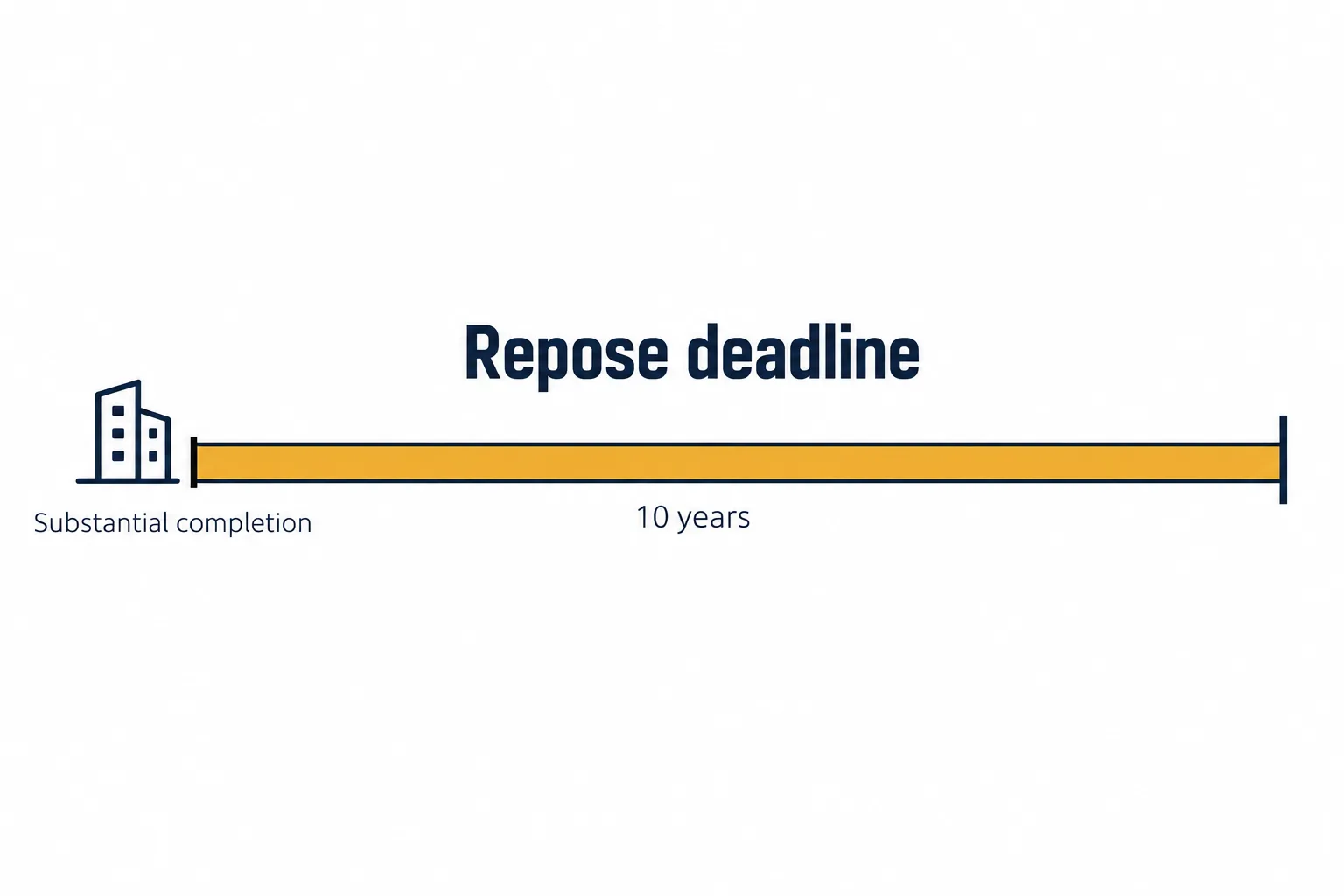
Texas has statutes of repose for certain construction claims in Chapter 16 of the Civil Practice and Remedies Code. Section 16.008 addresses certain claims against licensed design professionals, including architects and engineers who design, plan, or inspect improvements. Section 16.009 addresses certain claims against people who construct or repair improvements to real property.
For many covered private-party claims, the period is 10 years after substantial completion of the relevant improvement. The statutes also provide different rules for some governmental claims and a narrow residential-construction provision that may reduce the period to six years when a contractor provides a qualifying written warranty for a statutorily defined residence. That six-year provision does not automatically apply to every HOA, condominium, or apartment project. Counsel should check the statute, the project dates, the contract, and the warranty. The 2023 amendment has specific effective-date conditions; the State Bar of Texas summary of the change provides background.
At a Glance: Which Texas Repose Statute May Apply?
This table is a starting point only. Counsel should confirm the defendant, claim, improvement, and applicable version of the law.
| Statute | Who it addresses | General statutory framework |
|---|---|---|
| §16.008 | Certain registered or licensed design professionals who design, plan, or inspect improvements | Generally 10 years from substantial completion or, for covered equipment, the beginning of operation; different rules apply to some governmental claims. |
| §16.009 | Certain people who construct or repair improvements to real property | Generally 10 years from substantial completion for covered private claims; different rules apply to governmental claims and certain statutorily defined residential work. |
The table does not determine which deadline applies to an HOA, condo, or apartment project.
What “Substantial Completion” Means and Why the Date Gets Disputed
Substantial completion is not automatically the move-in date, the final payment date, or the date on a certificate of occupancy. For phased developments, condominium communities with several buildings, or projects completed by multiple contractors, the relevant date may depend on the improvement and work at issue. A later repair may also raise a separate question about the scope and completion date of that work.
A practical step for every HOA manager and owner:
- Locate closeout documents and any certificates of substantial completion.
- Record warranty start dates for roofing, waterproofing, and windows.
- Keep contracts, change orders, repair records, and completion documents in the association’s permanent files, not only in a departing manager’s inbox.
How a particular date is determined is a legal question. Bring the documents to counsel and let them make that call.
Can a Written Claim Extend the Repose Period?
In some circumstances, yes. Section 16.009 provides an extension when a claimant presents a qualifying written claim to the person who performed or furnished the construction or repair work during the applicable period. The extension is generally two years for claims under subsection (a), and one year for claims under subsections (a-1) or (a-2). Section 16.008 has its own written-claim extension rules for design professionals. Which provision applies, what the notice must include, and when it must be delivered are questions for counsel.
Section 16.009 also identifies circumstances in which it does not bar an action, including certain written warranties or contracts, claims against a person in actual possession or control when the damage occurs, and claims based on wilful misconduct or fraudulent concealment. These provisions are fact-specific; do not assume an exception applies without legal advice.
Statute of Repose vs. Statute of Limitations: How the Two Deadlines Work Together
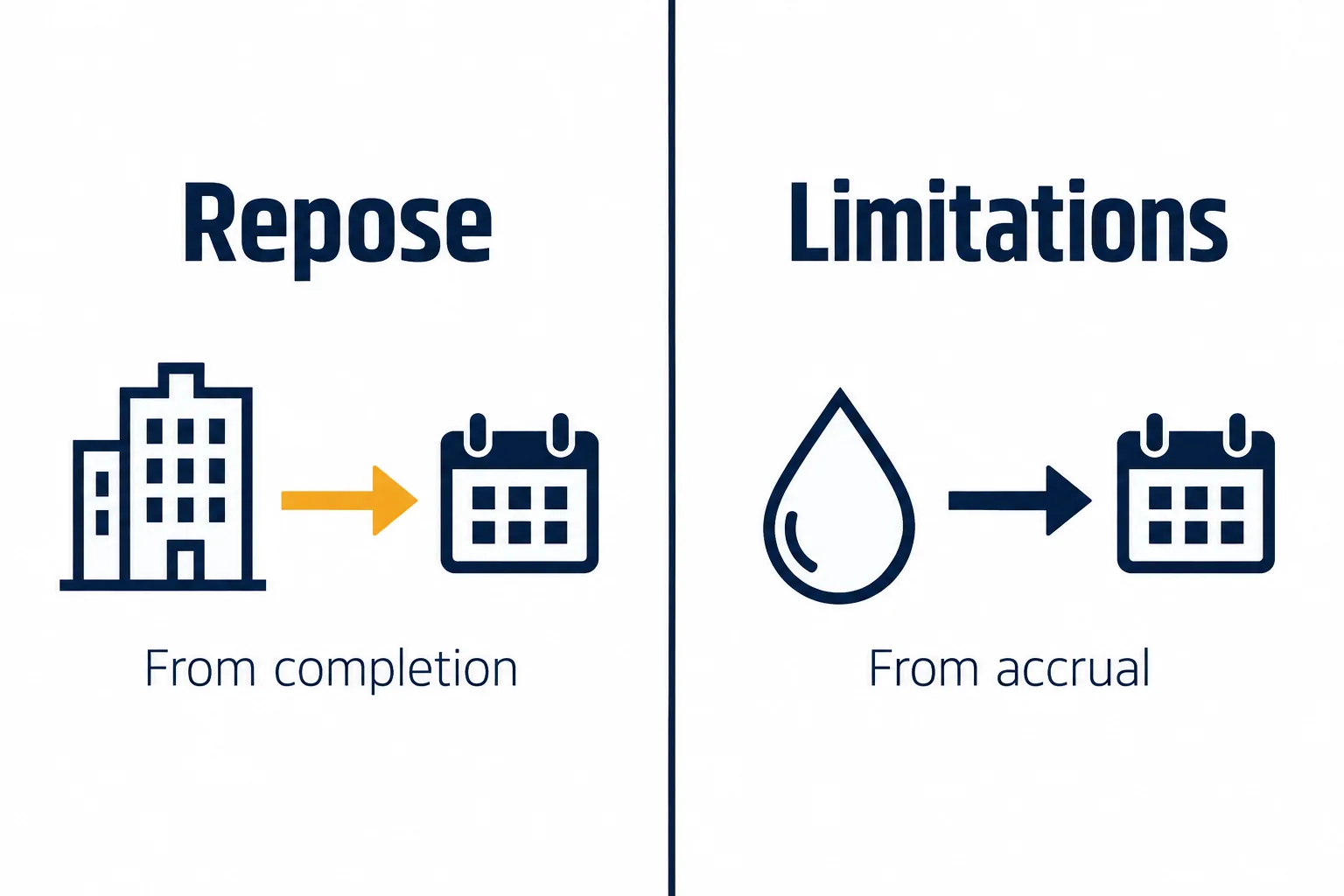
Owners often treat these as the same thing. They are not.
The statute of limitations depends on the type of claim. Negligence and property-damage claims generally carry a two-year period under Section 16.003, while some contract claims generally carry four years under Section 16.004. The applicable claim, accrual date, contract language, and any potential discovery-rule issue should be reviewed by counsel.
How they compare:
- Trigger: A limitations period generally runs from accrual of the claim. A discovery rule may affect accrual in some cases, but it does not apply automatically to every construction-defect claim. Repose generally runs from substantial completion or another event specified in the statute.
- Discovery rule: If it applies, it may affect when a limitations period begins. It does not automatically extend a statute-of-repose period.
- Written-claim extensions: The statutes set out specific extensions for qualifying written claims; the period depends on the provision that applies.
The takeaway: an owner can be inside the limitations period and still be outside repose, or the reverse.
Does the Residential Construction Liability Act Apply, and What Notice Does It Require?
Texas Property Code Chapter 27, the Residential Construction Liability Act (RCLA), can add notice, inspection, and settlement procedures to certain residential construction-defect claims. Its application depends on the statutory definitions of the property, claimant, and claim; it should not be assumed to cover every apartment building or HOA. Review the official Texas Property Code, Chapter 27.
When Chapter 27 applies, it generally requires written notice at least 60 days before filing suit or initiating arbitration. The contractor may request an opportunity to inspect, and the statute provides procedures for a repair or settlement offer. It also contains exceptions, including when earlier action is necessary to avoid expiration of a limitations period. Ask counsel whether the Act applies and what steps are required for the specific property and claim.
What Is a One-Year Contractual Correction Period?
A “12-month defects liability period” is not a general statutory deadline in Texas. Some construction contracts include a correction period, often about a year after substantial completion, during which the contractor must address work that does not conform to the contract documents. The contract controls the actual terms.
A correction period, an express warranty, and statutory filing deadlines are separate provisions that may interact. A qualifying written warranty can also affect the statutory repose period for a narrow category of residential claims. Have counsel review the contract and warranty together with the applicable statutes. If you are sorting out who pays when a roof fails after a project, see our guide to roof warranty disputes after reconstruction.
When Should an HOA Investigate Roof Leaks and Envelope Defects?
When a condo roof leaks, the first question is usually whether the HOA is responsible for the water damage. Governing documents typically allocate responsibility for common elements such as roofs and exterior walls, so boards should start with their declaration.
Recurring leaks in a building approaching a possible repose deadline deserve a documented investigation, not another round of patching alone. Coordinate with counsel and the forensic engineer before permanent repairs alter conditions that may need to be documented. Emergency measures to protect residents and prevent further damage may still be necessary; ask counsel and the project professionals how to record them.
A Step-by-Step Checklist for Owners Facing a Repose Deadline
- Gather records. Completion dates, contracts, warranties, change orders, repair scopes, maintenance records, and leak logs.
- Document conditions. Dated photos, moisture readings, and leak reports tied to specific locations.
- Engage a forensic engineer to evaluate the cause and identify any investigation needed.
- Consult a Texas construction-defect attorney about deadlines, notice requirements, and evidence preservation.
- Coordinate investigative testing and cost-of-repair support with the attorney, engineer, and reconstruction contractor.
- Plan interim protective repairs that limit further damage while documenting conditions and preserving evidence where practical.
This checklist is general information. It cannot determine which deadlines apply or predict a legal or financial outcome.
Where a Reconstruction Contractor Fits in the Timeline
Shepperd Construction is a Texas general contractor focused on reconstruction. We work alongside forensic engineers and construction defect attorneys to support investigative testing and data gathering, and we prepare cost-of-repair estimates for building owners. The forensic engineer evaluates cause and technical findings; the attorney advises on legal rights and deadlines. Shepperd can support testing access, documentation, repair planning, and reconstruction when authorized.
That can include coordinating testing openings at the direction of the project professionals, documenting existing conditions, and flagging constructability issues during planning. Shepperd’s role is to support the investigation and repair process, not to replace independent engineering or legal advice. Boards can also review how to choose a reconstruction contractor for an HOA when comparing firms for the repair phase.
Our Vice President of Sales, Brett Grobarz, brings more than 16 years of experience across construction, development, and building-envelope work, along with a master’s degree in architecture. That experience helps connect design intent with construction planning. Shepperd has worked in Texas reconstruction for more than a decade. Learn more about Shepperd’s HOA reconstruction and litigation-support work.
Frequently asked questions
Does Texas have a statute of repose for construction defects?
Does the 10-year period apply to every apartment, condo, or HOA project?
Can a written claim extend the Texas statute of repose?
What is the statute of limitations for construction defects in Texas?
Does discovering a defect late extend the statute of repose?
Is a one-year correction period the same as the statute of repose?
Who is responsible for a condo roof leak, the HOA or the unit owner?
What records should an HOA gather first?
Start the Conversation Early
If your building has recurring envelope problems and project deadlines may matter, early documentation can help your attorney and engineer assess next steps. Shepperd Construction works with owners, HOA managers, and their advisors on investigative testing support, cost-of-repair estimates, and building-envelope reconstruction across Texas. Start a conversation with our team to discuss the reconstruction work your building may need.