A roof warranty dispute after reconstruction who is responsible often depends on the contract, warranty terms, cause of failure, maintenance records, and who touched the roof after the work. In this article, we explore how responsibility may fall on the roofer, reconstruction contractor, manufacturer, HOA, building owner, insurer, or another party, and why Texas property teams need a cause-first review before blame starts.
Roof Warranty Dispute After Reconstruction Who Is Responsible
A roof warranty dispute after reconstruction who is responsible starts with one question that sounds basic but changes everything: what actually failed?
If the leak came from poor installation, the roofing contractor or reconstruction contractor may have responsibility under a workmanship warranty or contract. If the roof product failed even though it was installed correctly, the manufacturer may need to review the claim. If a third party cut into the roof for HVAC, solar, plumbing, signage, telecom, or access work, that party may be part of the problem.
If the owner, HOA, or property manager skipped required maintenance, ignored ponding water, failed to keep drain areas clear, or waited too long to report the issue, warranty coverage may face pushback.
Here’s the thing: after reconstruction, a roof is not just a roof. It is part of a larger building-envelope system. The answer depends on evidence, not assumptions.
For property managers and HOA boards, this can help: do not start with blame. Start with cause. Once the cause is clear, the responsible party is easier to identify.
Building Envelope Liability After Roof Repair
A roof warranty dispute after reconstruction can involve more than a roofing company. In reconstruction, the roof often connects to other exterior systems, including walls, deck coatings, waterproofing transitions, gutters, drains, scuppers, coping, expansion joints, and structural decks.
That is one reason these disputes feel frustrating. A contractor may have rebuilt the roof, but the leak may come from a wall above it. Or the roof may be fine, but a new mechanical curb may have damaged the membrane. Or the original reconstruction scope may not have included a hidden defect that later became visible.
This is where a reconstruction contractor with building-envelope experience matters. Shepperd Construction’s work is built around complex Texas reconstruction projects, not quick patches. The team works with owners, property managers, attorneys, and forensic engineers to document conditions, coordinate the right scope, and communicate clearly before the project drifts into finger-pointing.
| Cause Found After Reconstruction | Party That May Be Responsible | Why It Matters |
| Poor roof installation or missed flashing detail | Roofing contractor or reconstruction contractor | This may fall under workmanship, contract, or defect responsibility. |
| Failed roof product despite correct installation | Manufacturer | This may relate to a materials warranty, but only if warranty rules were met. |
| Design detail conflicts with warranty requirements | Design professional, owner, or project team depending on contract | A contractor may argue it followed the supplied plans. |
| Unauthorized roof penetration by another trade | Third-party contractor or vendor | Unauthorized work can weaken or void warranty coverage. |
| HOA or owner failed to maintain the roof | Owner, HOA, or property manager | Many warranties require maintenance logs, inspections, and fast notice. |
| Storm, hail, wind, or sudden weather event | Insurance carrier, owner, or contractor depending on facts | Warranty and insurance are different paths. |
| Leak caused by wall, window, balcony, or stucco failure | Building-envelope contractor or responsible maintenance party | The roof may not be the true source. |
A roof warranty is not a promise that every future leak will be fixed for free. It is a written commitment with limits, exclusions, notice rules, maintenance duties, and scope boundaries.
The Roofing Contractors Association of Texas puts it plainly: “After all, a warranty is only as good as the company that offers it.” That line matters because a warranty dispute is not only about paper. It is also about whether the contractor, manufacturer, owner, and project records can prove what happened.
Workmanship Warranty vs Manufacturer Warranty
Most roof warranty disputes become clearer once the parties separate workmanship from materials.
A workmanship warranty usually deals with labor. It may cover installation errors, poor flashing, bad tie-ins, improper fastening, missing sealant details, or work that did not match the agreed scope. A manufacturer warranty usually deals with the roof product itself, such as the membrane, shingles, coating, underlayment, or roof system material.
But manufacturer warranties often exclude poor installation, maintenance failure, unauthorized changes, damage by other trades, or work that did not follow the approved system.
That distinction matters after reconstruction because one building can have several warranties at the same time. The original roof may have had a manufacturer warranty. The reconstruction contractor may have issued a workmanship warranty. A waterproofing subcontractor may have separate coverage. An engineer or consultant may have prepared the repair scope. The HOA or owner may also have maintenance obligations.
A roof warranty dispute after reconstruction should not be handled by guesswork. The first step is to gather the documents and sort them by purpose.
| Warranty or Document | What It Usually Controls | What to Check First |
| Contractor workmanship warranty | Labor quality and installation defects | Term length, exclusions, notice method, repair rights |
| Manufacturer warranty | Product or system performance | Approved installer status, registration, inspection rules |
| Reconstruction contract | Scope, exclusions, change orders, dispute process | Whether the disputed area was included in the work |
| HOA governing documents | Common element and owner duties | Roof, deck, wall, balcony, and interior repair responsibility |
| Insurance policy | Covered storm or sudden loss | Deductible, exclusions, notice deadlines, cause of loss |
| Engineering or consultant report | Observed cause and repair scope | Whether the roof was the source or only one affected area |
This is where many disputes go sideways. Someone says, “The roof was rebuilt, so the contractor must fix it.” Maybe. But if the new leak came from an owner-approved satellite mount, clogged drain, wall defect, storm event, or detail outside the repair scope, the claim may not be that simple.
Construction Defects and Warranty Disputes
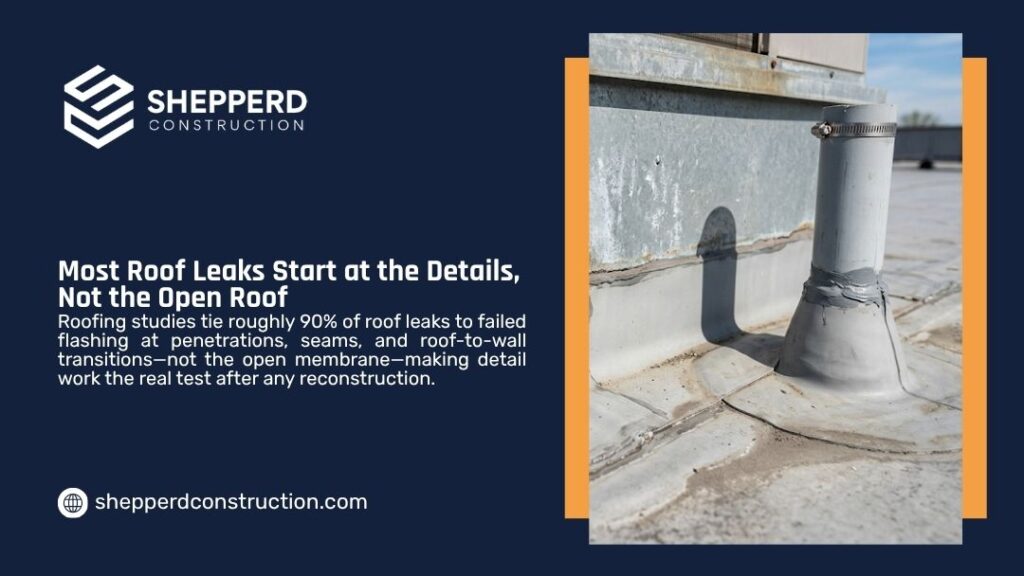
Construction defects are not always obvious on the day a project ends. A roof can pass a visual review and still fail later because of hidden moisture, deck movement, poor slope, weak transitions, bad drainage, or waterproofing that was never tied into the full envelope.
Texas construction defect disputes can also involve Chapter 27 of the Texas Property Code, especially in residential construction contexts. The statute defines a construction defect as a deficiency in the design, construction, or repair of a residence, alteration, repair, addition, or related appurtenance. The law also includes notice and settlement procedures before certain claims move forward.
That does not mean every roof warranty problem is a lawsuit. In fact, most responsible property teams want the opposite. They want a clean answer, a clear repair scope, and a path that protects residents, tenants, budgets, and building value.
This is where Shepperd’s preconstruction mindset fits the issue. On complex reconstruction work, the planning phase is not a formality. It is where the team reviews known conditions, likely risk points, access issues, communication needs, repair sequencing, resident impact, and documentation standards before work begins.
For commercial buildings, multifamily properties, and HOA communities, a vague complaint such as “the roof still leaks” often does not help much. A stronger notice explains when the leak happened, where water appeared, what weather or work came before it, what prior repairs exist, and what evidence supports the concern.
A careful project team will ask for photos, roof access logs, maintenance records, warranty certificates, infrared data if relevant, prior repair invoices, contract scope, and consultant reports. That record can help determine whether the issue is a covered defect, excluded damage, maintenance failure, storm loss, or new condition.
Are Roofers Responsible for Leaks After Reconstruction?
Are roofers responsible for leaks? Sometimes, yes. If a roofer caused the leak through defective work, improper materials, missed flashing, poor penetration details, failure to follow manufacturer requirements, or incomplete scope, responsibility may point back to that roofer. But that is not the whole story.
A roofing company may not be responsible for leaks caused by later unauthorized work, storm damage beyond warranty terms, neglected drains, heavy foot traffic, owner-directed shortcuts, design errors, structural movement, or work outside the contract scope.
So when a property team asks who is responsible after reconstruction, the better answer is this: responsibility follows the cause, the contract, and the warranty language.
For Texas owners and managers, contractor vetting also matters. Texas does not regulate roofing contractors in the same way it regulates some other trades at the state level. That makes insurance review, references, warranty clarity, scope detail, communication standards, and contractor experience even more important before major roof or reconstruction work.
Shepperd Construction’s Texas focus is a real advantage here. The company understands the state’s climate, building conditions, HOA concerns, commercial property pressures, and the communication demands that come with occupied reconstruction projects.
Roofing Company Unauthorized Work Legal Rights
Roofing company unauthorized work legal rights become important when a contractor performs work outside the approved scope, changes materials without consent, opens part of the roof without authority, or lets another trade alter a warranted roof system.
Unauthorized work can create two problems at once. First, it may damage the roof or building envelope. Second, it may give the original contractor or manufacturer a reason to deny warranty coverage.
For example, a building owner may hire an HVAC contractor after reconstruction to add rooftop equipment. If that contractor cuts into the membrane, modifies flashing, or adds curbs without coordination, the next leak may lead to a finger-pointing match. The roofer may say the roof was altered. The HVAC vendor may say the roof detail was already weak. The owner may say both should have known better.
The safer path is written coordination before any roof change. Every roof penetration, access hatch, curb, drain, vent, antenna, fall-protection anchor, and solar mount should have written approval from the right party. If a manufacturer warranty exists, the manufacturer’s process should be checked before the work starts. If an HOA controls the roof as a common element, the association should document who approved the work and who had authority to do so.

Are Roofing Companies Liable for Damage?
Are roofing companies liable for damage? They can be, but facts matter. Damage may include water intrusion, ruined insulation, interior finish repairs, ceiling damage, mold-related remediation, tenant disruption, resident complaints, or added repair costs caused by defective work.
The hard part is proof. A stain below the roof does not prove the roofer caused it. A leak after reconstruction does not prove the reconstruction contractor failed. Property teams need to know the difference between sequence and cause.
A good dispute file includes dated photos, leak maps, roof plans, weather data, maintenance logs, warranty papers, contract scope, inspection reports, and written correspondence. If the leak affects a condo, apartment complex, senior living center, student housing property, or HOA community, the file should also include governing documents and board-approved maintenance records.
NOAA’s billion-dollar disaster archive shows how often severe weather, hail, and high wind events affect Texas and surrounding states. That matters because roof warranty disputes often overlap with insurance claims after storm seasons. Warranty may deal with product or workmanship. Insurance may deal with a covered sudden loss. Those are different paths, and mixing them can slow the repair process.
Condo, HOA, and Property Manager Responsibility
In an HOA or condo project, roof responsibility often depends on whether the roof is a common element, limited common element, owner-maintained component, or part of a special reconstruction scope. Traditional condo roofs are often association-maintained, but townhomes, stacked condos, mixed-use buildings, and phased communities can be less clear.
For Texas communities, the governing documents matter. The declaration, bylaws, maintenance matrix, reserve study, prior repair history, and board minutes may all shape the answer. A property manager may coordinate repairs, but the association or owner may still hold the duty. A contractor may perform the work, but the warranty may require the owner to maintain drains, keep records, and report issues fast.
This is why Shepperd Construction’s work in HOA reconstruction services matters. Complex communities need a contractor that understands boards, residents, property managers, forensic engineers, attorneys, and the pressure that comes with occupied building repairs.
A property manager facing a large repair can refer to Shepperd’s guidance on how to manage a reconstruction project as a property manager, which provides context for communication, planning, and project control.
Lawyer for Roofers, Owners, or Associations: When Legal Help Makes Sense
A lawyer for roofers, owners, or associations may be needed when the claim involves major water damage, denied warranty coverage, construction defects, refused inspection access, unpaid invoices, unauthorized work, insurance overlap, or a dispute tied to litigation.
Shepperd Construction is not a law firm, and this article is not legal advice. But from a reconstruction standpoint, legal counsel often needs technical support. Attorneys may need cost-of-repair data, field documentation, destructive or investigative testing support, and a repair scope that makes sense outside the courtroom.
That is where a reconstruction contractor can help without trying to play lawyer. The contractor documents conditions, explains repair options, coordinates with engineers, and helps stakeholders understand what it may take to restore the building.
For complex properties, Shepperd’s broader reconstruction services show how preconstruction, communication, care, and repair execution connect on real projects.
What to Do Before the Dispute Gets Worse
A roof warranty dispute after reconstruction becomes harder to solve when the site changes before evidence is preserved. Owners and managers should slow down just enough to document the issue. That does not mean letting water continue to spread. It means separating emergency protection from permanent repair.
| Step | What to Do | Why It Helps |
| Preserve evidence | Take dated photos, keep damaged materials where practical, record leak locations | Helps show cause and timeline |
| Stop active damage | Use temporary protection, dry affected spaces, protect residents or tenants | Reduces loss and safety risk |
| Review documents | Pull contract, warranty, roof plan, maintenance logs, insurance policy, HOA documents | Clarifies duties and notice rules |
| Notify the right parties | Contact contractor, manufacturer, insurer, manager, board, or counsel as needed | Protects claim rights and avoids delay |
| Avoid unauthorized permanent repair | Do not let a new trade alter the roof without written approval | Prevents warranty denial arguments |
| Get technical review | Use a qualified reconstruction contractor, consultant, or forensic engineer when needed | Helps identify the true source |
If the building has active water damage, Shepperd’s information on when water damage requires reconstruction can help owners understand when a simple patch may not be enough.
How Reconstruction Contractors Help Resolve Roof Warranty Disputes
A reconstruction contractor does not decide legal liability. But the right contractor can make the dispute easier to understand.
On complex projects, the contractor may help expose hidden conditions, document failed assemblies, coordinate with engineers, price the repair scope, protect occupied spaces, and rebuild the affected system. That support is useful for property managers, attorneys, building owners, and forensic engineers who need facts, not hunches.
Shepperd Construction is built for this type of work. The company serves Texas clients dealing with building-envelope failures, construction defects, waterproofing problems, aging infrastructure, and post-litigation reconstruction needs. Its work depends on the same things that matter in a warranty dispute: careful planning, clear communication, technical knowledge, field documentation, and quality repair work.
Owners in major Texas markets can review Shepperd’s reconstruction work in Austin, Dallas, Fort Worth, and San Antonio.
The Answer Property Teams Need Before They Act
A roof warranty dispute after reconstruction over who is responsible usually comes down to five things: what the contract promised, what the warranty covers, what the evidence shows, who changed or maintained the roof after completion, and whether the leak came from the roof or another building-envelope component.
If the reconstruction contractor agreed to repair a specific roof area and that work failed due to poor workmanship, responsibility may point back to that contractor. If the product failed, the manufacturer may be involved. If the HOA or building owner failed to maintain the system, responsibility may shift. If an unauthorized trade damaged the roof, that contractor may be the problem. If the leak came from a wall, balcony, coping, drain, or window assembly, the “roof warranty” may not be the right claim at all.
For Texas property managers, HOA boards, building owners, attorneys, and engineers, the smartest move is not to argue from the ceiling stain. Start with the records. Confirm the scope. Preserve the evidence. Map the water path. Then bring in the right technical team.
Shepperd Construction helps Texas property teams deal with complex reconstruction, building-envelope repair, water intrusion, and litigation-sensitive project conditions. If your property is facing a roof warranty dispute after reconstruction and responsibility is unclear, contact Shepperd Construction through the company’s project consultation to discuss the documentation, scope, and next repair steps.