
By Brett Grobarz, Vice President of Sales, Shepperd Construction. Brett brings more than 16 years of experience across the construction, development, and building-envelope industries and holds a Master’s Degree in Architecture.
A failed balcony, a roof that has leaked into upper units for two seasons, sealant joints that gave up years ago: reconstruction problems rarely arrive on budget. When the reserve study did not plan for them, and insurance covers only part of the work, the board’s next conversation is about a special assessment.
For a Texas property manager, that conversation carries weight. You present the number, answer owner emails, field questions at the meeting, and administer payments. This guide explains how a Texas HOA special assessment for reconstruction may be authorized, what to verify in the governing documents, and how to connect the project scope with a clear funding plan.
Nothing here is legal advice. Treat it as orientation before you sit down with association counsel.
Quick answer: For a property owners’ association covered by Chapter 209, the board must consider or vote on adopting or increasing a special assessment at an open board meeting with prior notice. That does not mean every assessment requires an owner vote; check the governing documents. Condominiums follow a separate statutory framework.
What a Reconstruction Special Assessment Is (and How It Differs From Dues and Reserves)
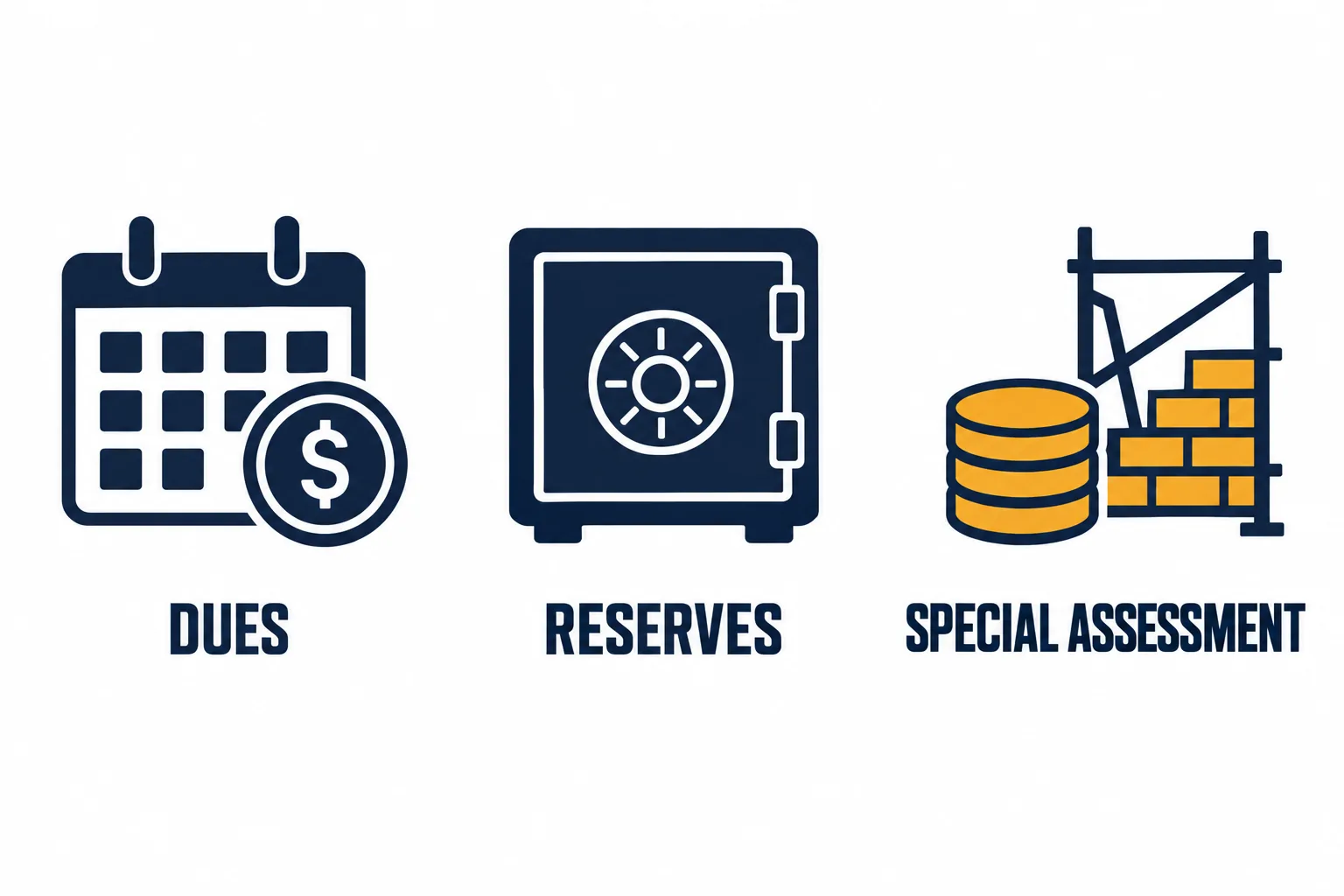
A special assessment is a one-time or temporary charge levied on owners to cover a cost the association cannot pay from its regular budget or reserves. The association’s authority, allocation method, approval process, and payment terms depend on the governing documents and applicable law. It sits alongside the two funding sources owners already know:
| Funding source | What it covers |
|---|---|
| Regular dues | The operating budget: management, landscaping, utilities, routine maintenance, and insurance premiums. |
| Reserve funds | Predictable capital replacement, such as roofs, paving, and mechanical systems reaching the end of their service life. |
| Special assessments | The gap when a cost is too high, too sudden, or never planned for. |
Reconstruction can require substantial funding when structural, waterproofing, or building-envelope conditions are discovered. A reserve study can plan for expected component replacement, while concealed deterioration may call for a separate condition assessment and project-specific scope.
We cover the relationship between reserves, assessments, and the board’s obligations in our article on reserve funds, special assessments, and fiduciary duty after a disaster, so this guide focuses on levying and administering the assessment itself.
Why Texas Associations Levy Special Assessments for Reconstruction
The triggers vary, but a handful show up again and again in Texas condominium and townhome communities.
Underfunded reserves. A reserve study is a planning tool based on its inventory, assumptions, and condition observations. It may not include the cost of concealed damage or a reconstruction scope that was not known when the study was prepared.
Insurance gaps. Deductibles on a multi-building community can be substantial. Coverage depends on the policy, cause of loss, and claim facts. Wear, deferred maintenance, or long-term water intrusion may not be covered, so confirm the available proceeds and deductible with the insurer before setting the funding plan.
Aging building envelopes. Roofs, balconies, sealants, windows, cladding, and waterproofing membranes all have finite service lives. Texas heat, sun exposure, and storm cycles shorten them.
Water intrusion that spreads. Condo water damage from a roof leak rarely stays in one unit. Water travels along framing and slabs, reaching shared walls, corridors, and units below before anyone sees a stain.
Scope growth after opening walls. Once cladding comes off, crews often find more deteriorated sheathing, framing, or flashing than a visual inspection suggested. Without a planned contingency, that growth becomes a second assessment.
Which Texas Rules Apply: Chapter 209, Condo Statutes, and Your Governing Documents

No single statewide rule governs every special assessment in Texas. Three layers usually matter:
- Chapter 209 of the Texas Property Code (the Texas Residential Property Owners Protection Act) applies to many residential subdivisions governed by a property owners’ association. It includes rules on open board meetings, owner access to records, voting procedures, and payment-plan guidelines for certain delinquent assessments.
- Condominium statutes. Condominium associations generally follow a separate framework under Chapters 81 or 82 of the Texas Property Code. The applicable chapter can depend on the condominium’s creation date and governing documents, so counsel should confirm which rules apply. Review Chapter 82 of the Texas Property Code.
- Your governing documents. The declaration, bylaws, and other dedicatory instruments usually set the authority to levy a special assessment, any dollar or percentage caps, voting thresholds, and how the cost is allocated among owners.
For a Chapter 209 property owners’ association, the statute sets certain procedural requirements. The declaration and other governing documents may add authority, voting, allocation, and notice requirements.
Approval and Voting Requirements
Separate the board’s required action from any owner approval. For a POA covered by Chapter 209, the board must consider or vote on adopting or increasing a special assessment at an open meeting after prior notice. Whether owners must also approve it depends on the governing documents and applicable law. If members vote, Chapter 209 ballot requirements may apply. Do not rely on a vote percentage quoted for another community; have counsel review your documents.
Governing documents may distinguish emergency repairs from discretionary improvements. If an unsafe condition or active intrusion needs prompt action, ask counsel to confirm the board’s authority and the required process while qualified professionals assess the building.
When a vote fails. A failed vote does not fix the building. Boards commonly respond by:
- Phasing the scope so the most urgent work proceeds first
- Exploring association loans to spread the cost over time
- Revising the operating budget or reserve contributions
- Re-presenting the assessment with better documentation, a clearer scope, and competing bids
If another vote is allowed, a clearer scope, cost basis, schedule, and records may help owners evaluate the proposal.
Notice, Open Meetings, and Owner Access to Records
Chapter 209’s transparency rules shape how an assessment should be presented. For POAs covered by Chapter 209, Texas Property Code §209.0051 addresses open board meetings, notice, and matters the board must consider or vote on in an open meeting. Exceptions and applicability depend on the association. Plan for owners to attend the meeting where the assessment is discussed and to ask questions.
Owners can also see the paper trail. For associations covered by Chapter 209, §209.005 governs owner access to certain association records. It does not mean every engineering report or privileged communication must be released; have counsel review records requests and exceptions. Assume engineering reports, scopes of work, bids, and budget figures tied to the assessment may be requested.
Practical steps for managers:
- Publish a summary of the engineering findings, the repair scope, and the bid comparison before the vote, not after.
- Keep minutes that record what was presented, what was decided, and why.
- Retain copies of every notice sent, with dates and delivery method.
- Confirm notice timing requirements for your community with counsel before scheduling the meeting.
Clear minutes, notices, and retained project records help document the board’s process.
Payment Plans and Collection Basics
Large reconstruction assessments strain household budgets. For a POA with more than 14 lots, Texas Property Code §209.0062 requires reasonable guidelines for an alternative payment schedule for delinquent regular or special assessments. The section includes limits on eligibility and plan length; confirm current requirements and association policy with counsel.
Fees, liens, and other collection remedies are governed by both statute and the governing documents, and the rules have changed over time. Verify current requirements with counsel rather than relying on an old collection policy.
Manager tip: Tell owners how to find the association’s payment-plan guidelines and whom to contact. Do not promise that a particular owner qualifies without checking the statute and association policy.
Do Owners Have to Pay a Special Assessment?
In general, an assessment properly adopted under the governing documents is an obligation of each owner, just like regular dues. Whether it was properly adopted typically turns on four questions:
- Authority: Do the governing documents allow this kind of assessment?
- Voting: Was any required owner approval obtained?
- Notice: Were owners notified as the documents and statute require?
- Procedure: Was the decision made at a properly called, open meeting and documented?
Owners with questions about their own obligation should talk with an attorney, and managers should route those questions to association counsel rather than answering them directly.
How Owners Can Review and Question an Assessment
Owners who question an assessment can start by reviewing the governing documents, requesting records through the applicable process, and raising questions at a properly noticed meeting.
- Read the declaration and bylaws to understand the board’s authority, caps, and voting requirements.
- Request records in writing, including the engineering report, scope of work, bids, and budget.
- Attend open board meetings and ask questions on the record.
- Put questions in writing so answers are documented.
- Use petition or special-meeting provisions where the governing documents let owners call a meeting or force a vote.
- Consult a Texas real estate or HOA attorney if they believe the assessment was not properly adopted.
For managers, respond with the available project records: the condition findings, defined scope, estimate assumptions, funding sources, and approval steps. Direct legal questions about the assessment to association counsel.
Building a Well-Supported Assessment Budget: Scope Before Dollars
A clear project scope and estimate give owners a basis to understand the proposed amount. A single early walkthrough may not account for concealed conditions, access, phasing, or resident protection.
A useful sequence is:
- Engineering assessment. An engineer evaluates conditions and cause within the agreed scope and identifies further evaluation that may be needed.
- Investigative testing. With the engineer’s direction, water testing, moisture mapping, or targeted openings can help document concealed conditions.
- Defined repair scope. The engineer’s findings inform a written scope with clear boundaries and repair details.
- Cost-of-repair estimate. A reconstruction contractor prices the scope, including appropriate allowances for access, phasing, and protection.
- Funding decision. The board evaluates available funding, allocation rules, and approval requirements before setting the amount and payment schedule.
Several items are routinely left out of early estimates and resurface as surprises:
- Contingency for hidden conditions found once work begins
- Phasing costs when work is sequenced around occupied units
- Access costs such as scaffolding, swing stages, or lifts on difficult-access buildings
- Permitting, protection of finishes, and resident logistics
A simple funding worksheet can show how the requested assessment amount was reached:
Project budget + project-related costs − confirmed insurance proceeds − available reserves − approved financing = remaining funding gap.
Then apply the allocation method in the governing documents; the amount may not be divided equally among owners. Label assumptions clearly, especially when an insurance payment or final scope is not yet confirmed.
Preconstruction can help identify scope gaps before work starts. Hidden conditions may still require changes, so present estimate assumptions and contingency planning clearly rather than promising that change orders will be avoided.
This is where Shepperd Construction typically comes in. As a Texas reconstruction contractor, we partner with forensic engineers and owners’ advisors to perform investigative testing and provide cost-of-repair data. The engineer concludes; we help gather field information and turn the engineered scope into a buildable, priced plan. See our HOA reconstruction services for the types of preconstruction and reconstruction support we provide. For an example focused on a single building element, see how reconstruction gets scoped from inspection to rebuild on a failed balcony. If your board is weighing a larger project, our overview of the cost of full building reconstruction for HOA properties covers the major cost drivers.
Where Insurance Fits Into the Funding Plan
Include insurance in the funding analysis, but do not assume a claim will cover a particular repair or that proceeds will be available by the time work must begin. Confirm the deductible, coverage position, timing, and any uncovered scope with the insurer and counsel.
Project records such as dated photographs, testing documentation, engineering findings, and a defined scope can help explain both the claim and the funding request. Keep claim-related communications coordinated with the insurer and counsel. Our guide on building a strong HOA reconstruction insurance claim long before repairs begin covers that side in detail.
Water Leaks and Roof Damage: Association vs. Owner Responsibility
For a roof or plumbing leak, identify the source and review the declaration’s maintenance responsibilities before allocating repair costs.
Responsibility usually follows the maintenance allocation in the declaration. Common elements like the roof and exterior envelope are typically the association’s. Unit interiors and fixtures are often the owner’s. Limited common elements such as balconies or patios can go either way depending on the documents.
A ceiling stain could result from the roof, a failed window, a balcony membrane, or plumbing in another unit. Investigative testing can help identify the source; the governing documents and counsel determine responsibility and cost allocation.
How to Write an HOA Special Assessment Notice Letter
The notice letter is often the first thing owners read about the project, so it sets the tone. The exact legal notice requirements and timing vary by association and governing documents. As a communication checklist, a letter can include:
- Purpose: A plain-language description of the reconstruction work and why it is needed.
- Cost: The total project cost, the per-owner amount, and how the cost was allocated.
- Due dates: When payment is due, and whether installments are scheduled.
- Authority: Which provision of the governing documents allows the assessment and how approval was obtained.
- Payment plan: That an alternative payment schedule is available and how to request it.
- Records: Where owners can review the engineering report, scope of work, and bids.
- Contact and meeting: Who to contact with questions, and the date of any owner meeting.
Keep the tone factual. Do not speculate about fault, blame prior boards or builders, or predict the outcome of any claim. Have counsel review the letter before it goes out.
Keeping Owners Informed Once Reconstruction Starts
Collecting the assessment is only the start. Owners who paid want to see the work happen and know how it affects daily life.
A practical communication plan covers:
- Schedule: Phases, expected durations, and which buildings or elevations are affected when.
- Access impacts: Parking, walkways, balconies, and amenities that will close.
- Safety: Fall protection zones, scaffolding, and areas residents should avoid.
- Noise and work hours.
- Unit entry: How and when crews need access inside units, with advance notice.
- Progress updates: Regular updates tied to assessment spending, so owners see where their money goes.
The contractor, manager, and board each have a role in project communication. Agree on who sends notices, handles access questions, and shares schedule updates so residents receive consistent information.
My background spans architectural design and construction execution. In reconstruction, early coordination between the engineer’s design intent and construction conditions can surface constructability questions before work begins. That can help the team plan for scope decisions and communicate potential cost changes.
Frequently asked questions
What are the rules for HOA special assessments in Texas?
How can owners question an HOA special assessment?
Do owners have to pay an HOA special assessment?
How do you write an HOA special assessment letter?
Does every Texas HOA special assessment require an owner vote?
Can a Texas HOA special assessment be paid in installments?
Talk With a Texas Reconstruction Team Before You Set the Number
A second assessment can add financial strain and be harder to explain. A defined scope, documented estimate assumptions, and a clear funding plan can help the board present the proposed amount before owners vote.
For more than 12 years, Shepperd Construction has worked alongside forensic engineers, attorneys, and property managers across Texas on construction defect repair, building-envelope reconstruction, investigative testing, and cost-of-repair services. If your community needs project scope or reconstruction support, contact our team to discuss the building and possible next steps.