When a ceiling stains after a roof leak or a crack widens above a doorway, the first question is rarely the right one. Owners and property managers ask, “How bad does it look?” The question that actually matters is whether the building can still safely carry the loads it was designed to carry. Get that call wrong in one direction and you pay for a full rebuild that a targeted repair would have solved. Get it wrong in the other and you paint over a hidden hazard that keeps getting worse behind the drywall.
This guide lays out how professionals separate the two: what distinguishes a repair from a reconstruction, how to tell cosmetic damage from structural, the code and insurance thresholds that can force the decision for you, and, because so much of this plays out in Texas condos and multifamily buildings, who ends up responsible when the damage is shared.
Repair vs. Reconstruction: What Actually Separates Them
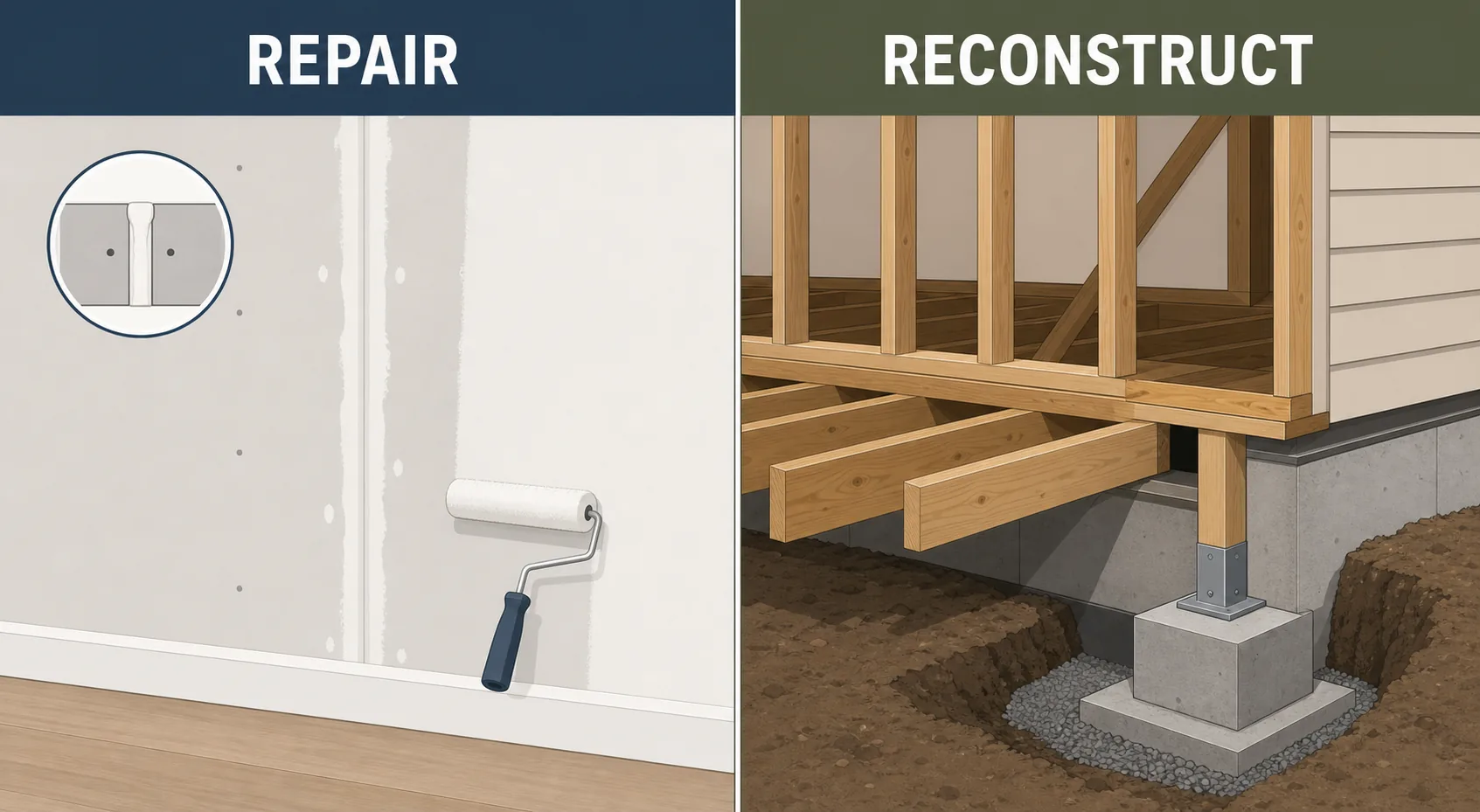
A repair restores damaged elements so the building is no less safe or sanitary than it was before the damage occurred. You replace the wet drywall, re-flash the roof, re-seal the failed joint. The structure itself was never in question, you’re addressing symptoms and surfaces.
Reconstruction goes further. It rebuilds the structural systems themselves, framing, sheathing, load paths, foundation elements, because strength, not just finish, has been lost. The distinction isn’t scale or cost first; it’s what failed. If the thing that failed only carries appearance, it’s a repair. If the thing that failed carries load, you’re in reconstruction territory.
The distinction isn’t scale or cost first; it’s what failed. If the thing that failed only carries appearance, it’s a repair. If the thing that failed carries load, you’re in reconstruction territory.
That framing answers two questions people ask constantly. A structural repair restores a load-bearing component to its intended capacity, reinforcing a joist, sistering a rotted rafter, repairing a cracked footing. Structural damage is any harm to those load-bearing components serious enough that they can no longer safely do their job.
What Counts as “Structural” Damage (and What Doesn’t)
Cosmetic and surface damage
Stained drywall, peeling paint, warped baseboard, a water ring on a ceiling, these are finish problems. The frame behind them is intact and dry. Once the source is fixed and the area dries, you replace the affected finishes and you’re done. This is the large majority of what property managers see, and it’s squarely repair work.
Structural damage
Compromised framing, rotted sheathing or floor joists, foundation movement, a roof structure that visibly sags or deflects, and large active cracks all point the other way. The test is simple to state and harder to judge: can the load-bearing elements still safely carry their design loads? When the answer is no, or maybe, you’ve crossed into structural territory.
Engineering literature has long drawn a related line between repairing damage and strengthening or rehabilitating a structure so it performs to a required standard; a foundational NIST/NEHRP report on the repair, strengthening, and rehabilitation of buildings treats these as distinct interventions rather than degrees of the same fix. That distinction is exactly the fork owners face. If you’re unsure which side of it your damage sits on, the signs that water damage requires reconstruction rather than repair are a useful checklist before anyone opens a wall.
| Cosmetic / surface damage | Structural damage |
|---|---|
| Stained drywall, peeling paint, warped baseboard, water ring on a ceiling | Compromised framing, rotted sheathing or floor joists |
| Frame behind is intact and dry | Foundation movement; roof structure that sags or deflects |
| Fix the source, dry the area, replace finishes | Large active cracks; load-bearing elements may fail their design loads |
| The large majority of what property managers see; squarely repair work | When load-bearing elements can no longer safely carry loads, it’s reconstruction territory |
Water Damage: The Most Common Trigger in Condos and Multifamily
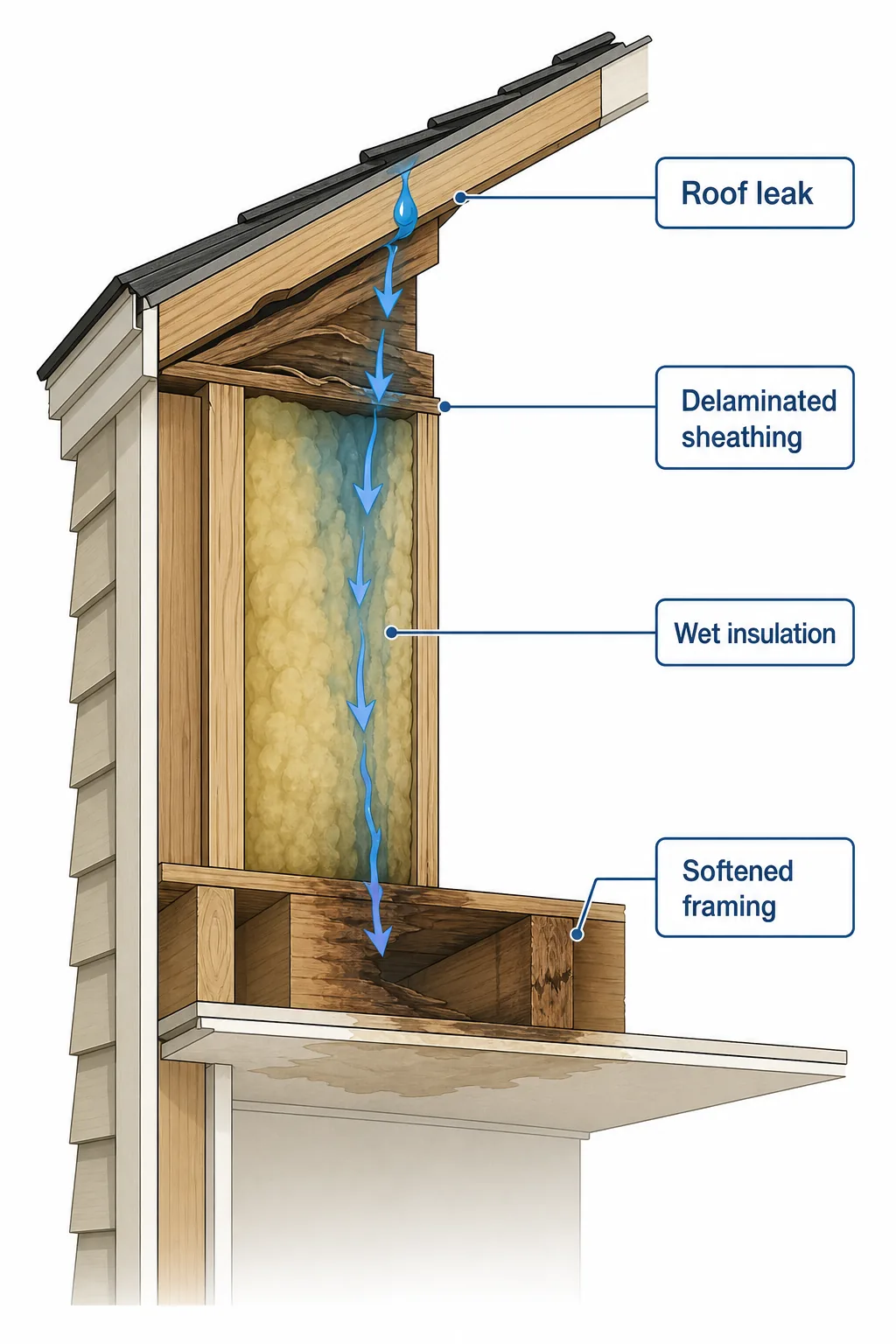
In HOA and multifamily buildings, water is the recurring culprit. Roof leaks, failed flat-roof membranes, and, more often than owners expect, water intrusion during a reroof or replacement job send moisture into ceilings and wall cavities that were never designed to get wet. A slow leak above a shared wall can run for months before anyone sees a stain.
Surface-level water damage
If water reached a finished surface, the source is fixed, and the framing behind it dries fully with sound moisture readings, you repair. The footprint on the ceiling can look alarming and still be entirely cosmetic.
Hidden and progressive water damage
The dangerous cases are the quiet ones: moisture wicking into wall cavities, saturated insulation that never dries, sheathing that delaminates, chronic slow leaks that soften framing over time. Here the visible damage understates the real damage. This is where repair stops being enough and reconstruction becomes the honest answer.
Mold and sustained moisture
When materials stay saturated, microbial growth follows, and porous building components can’t simply be cleaned and left in place. Sustained moisture that has fed mold usually means tear-out well beyond a cosmetic patch, removing and rebuilding the affected assemblies rather than surface-treating them.
The theme across all three: duration and concealment matter more than the visible footprint. A small stain from a two-year-old leak is often worse than a large stain from last week’s storm.
The Thresholds That Force the Decision (Code, the 50% Rule, and Insurance)
Sometimes the engineering is ambiguous but the rules are not. Regulation and economics can set the repair-versus-reconstruct line for you.
The “no less safe than before” standard
The baseline for a genuine repair is that the repaired condition be no less safe or sanitary than the pre-damage condition. Meet that and, in many cases, you can repair in kind without triggering broader upgrades.
Substantial damage and the 50% rule
Once the cost to repair approaches or exceeds roughly half the structure’s value, the calculus changes. Under the National Flood Insurance Program, FEMA’s guidance on substantial improvement and substantial damage defines substantial damage as damage where restoring the building to its before-damaged condition would cost 50% or more of its market value, and buildings that cross that line in a flood hazard area must be brought into compliance with current requirements. At that point, “repair” effectively becomes reconstruction whether you wanted it to or not.
Substantial structural damage
Separately, codes define specific levels of substantial structural damage, thresholds of harm to lateral or vertical load-carrying systems that disqualify a project from being treated as a simple repair and pull in broader evaluation and upgrade obligations. This often answers the harder question owners ask: at what point is a building not worth fixing as-is? When the damage crosses these defined levels, the economics and the code tend to agree that rebuilding the system beats patching it.
How Cracks and Structural Movement Are Judged
Water gets most of the attention, but cracks are the other major signal, and in Texas they deserve their own conversation. Not every crack is a problem. Hairline cracks at drywall seams, shrinkage cracks in fresh concrete, and cosmetic cracking around openings are common and usually harmless.
The cracks that matter are active ones: cracks that widen over time, stair-step through masonry, run diagonally from window and door corners, or open and close with the seasons. In Texas’s expansive-clay soils, foundations rise and fall as moisture swings, and that movement shows up as cracking that tracks a real load-path or foundation problem. Crack width, pattern, and change over time, not the mere presence of a crack, determine whether epoxy injection and monitoring will do, or whether the structure needs rebuilding. Structural engineers formalize this through damage-state classification, and research such as a 2023 study in Engineering Structures on the seismic damage rates of buildings shows how severity is graded into discrete states, where higher damage levels call for interventions well beyond superficial repair.
How the Repair-vs-Reconstruct Decision Actually Gets Made
A defensible decision rests on evidence, not appearance. The assessment usually runs in this order:
- Visual inspection and moisture mapping to establish where water has traveled and how far.
- Exposing concealed conditions, opening ceilings and wall cavities to see framing, sheathing, and insulation directly rather than guessing.
- Structural evaluation of load paths to confirm whether load-bearing elements retain their capacity.
- Moisture and mold testing to distinguish dried-out surface damage from ongoing saturation.
- Cost-to-repair versus cost-to-rebuild analysis, weighed against the value of the structure.
- A code and floodplain check to catch any threshold, like the 50% rule, that removes the choice.
When you assess structural damage and estimate the work, the number is driven by the extent and location of affected load-bearing elements, moisture content and how long it’s been present, material and access costs, whether concealed conditions are likely to expand the scope once walls are open, and any code-mandated upgrades the damage level triggers. Careful documentation of conditions, photographs, moisture readings, structural findings, gives owners a decision grounded in data rather than a hunch, and it’s exactly the kind of evidence a reconstruction contractor working alongside engineers is built to gather.
Who’s Responsible When It’s a Condo or HOA Building?
For property managers, the engineering question is only half the problem. The other half is who pays. As a general framework, not legal advice, responsibility in a shared-ownership building is set by the governing documents (the CC&Rs) and by the master-versus-unit insurance structure. Roofs and common structural elements typically fall to the association, while interior finishes inside a unit often fall to the owner. So when a condo roof leaks and a ceiling comes down, the roof itself and the interior finishes below it may sit with different parties entirely.
The key point: the ownership question and the engineering question are separate. Whether the association or the owner pays is decided by the documents and the policies. Whether the damage needs a repair or a reconstruction is decided by the structure’s condition. Answer them independently, then bring them together. For larger portfolios and commercial assets, the same logic scales up, and knowing when repair is no longer enough for a commercial building helps boards and managers budget before a small problem forces a large one.
When Reconstruction Is the Right Call (and What It Involves)
Reconstruction is the answer when the evidence lines up behind it:
- Load paths are compromised, framing, joists, or foundation can’t safely carry design loads.
- Damage meets substantial or 50%-plus thresholds, or crosses defined substantial-structural-damage levels.
- Moisture is chronic and hidden, with saturation or mold beyond cosmetic patching.
- Cracks show active, ongoing structural movement.
- Code mandates upgrades that turn a repair into a rebuild.
A reconstruction scope for Texas multifamily or single-family buildings addresses the structure itself, reframing, sheathing, and load-path repair, along with waterproofing and building-envelope work so the same failure doesn’t return. Done properly, it’s built to last, not just to pass inspection. For homeowners specifically, our reconstruction contractors for single-family homes handle exactly this kind of structural and water-loss rebuild work.
If you’re weighing this decision on a real building, the fastest path to certainty is a professional assessment.