Two qualified contractors can look at the same stained ceiling and hand you two very different scopes: one wants to clean and dry, the other wants to open up the wall. The gap between those quotes has almost nothing to do with the size of the stain. It comes down to how far the moisture has actually traveled. This guide lays out the triggers that separate a contained mold remediation from full building reconstruction, and what each one means for who plans the work and who pays for it.
Remediation vs. Reconstruction: What Each Word Actually Means
These terms get used interchangeably in board meetings, and that confusion drives budgeting mistakes. Here is the plain-language version.
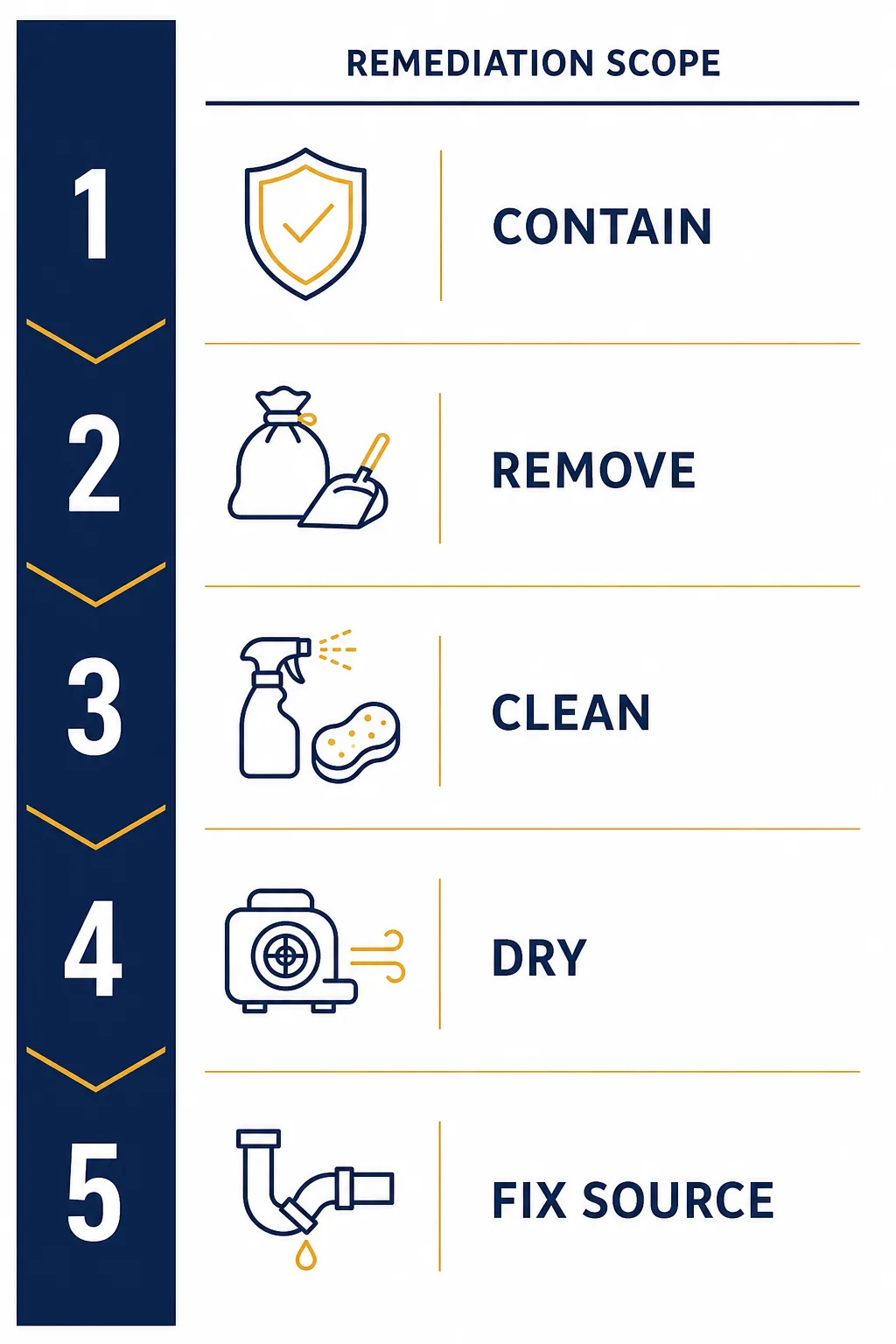
Mold remediation removes mold and, just as importantly, corrects the moisture source feeding it. It covers containment, cleaning, and drying of materials that can still be saved. The NCSU Environmental Health and Safety mold remediation guidelines frame the goal as controlling moisture and cleaning affected materials, not simply wiping visible growth off a surface. That last point is where mold removal differs: removal is surface-level and temporary, while remediation addresses the cause.
Full building reconstruction starts where salvage ends. It rebuilds structural framing, sheathing, waterproofing layers, and envelope assemblies once those materials can no longer be dried or restored. Remediation returns a space to a safe condition; reconstruction rebuilds the parts of the building that have failed. For an owner or property manager, the real question is not the definitions, it is the threshold: at what point does a cleanup become a rebuild?
| Mold remediation | Full building reconstruction | |
|---|---|---|
| What it does | Removes mold and corrects the moisture source feeding it | Rebuilds framing, sheathing, waterproofing, and envelope assemblies |
| Scope | Containment, cleaning, and drying of salvageable materials | Rebuilds the parts of the building that have failed |
| Goal | Returns a space to a safe condition | Rebuilds materials that can no longer be dried or restored |
What Triggers Mold Remediation (and Where It Stops Being Enough)
Remediation is the right call when three conditions line up: the growth is contained, the affected materials are structurally sound and salvageable, and the moisture source can be found and corrected. Meet those, and cleanup genuinely resolves the problem.
When remediation genuinely resolves the problem
Owners and managers often ask whether mold can ever be fully remediated, or whether the whole service is a rip-off. Done correctly, remediation works, and people live in the space afterward without issue. The catch is the moisture. Mold that comes back is almost never a cleaning failure; it is a water problem that was never fixed. The NIH Office of Research Services moisture and mold remediation procedures put moisture-source control at the center of durable results. So the honest answer to the skepticism is this: remediation earns its bad reputation only when a contractor cleans the mold and ignores the leak. Correct the water, save the intact materials, and the outcome holds.
Mold that comes back is almost never a cleaning failure; it is a water problem that was never fixed.
When materials are already saturated or compromised, cleaning them is treating a symptom, and that is the signal to look harder at whether the damage has crossed into reconstruction. If you are trying to gauge that line, our breakdown of when water damage requires more than surface repair walks through the warning signs.
What Triggers Full Building Reconstruction
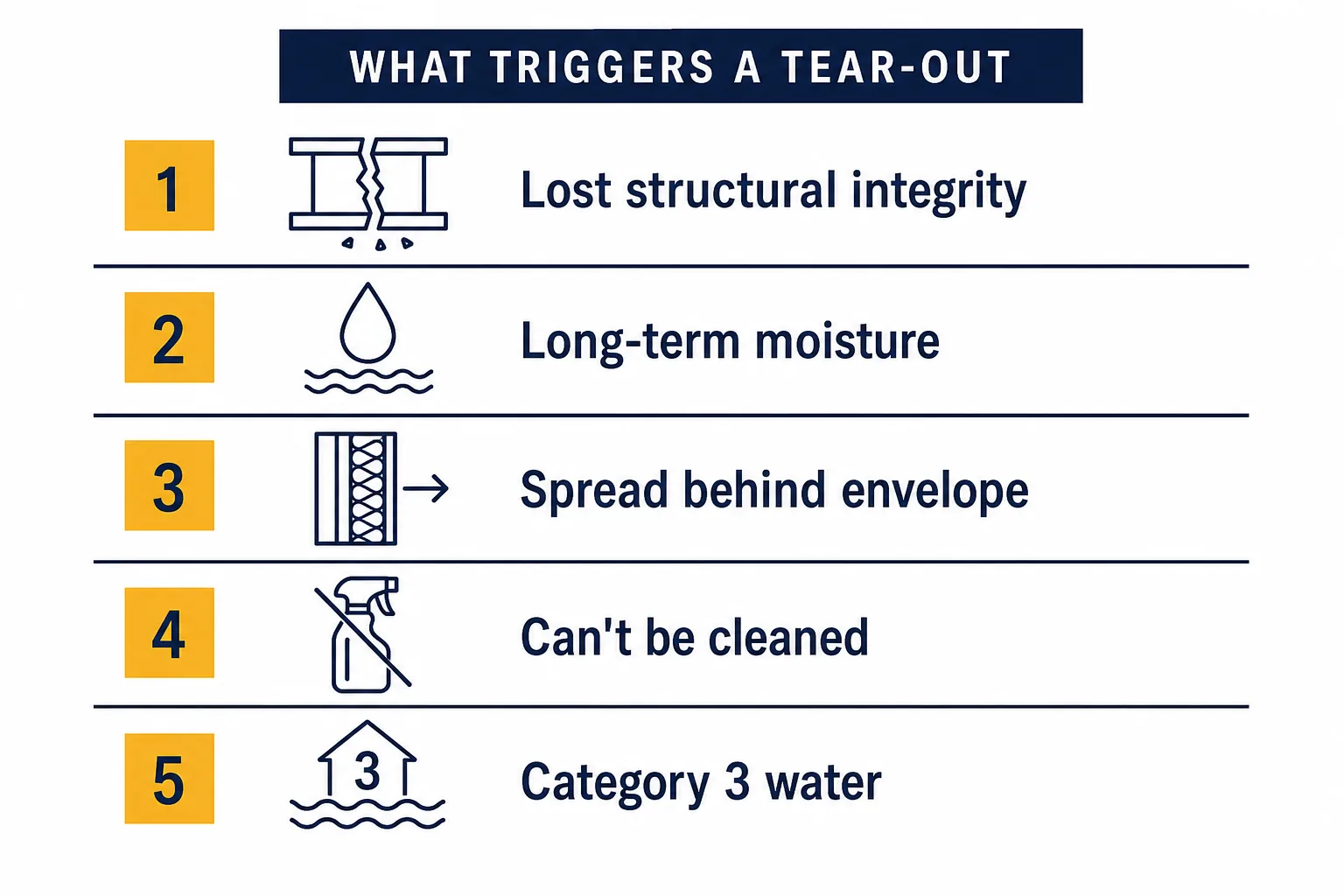
Reconstruction gets triggered when the damage has moved past the surface and into the parts of the building that hold water out and hold the structure up. The common triggers:
- Moisture that has penetrated structural framing, sheathing, or the building envelope
- Load-bearing or waterproofing assemblies that are compromised rather than just wet
- Saturation inside wall cavities or behind façade systems that cannot be dried or salvaged
- Growth that keeps returning to the same area, pointing to a systemic envelope or design issue
- Widespread material loss across gypsum, insulation, and subfloor that is well beyond spot repair
Materials also fail at different rates under sustained moisture, which is why a wet-drywall problem and a wet-sheathing problem are not the same conversation. A comparison of mold experiments on building materials in the journal Building and Environment documents how susceptibility varies by material, reinforcing why some assemblies come back after drying and others have to be replaced.
Building-envelope failure as the tipping point
The trigger that most often turns a cleanup into a reconstruction is envelope failure, and it is the one cleanup-focused contractors are least equipped to see. Water gets behind cladding, collects at wall-to-roof transitions, and moves through poorly detailed penetrations, all of it invisible until the assembly is opened. By the time mold shows on the interior finish, the water has often been working inside the envelope for a long time. This is the heart of reconstruction work: identifying and rebuilding the failed assembly, not just the drywall in front of it. Our overview of the main triggers for full building reconstruction after mold or water damage goes deeper on how those thresholds get evaluated.
Condo and Multifamily Reality: Roof Leaks, Ceilings, and Who’s Responsible
In a single-family home, a leak is one owner’s problem. In a condo or apartment building, one roof leak can become a building-wide question fast.
Why a roof leak in one unit can become a building-wide reconstruction question
Water does not respect unit lines. A stain on one owner’s ceiling can mean the roof deck, insulation, and shared framing above it are saturated across a much larger footprint. What looks like a single-unit ceiling repair can turn out to be a shared-assembly reconstruction once the extent of the moisture is mapped. The same pattern plays out in commercial properties, where damage hides behind façades and under flooring; our look at hidden water damage and mold growth in commercial buildings traces how far it can spread before anyone sees it.
General guidance on responsibility (without the legal fine print)
Who covers a roof leak, and who pays for mold remediation, are among the most-searched questions in multifamily ownership, and the honest answer is that it depends. Responsibility usually turns on the interplay between unit boundaries, common elements, the association’s governing documents, and the applicable insurance policies. Because those answers are specific to your documents and jurisdiction, treat this as a prompt to review your governing documents and coverage and consult the appropriate legal and insurance professionals, not a rule you can apply blindly. A reconstruction contractor’s job here is narrower and more practical: to assess the physical damage accurately and document its extent so the responsible parties have real data to work from.
How the Right Assessment Prevents Paying Twice
The most expensive mistake in this decision is misreading the trigger. Remediate when you actually needed reconstruction, the mold comes back, and you pay twice. Over-scope to a full rebuild when careful remediation would have held, and you burn capital budget you never needed to spend. Getting the scope right is the entire value of a proper assessment.
That is where investigative testing and cost-of-repair evaluation earn their keep, paired with preconstruction planning that maps the real extent of the damage before anyone signs a contract. It is also where working alongside forensic engineers to gather clear data matters, because the goal is a scope grounded in what the building is actually doing, not a guess. Over more than eleven years of reconstruction work across Texas, that combination of design understanding and construction execution is what keeps owners from solving the same problem twice. Larger capital and aging-infrastructure programs follow the same discipline once the immediate issue is understood.