
A roof leak sends water pouring into condo units. Within a day, the carrier calls the board with a “preferred vendor” already lined up and ready to start. The pressure is to sign fast. Before you do, two things are worth knowing: you are almost never required to use that vendor, and the real difference between the two paths comes down to a single question — who does the contractor answer to?
Do You Actually Have to Use Your Insurance Company’s Preferred Vendor?
No. In Texas, policyholders have the right to have their property repaired by a contractor of their choosing. A carrier can recommend a vendor; it generally cannot force one on you.
The vocabulary tends to blur the issue. “Preferred vendor,” “preferred provider,” and “program contractor” all describe the same arrangement — a contractor working inside the insurer’s managed-repair network. That’s different from an independent contractor you retain directly. A legitimate independent contractor carries its own general liability and workers’ compensation coverage and stands behind its own work, as Loyola University’s overview of insurance requirements for contractors lays out. Knowing which you’re hiring changes who is accountable when a repair goes sideways.
What a “Preferred Vendor” Really Is (and Who Pays Them)
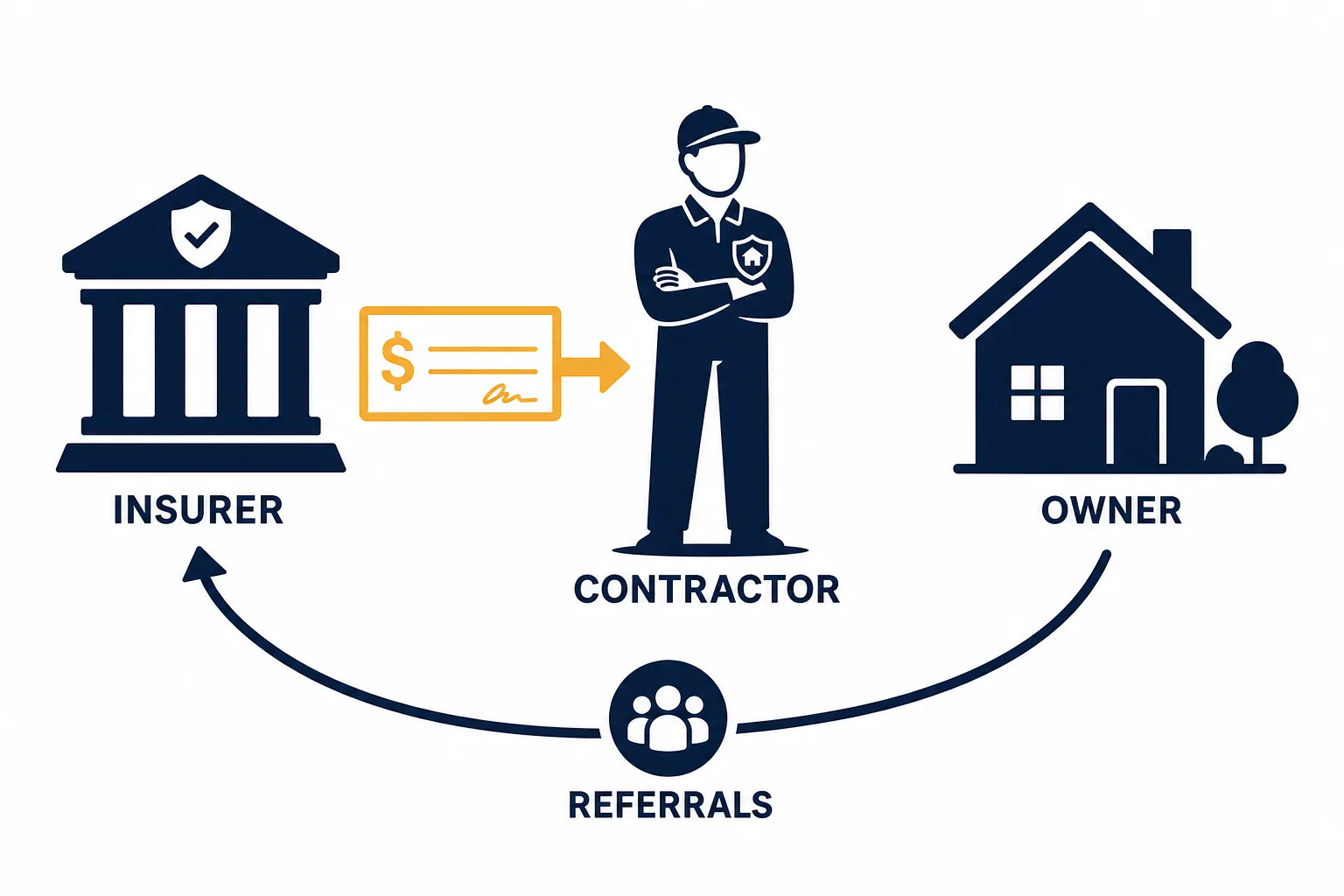
A preferred vendor sits on the insurer’s approved program. Their volume of work — and their next referral — depends on the carrier, not on you. That’s the alignment problem, stated plainly: their repeat business flows from the party writing the check.
That structure serves the insurer well. Repairs get standardized, costs stay predictable, and the claim closes quickly. It can serve the contractor too, through a steady pipeline of referred jobs. Where it can fall short is the building owner. When the same company both estimates and repairs the loss, the incentive leans toward the minimum scope the program authorizes rather than the full extent of the damage. On a small, clear-cut claim, that trade-off may be fine. On a multifamily envelope loss, the gap between “authorized” and “actually damaged” is where problems hide.
What an Independent Reconstruction Contractor Does Differently
An independent reconstruction contractor is retained by — and accountable to — the building owner or HOA. That single shift reorders the priorities. The job is to document the complete damage and repair the building correctly, not to close a file.
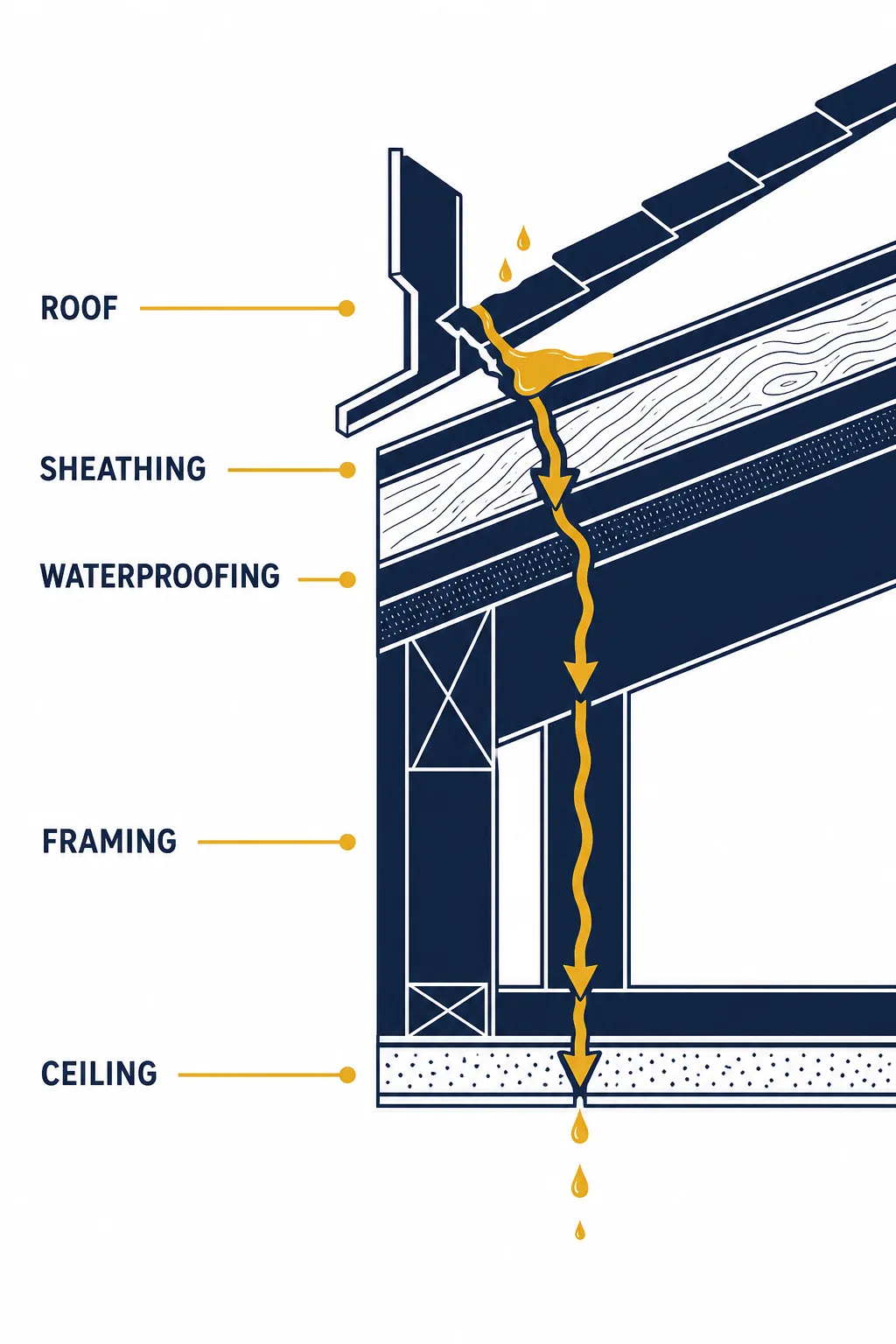
Repair what’s visible while leaving the wet assembly behind it sealed up, and a “finished” job becomes next year’s bigger claim — often with mold and structural decay in the walls by then.
That matters most with roof-origin water intrusion, which is rarely just stained drywall. Water that enters through a roof or a failed flashing detail travels through sheathing, waterproofing layers, and framing before it ever shows on a ceiling.
Getting the scope and the contract right at the outset is the other half of the work. Our guide on how to choose a reconstruction contractor for large projects in Texas walks through why unclear construction contracts are a leading source of industry disputes, and why milestone-based work with a defined scope protects an owner far better than a handshake and a program authorization.
Head-to-Head: Preferred Vendor vs. Independent Contractor
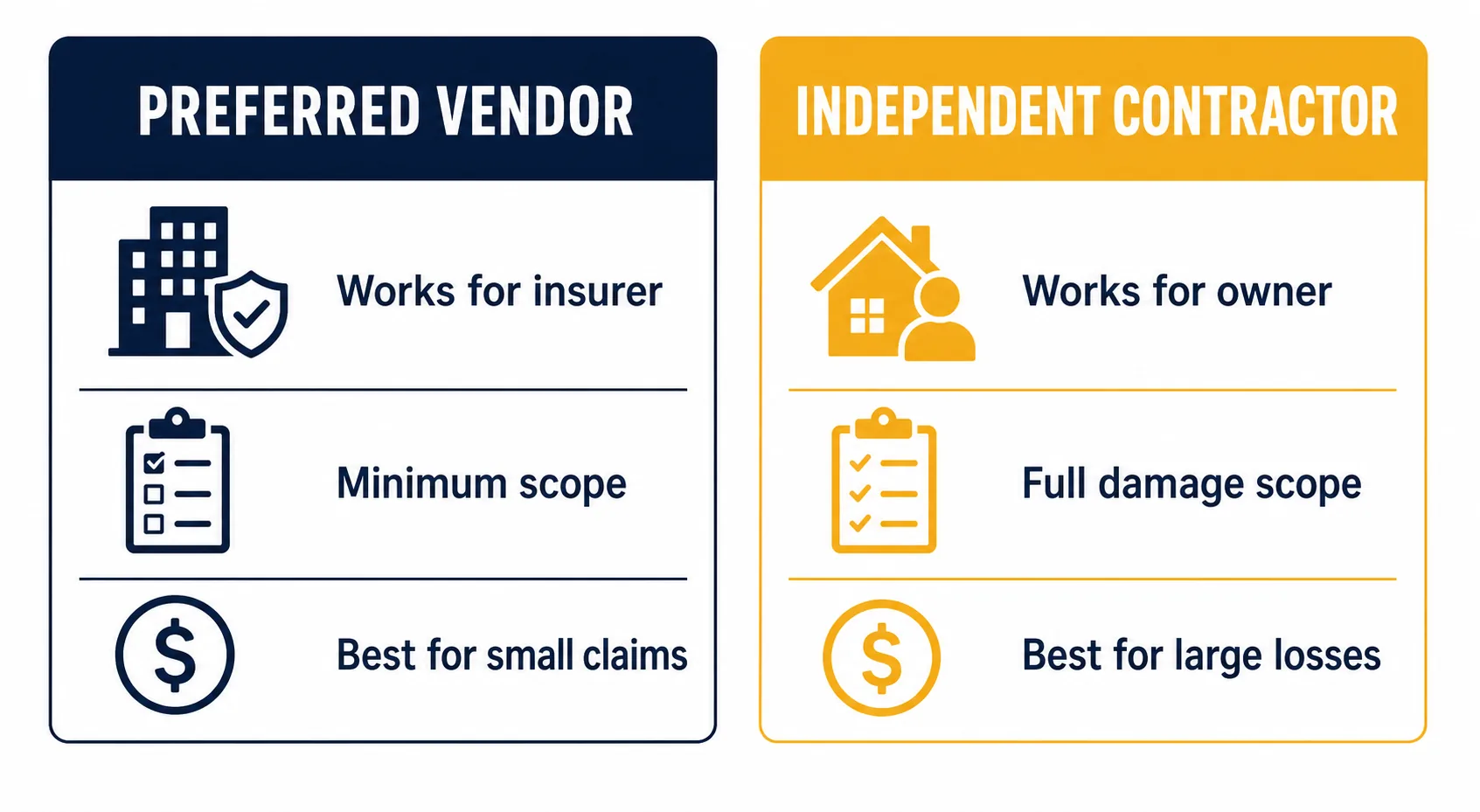
| Dimension | Preferred Vendor | Independent Reconstruction Contractor |
|---|---|---|
| Works for | The insurance carrier | The building owner / HOA |
| Scope of repair | The program-authorized minimum | The full documented extent of damage |
| Design & finish flexibility | Standardized, limited | Matched to the building and owner |
| Warranty accountability | Shared with the program | Direct, from the contractor to you |
| Speed vs. thoroughness | Faster on simple claims | Thorough on complex envelope losses |
| Best fit | Small, clear-cut repairs | Large multifamily and structural work |
Be honest about the trade-off: for a modest, well-defined claim, the preferred-vendor path is often faster and lower-friction, and that convenience has real value. It’s on large multifamily and building-envelope losses — where hidden damage, waterproofing, and structure are all in play — that the calculus flips toward independent advocacy.
Special Case: Condo & HOA Roof Leaks — Who’s Responsible?
Does the HOA cover roof leaks?
Usually, yes — roofs are typically common elements the association maintains, so a roof leak often falls to the HOA’s policy and responsibility. The split between the structure and the interior of a unit varies, though. Your association’s declaration and bylaws are the controlling documents; read them before assuming who owns what.
A leak in the condo or apartment ceiling — who is responsible?
The answer usually turns on the common-element versus unit-owner boundary defined in the governing documents. Because responsibility can straddle that line, thorough damage documentation helps whoever ends up filing.
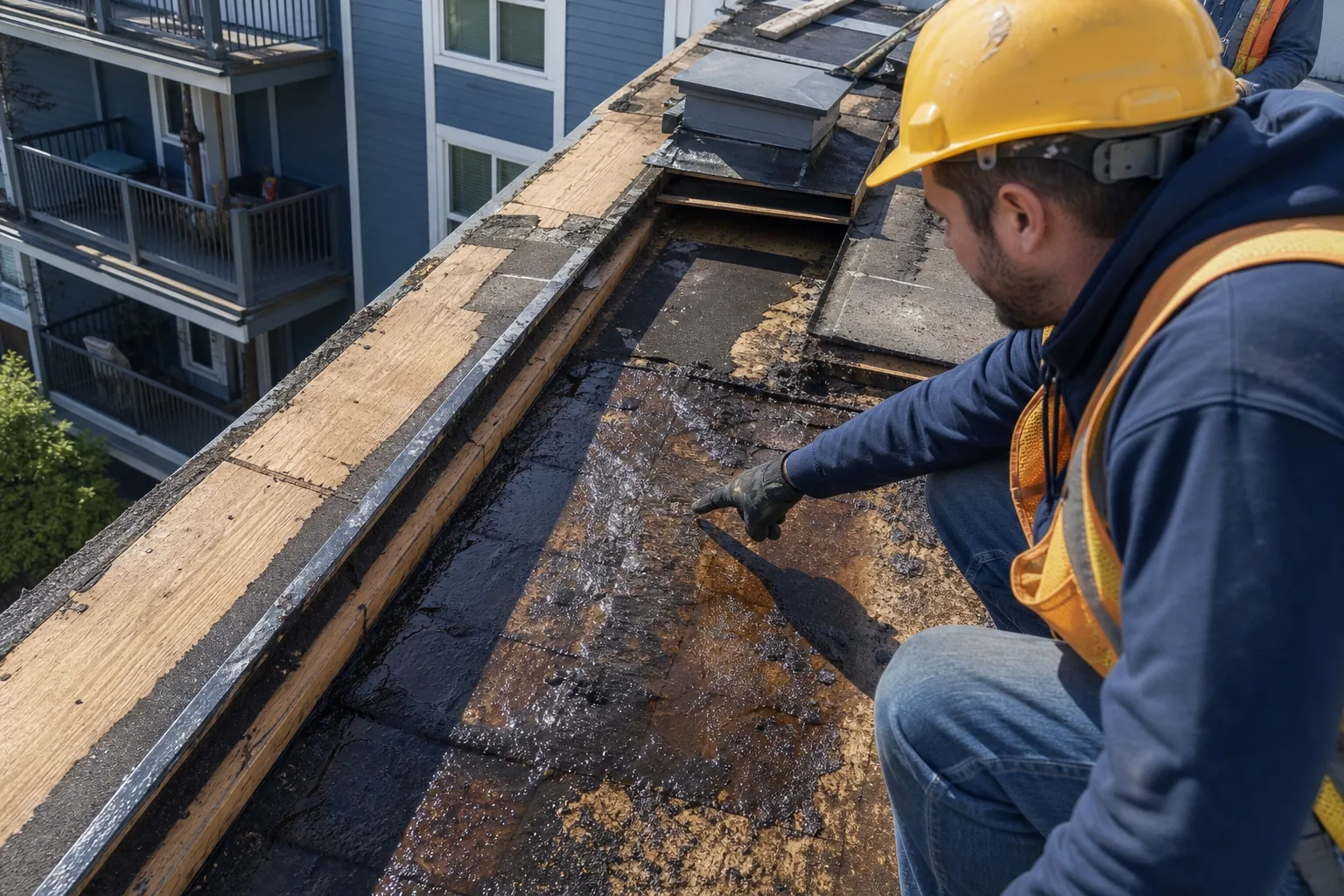
When a reroof or roof repair causes water damage inside units
This is common: a reroofing crew opens the deck, weather moves in, and units flood. Remediation done right traces the water to every wet assembly, not just the visible ceiling — which is exactly where a contractor accountable to the owner, rather than to a repair program, changes the outcome.
Getting the Full Scope Documented on Large Losses
Multifamily and capex-scale water intrusion needs the hidden damage found before anything gets closed up. That means working alongside the building’s own professionals — forensic engineers, property managers, and owners — to capture the true condition of the envelope and structure, then repairing to that reality.
This is the core of what Shepperd Construction does. For more than eleven years, we’ve focused on reconstruction and building-envelope repair across Texas, from construction-defect and waterproofing work to aging-infrastructure and capex renovation for apartment communities and HOAs, including difficult-access conditions most crews avoid. Care, quality, and hard-won experience are what a large water loss actually requires.
How to Decide: A Quick Checklist
- Who signs my contractor’s paycheck — the carrier or me?
- Is the full scope of damage documented, including the envelope and structure?
- Is there a real, written workmanship warranty?
- Who handles supplements if hidden damage turns up mid-project?
- For a large multifamily loss, does the contractor specialize in building-envelope reconstruction?
If you searched “Shepherd Construction” or “Shepperd Chao” to find us, you’re in the right place — Shepperd Construction.