A patch of concrete flaking off a beam. A chunk fallen from an overhead slab. A rust-colored stain bleeding through with steel showing underneath. The honest answer to “how serious is it?” is that spalling runs the full range, from a surface blemish to a real structural warning. What tips it one way or the other is happening beneath the surface, at the reinforcing steel.
What Is Concrete Spalling?
Spalling is concrete flaking, chipping, or breaking away from the surface, often exposing the aggregate or the rebar underneath. It is not the same as hairline cracking or scaling, the thin sandpaper-like loss of the top layer. Spalling means material has actually detached, leaving a pit, a spall, or a delaminated section that sounds hollow when tapped.
So How Serious Is It, Really?
Think of it as a spectrum.
- Lower concern: shallow, isolated surface spalling with no exposed steel and no rust staining. Often cosmetic, but still worth monitoring.
- Higher concern: exposed or corroding rebar, spalling on structural members (columns, beams, slab undersides and soffits), a widespread pattern, or debris falling from above.
A parking garage is not a sidewalk. It is an elevated, load-bearing structure carrying vehicles over occupied space. When a soffit spall drops from an overhead deck, that is a life-safety issue, not an appearance problem. And once steel in a structural member starts losing section, the loss of load capacity can be significant, research on dangerous damage to reinforced-concrete structural members documents how quickly that capacity erodes. Structural-member spalling belongs firmly in the act-on-it category.
When a soffit spall drops from an overhead deck, that is a life-safety issue, not an appearance problem.
Will Spalling Concrete Get Worse?
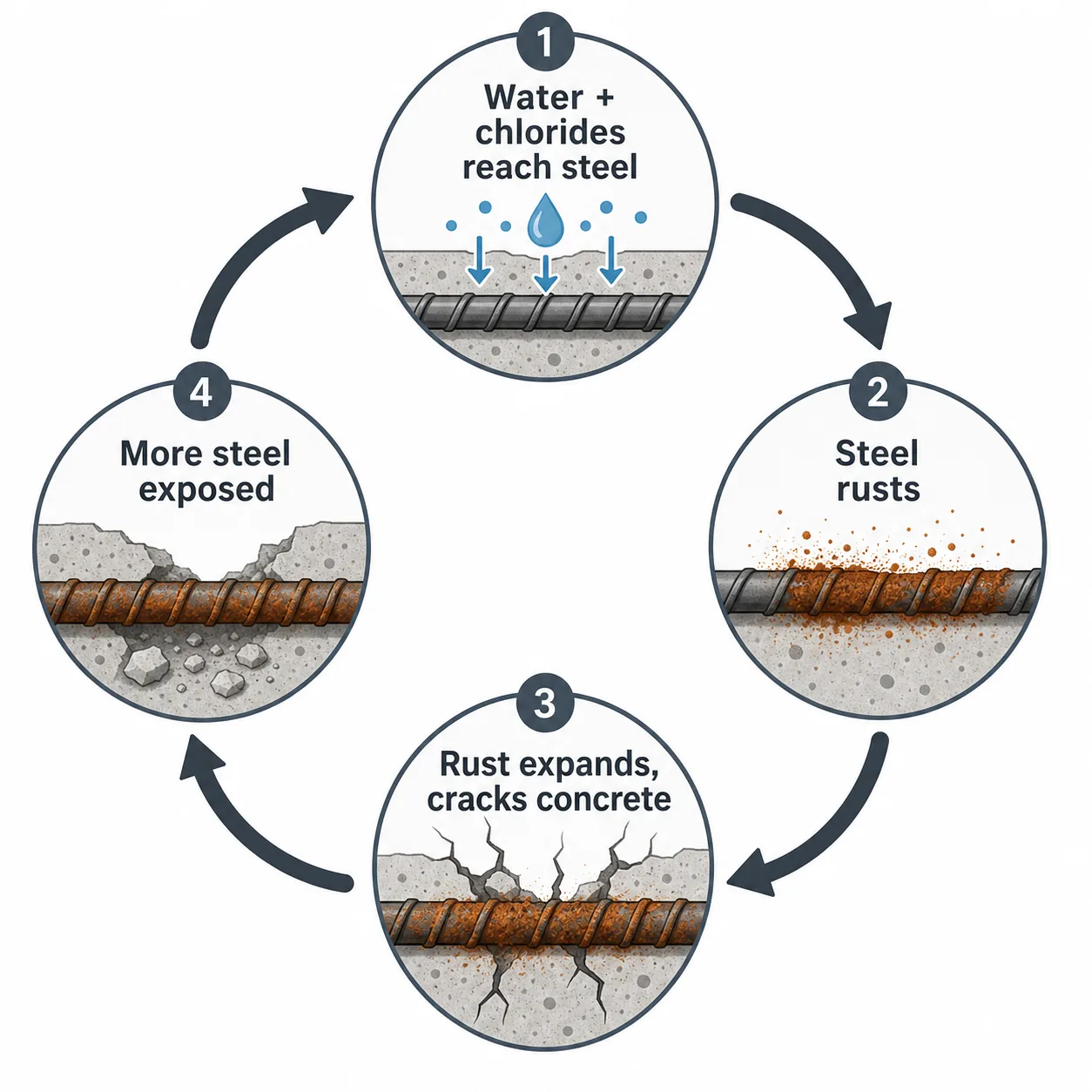
Yes. Untreated spalling is progressive, not self-limiting. It works as a feedback loop: water and chlorides reach the embedded steel, the steel rusts, and rust takes up several times the volume of the original metal. That expansion cracks the surrounding concrete and pushes it off, which exposes more steel, and the cycle speeds up. Repeated wetting, temperature swings, and traffic loading all compound it. Left alone, a small spall today is a larger repair next year.
Yes. Spalling generally occurs when steel reinforcing bars within the concrete are exposed to moisture and rusts – even very small amounts …
What Causes Spalling in Parking Structures?
Chloride intrusion
Texas sees far less freeze-thaw than northern states, but chlorides still ride in on vehicles, and standing water keeps driving corrosion year-round.
Water infiltration and failed waterproofing
Deteriorated or missing waterproofing membranes and failed joints let water reach the steel. This is often the true root cause behind visible spalling.
Corrosion of reinforcing steel
Carbonation and chlorides break down the concrete’s natural protection around the rebar, and rust takes hold.
Poor drainage and standing water
Ponding on decks and clogged drains keep concrete saturated, the single biggest accelerant.
Original construction issues
Too little concrete cover over the rebar, mix problems, or poor detailing set the stage for early spalling.
How the Damage Is Assessed
A real evaluation goes past a walkthrough. It combines a visual survey, sounding or chain-drag to map delaminated areas that look intact but are debonded, a measure of spall depth, and a check on how far the steel corrosion has progressed. Tapping a deck that reads solid to the eye but hollow to the ear is exactly how debonded concrete gets caught before it falls. The point is to base decisions on the structure’s actual condition rather than on what is visible from the ground.
Repair vs. “Wait and See”
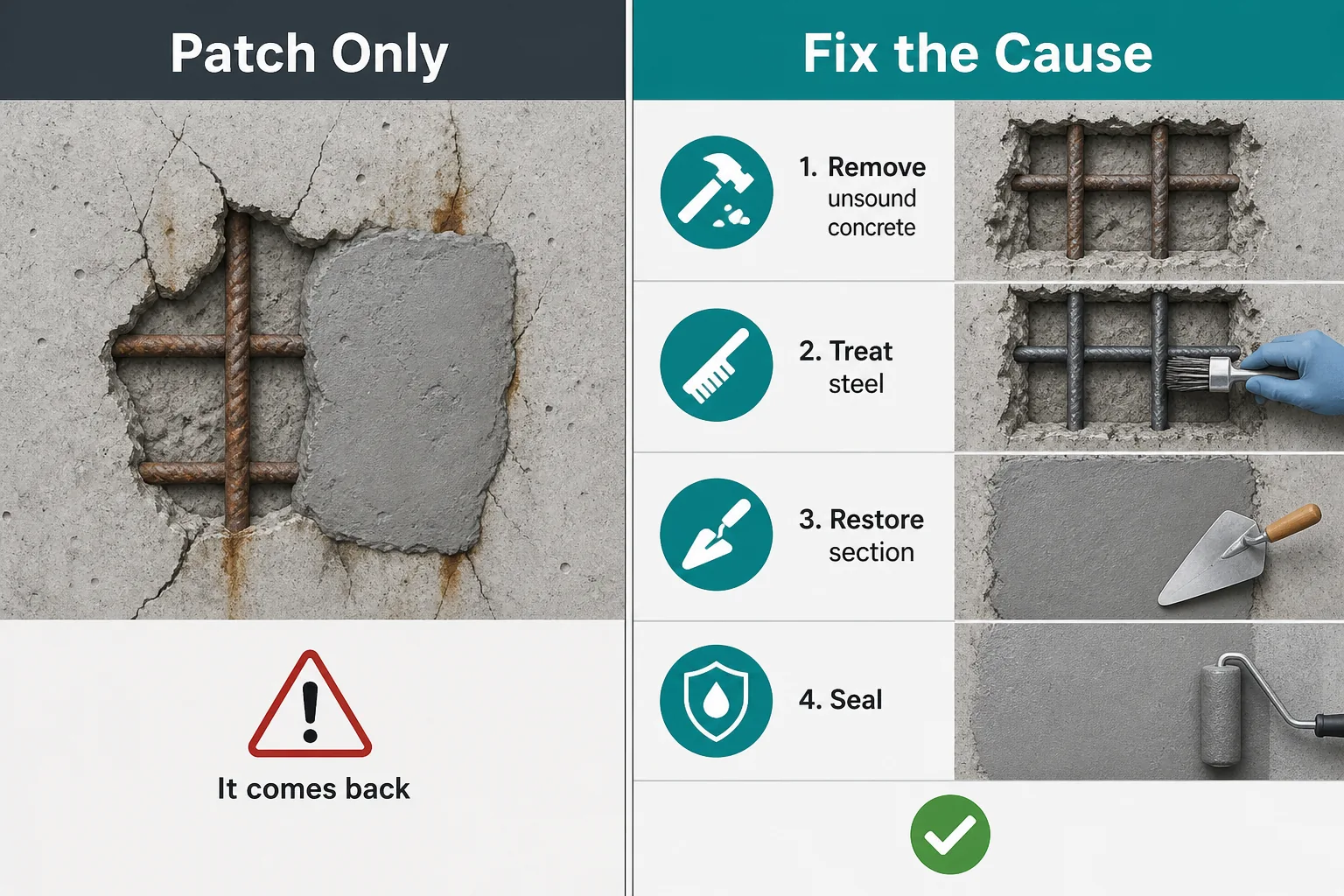
Patching over a spall without addressing the corroding steel and the water source just invites it back. The sequence that holds: identify the cause, remove all unsound concrete, treat or replace the affected steel, restore the section, then re-establish waterproofing and drainage. Fixing the root cause instead of covering it is where care, quality, knowledge, and experience actually show up.
Why This Matters More in a Multifamily or HOA Setting
For HOA property managers and owners of condo and multifamily buildings, a parking garage is shared common-area infrastructure. Resident safety, shared responsibility for the structure, and the compounding cost of deferred maintenance all raise the stakes, the same concerns that follow water intrusion elsewhere in an aging building.
Frequently asked questions
Is spalling concrete dangerous?
Will spalling concrete get worse if I leave it?
Can spalled parking-garage concrete be repaired, or does it need replacement?
How do I know if it’s structural or just surface-level?
Where can building owners in Texas get help?
Not Sure How Serious Yours Is?
If you are seeing spalling on your parking structure and can’t tell whether it’s cosmetic or a warning, have it assessed by a team that focuses on reconstruction in Texas. Talk to Shepperd Construction about getting a clear read on your structure’s condition.