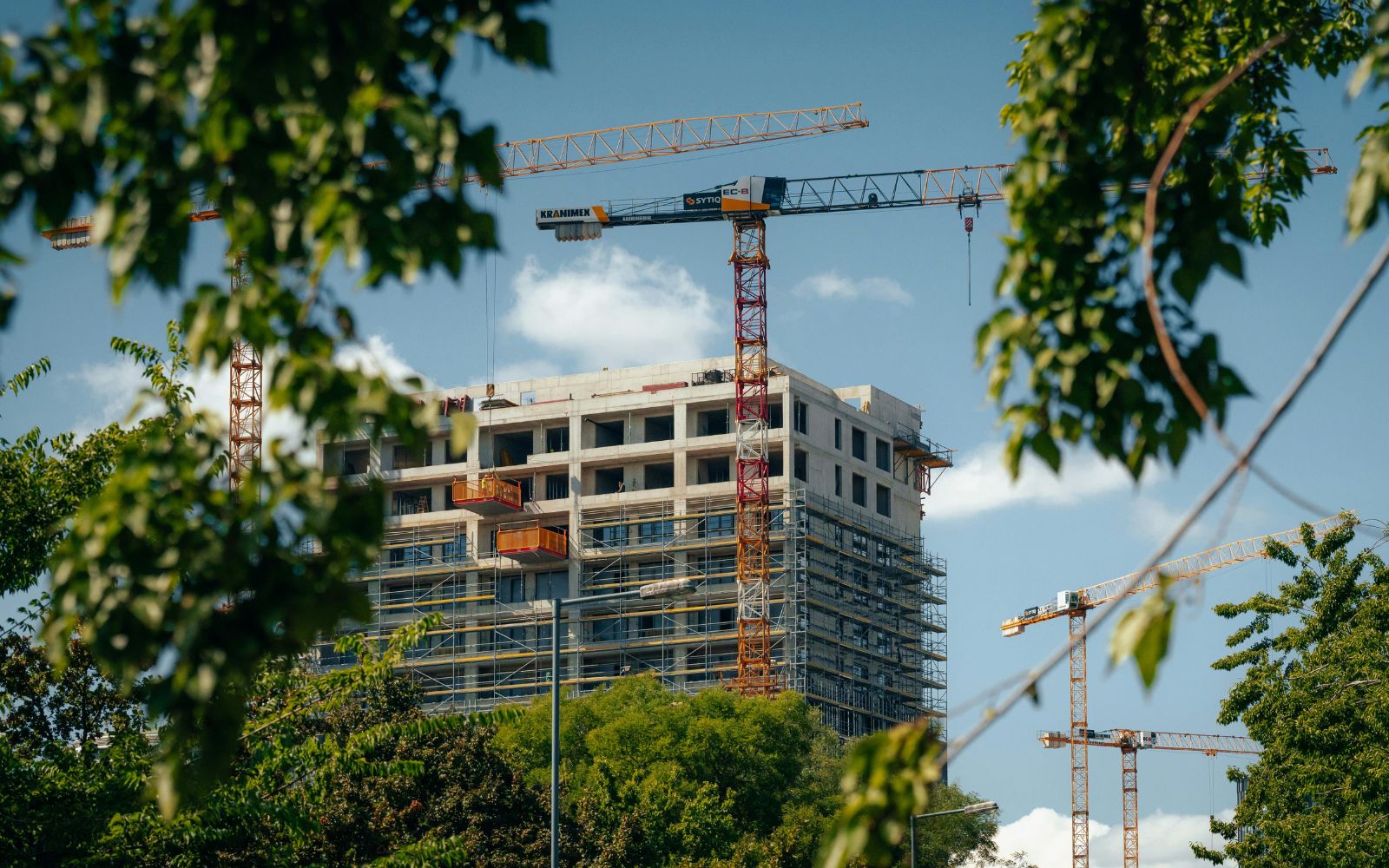
A stain appears on a third-floor ceiling. A plumber checks the lines above it and finds nothing. A roofer walks the roof, seals a few penetrations, and calls it handled. Four months later, the stain is back, wider, and there is a second one below it.
That is what happens when a building gets repaired but never investigated. Here is who actually performs the investigation, what each specialist can and cannot determine, and how the process runs from the owner’s or property manager’s side.
This guide is written for Texas HOA boards, condominium associations, multifamily owners, property managers, building owners, forensic engineers, and attorneys managing recurring water intrusion, not just a homeowner trying to identify a single plumbing leak.
The short answer: the investigator should match the suspected source. A forensic engineer or building-envelope consultant is usually appropriate when rain, walls, windows, roofs, balconies, or multiple units are involved. A licensed plumber is the better first call for a continuous, weather-independent leak. A reconstruction contractor supports testing, openings, pricing, and repair after the source and repair criteria are established.
The Short Answer: Who Actually Investigates Water Intrusion
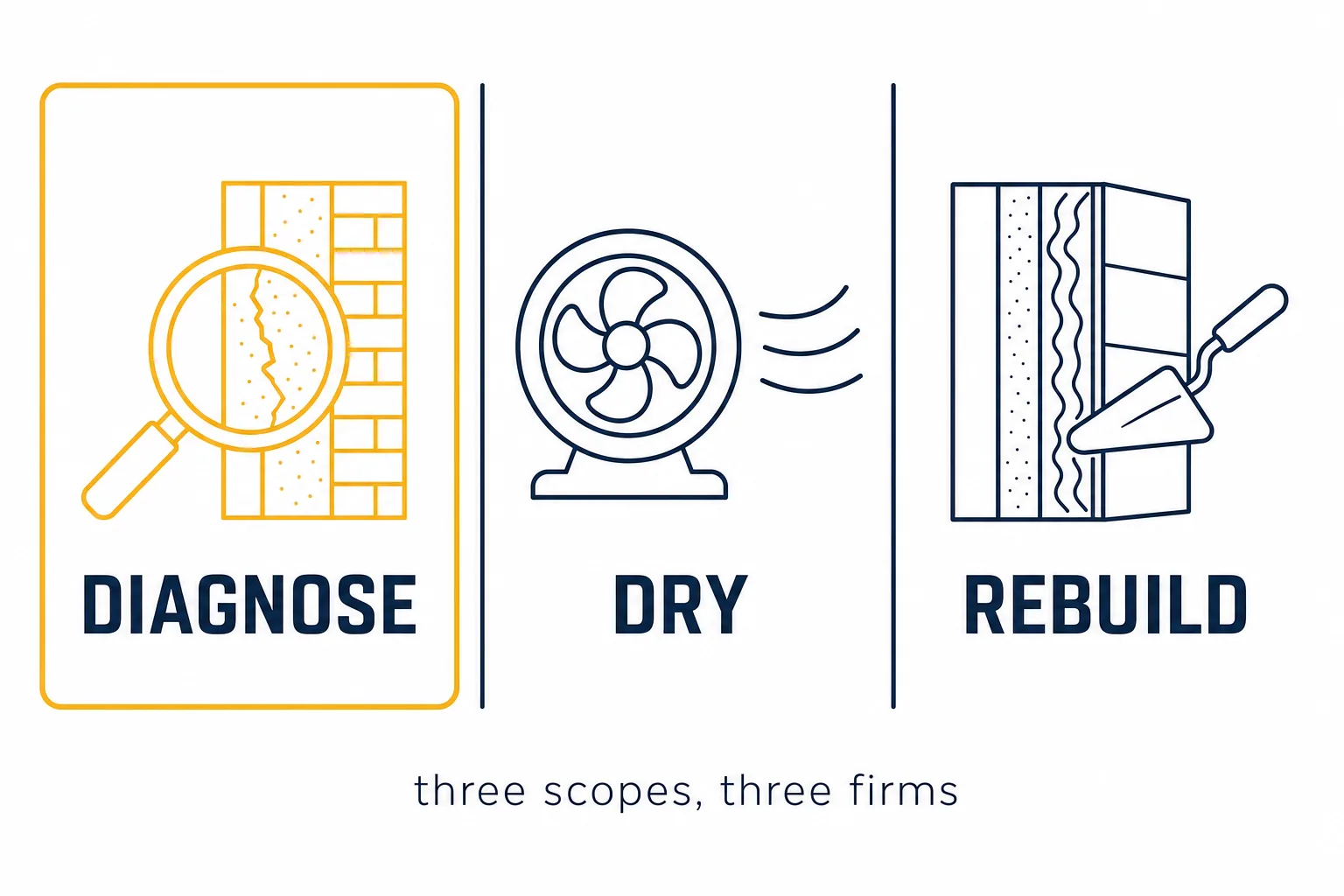
Most water intrusion investigations are led by a forensic engineer or a building envelope consultant. Depending on the suspected pathway, they bring in leak-detection specialists, roofing and waterproofing consultants, licensed plumbers, and sometimes an industrial hygienist when microbial growth is involved. A reconstruction contractor performs the openings and provides testing support, then prices and builds the repair.
The right lead depends on where the water is coming from:
- Continuous leak with no correlation to rain? Start with a licensed plumber or leak-detection specialist. Pressurized supply lines, drain lines, condensate, and HVAC pans are the usual suspects.
- Leak that tracks rain events, wind direction, or irrigation cycles? That is an envelope problem. Forensic engineer or envelope consultant.
- Below-grade, plaza deck, or planter-adjacent water? Waterproofing consultant with engineering oversight, because both the assemblies and the repair consequences are significant.
It also helps to separate three roles owners routinely blur together. The investigator diagnoses cause and origin. The restoration company dries, cleans, and remediates. The reconstruction contractor rebuilds the assembly that failed. One firm rarely does all three well.
An HOA board or commercial property manager in Texas is not hiring a single trade. They are assembling a small team, usually two or three parties, with clear scopes.
| Observed pattern | Best starting point | Why |
|---|---|---|
| Continuous leak unrelated to weather | Licensed plumber or leak-detection specialist | Helps evaluate supply, drain, HVAC, or condensate sources |
| Leak during rain or wind-driven storms | Building-envelope consultant or forensic engineer | Evaluates roofs, walls, windows, flashing, and drainage paths |
| Water below a plaza, balcony, or planter | Waterproofing consultant with appropriate engineering support | Connects horizontal or below-grade waterproofing conditions to observed damage |
| Multiple units or elevations affected | Envelope-focused investigation team | Tests whether a repeated design or installation condition is involved |
Why Water Intrusion Gets Misdiagnosed So Often
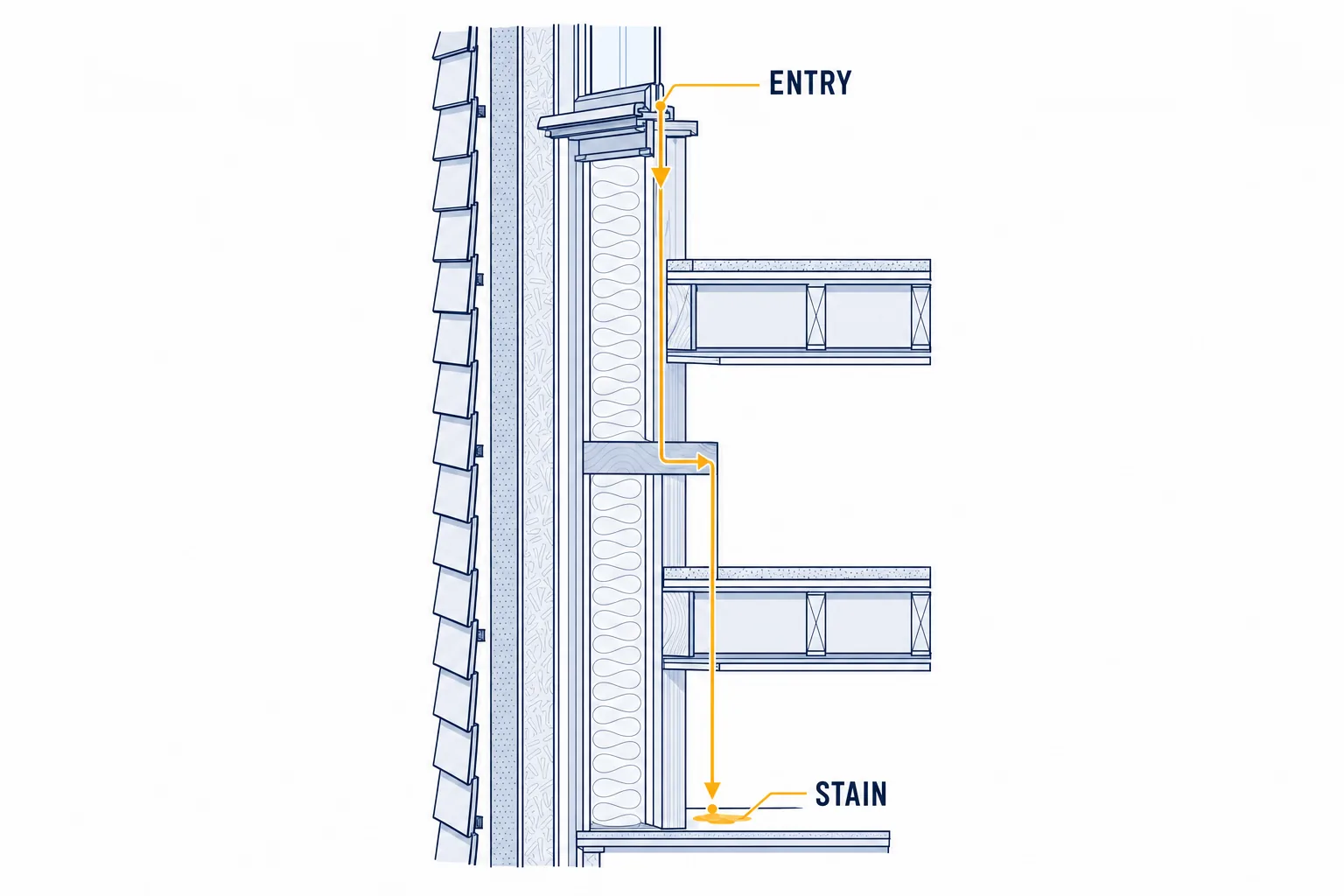
Water travels. It enters at a window head on the fifth floor, runs down a stud bay, crosses a floor line on a piece of blocking, and surfaces in a different unit two floors down. Entry point and stain location are frequently on different elevations and different assemblies.
Chasing the stain is how buildings get repaired in the wrong place, repeatedly.
Single-trade tunnel vision. A roofer inspects the roof and clears it. A plumber inspects the plumbing and clears it. Both are telling the truth about their own scope. Nobody owns the transitions between scopes, which is exactly where most leaks live: roof-to-wall, wall-to-window, deck-to-threshold, cladding-to-penetration.
Symptom sealing. Caulk over a stucco crack or a window perimeter can suppress a leak for a season while the real path stays wide open: a reverse-lapped weather-resistive barrier, missing head flashing, an unsealed through-wall penetration, a deck coating that terminates short.
Intermittent behavior. A leak that appears only during sustained rain out of the south, or only after the irrigation controller runs twice, is not an on-off source. It requires correlating events, not guessing.
Getting this wrong compounds. Sheathing and framing stay wet, insulation holds moisture, and mold conditions develop that expand the eventual reconstruction scope well beyond the original repair.
The Professionals Who Investigate Water Intrusion
Forensic Engineer (Licensed Professional Engineer)
A forensic engineer investigates building failures and evaluates cause and origin within the engineer’s professional scope. Depending on the assignment, the engineer may produce a professional report and repair criteria for use by owners, boards, insurers, and advisors.
When the question is why an assembly failed, or when structural damage, a building-wide pattern, or significant repair spend is on the table, that opinion should come from a licensed professional engineer. It is why engineers typically lead the larger assignments.
Building Envelope Consultant
Envelope consultants specialize in the systems that keep water out: roofing, cladding, fenestration, sealants, air and water barriers, and below-grade waterproofing. They compare construction documents against as-built conditions and identify what is missing or wrong, such as absent flashing, reverse laps, unsealed transitions, and terminations that were never detailed.
Their work may include a written test protocol and repair details a contractor can use to develop a buildable scope. On larger assignments, they frequently work alongside or under a licensed engineer.
Leak-Detection Specialist
These firms locate active leaks without demolition using acoustic listening equipment, tracer gas, thermal imaging, and electronic leak detection on membranes. They are the right call for concealed pressurized lines, slab leaks, pool and fountain structures, and roof or plaza membranes.
One limit to hold onto: leak detection finds where water is. That is not always where water entered.
Licensed Plumber
The correct first call when the leak is continuous, unrelated to weather, or clearly tied to supply, drain, waste, or vent systems. Isolation testing, camera inspection of drain lines, and riser and fixture evaluation in stacked condo construction rule the plumbing pathway in or out quickly and inexpensively.
Even when the answer is “not plumbing,” that is a useful result. It narrows the envelope investigation before anyone spends money on staging.
Roofing and Waterproofing Consultants
These specialists evaluate membrane condition, flashing, drains and scuppers, penetrations, parapets, coping joints, and balcony or deck coatings. They perform moisture surveys and core cuts to map wet insulation so replacement is scoped by evidence rather than square-footage guesswork.
One governance note for boards: when the party diagnosing the problem is also selling the repair, scope that relationship deliberately and document the decision.
Industrial Hygienist or Indoor Air Quality Consultant
Brought in when microbial growth, occupant health complaints, or remediation protocols enter the picture. The hygienist sets containment and clearance criteria, which directly shape reconstruction sequencing and schedule. This work runs parallel to the intrusion investigation and never substitutes for finding the source.
Reconstruction Contractor
The investigation only goes as deep as someone is willing to open the wall. A reconstruction contractor performs the selective demolition, window and cladding removals, and exploratory probes the engineer or consultant needs, documents field conditions as they are exposed, and re-secures the building envelope between test days so the property is never left vulnerable overnight.
After the report, that contractor converts the engineer’s repair criteria into a quantified cost-of-repair scope and executes the permanent repair.
That is Shepperd Construction’s role. We are a Texas general contractor focused on reconstruction, working alongside forensic engineers, property managers, building owners, and their advisors to gather field data and build the repair. We do not offer engineering or legal conclusions. The engineer determines cause. We open the building carefully, document what is there, and put it back correctly.
What a Water Intrusion Investigation Actually Involves
Step 1: Document Review and Leak History
Before anyone climbs anything, the investigator collects original drawings, specifications, submittals, prior repair invoices, maintenance records, and reserve study notes, then the occupant complaint log mapped by unit, elevation, and date.
That map gets correlated against weather: rainfall duration, wind direction, storm dates. Irrigation schedules and adjacent site drainage belong in this step too because either condition can affect observed water intrusion.
Step 2: Visual Site Inspection and Moisture Mapping
A systematic walk of roof, walls, windows and doors, balconies, transitions, and every interior damage location. Investigators use non-invasive and pin-type moisture meters plus infrared thermography, which has an established consensus procedure: ASTM C1153 is the standard practice for locating wet insulation in roofing systems using infrared imaging. Thermography only works under the right temperature differential, so timing matters more than equipment.
Difficult elevations require swing stage, rope access, or lift work. Access capability is a real constraint on investigation quality. Confirm early that whoever supports the investigation can physically reach the conditions in question.
Photo documentation standards matter here. Consistent location labeling, orientation, and dating are what make a report usable months later by a board, an insurer, or an engineer who was not on site that day.
Step 3: Water Testing to Standard
Controlled testing is where hypotheses get proven: spray rack and calibrated nozzle testing, chamber testing at windows and doors, flood testing on decks and plazas.
The discipline is to test one variable at a time, starting low on the wall and working up, so a positive result is attributable to a specific condition rather than to “somewhere over there.”
Recognized guidance exists for this work. AAMA 511 is the voluntary guideline for forensic water penetration testing of fenestration products, written for investigating leaks in existing buildings, and ASTM E1105 covers field determination of water penetration of installed exterior windows, skylights, doors, and curtain walls by uniform or cyclic static air pressure difference.
Common mistakes: testing several assemblies at once, exceeding realistic pressures so the result proves nothing about service conditions, skipping a pre-test moisture baseline, and running tests with no witness present.
Step 4: Invasive Openings and Exploratory Testing
Selective removals expose what nobody can see from outside: flashing configuration, weather-resistive barrier laps, sheathing condition, framing damage. Sample locations should be chosen because they represent the building’s conditions, not because they are easiest to reach from the parking deck.
Good practice on openings includes consistent labeling, control of removed materials, temporary weather protection, and same-day close-up. An occupied building should not sit open to the weather because the test day ran long.
Step 5: Findings, Repair Criteria, and Cost of Repair
The report ties observed conditions to intrusion pathways and sets repair criteria. The contractor then converts those criteria into a scoped, quantified cost-of-repair estimate with phasing and occupant-impact planning.
This is where the big decision gets made: targeted repair, partial re-cladding, or full envelope replacement. Condition mapping drives that call, which is why sample size and distribution in Step 4 matter so much.
An early, accurate estimate protects reserves and lets a board or owner plan CapEx across fiscal years instead of reacting to the next storm. For association-led reconstruction planning, see HOA reconstruction services.
Common Sources of Water Intrusion in Texas Buildings
- Roofing: failed membrane seams, clogged or undersized drains, ponding, parapet and coping joints, mechanical curb flashing.
- Walls and cladding: missing or improperly lapped weather-resistive barrier, unsealed penetrations, stucco and EIFS terminations, masonry weeps blocked or omitted.
- Windows and doors: perimeter sealant failure, absent head flashing, unsealed corners, omitted sill pans.
- Balconies, walkways, and plaza decks: coating wear at thresholds, failed drain flashing, guardrail post penetrations.
- At and below grade: negative slope toward the building, planters and over-watered irrigation, failed waterproofing at foundation transitions.
- Plumbing and mechanical: supply line failures, condensate drain overflow, HVAC pan and unit closet leaks, sanitary stack leaks in stacked units.
Texas adds its own pressures. Wind-driven rain from Gulf storms tests every horizontal joint and window perimeter. Hail damages roofs and cladding in ways that are not visible from the ground. Expansive clay soils move seasonally with moisture, working joints and stressing transitions. Thermal cycling here punishes sealants, which is why sealant-only repairs have such a short useful life.
Who Is Responsible When Water Leaks in a Condo or HOA Building?
The general framework: the declaration, bylaws, and other governing documents allocate maintenance, repair, and replacement duties between the association and unit owners. The common pattern is that the association handles roofs, exterior walls, and other common elements; owners handle what is inside their unit boundary, and limited common elements (balconies, exclusive-use patios, some windows) fall under their own provision.
Which is exactly why the investigation matters. Responsibility follows the source. A ceiling leak in a unit is not automatically the owner’s problem or the association’s problem. It depends on where the water came from, and that is a factual question only an investigation answers. Boards that argue about responsibility before establishing the source are arguing without information.
Insurance runs on parallel tracks, typically an association master policy and an individual owner policy, and documentation quality can affect how those claims are evaluated.
The Texas Department of Insurance explains that sudden and accidental water damage may be covered, while gradual leaks and seepage are commonly excluded. Well-labeled test results, dated photos, and a report connecting conditions to pathways provide useful documentation, but coverage remains policy- and fact-specific.
This is general education, not legal advice. Boards should have their own counsel review their specific governing documents. The same principle applies on the commercial side, where the lease allocates roof and structure against tenant improvements and the source determination drives who funds what.
How to Choose the Right Investigator: Questions to Ask
1. Is the person or firm licensed in Texas for the work they are performing? Ask directly, and ask who is stamping the report. 2. What written protocol and standards will govern the testing? “We’ll spray it and see” is not a protocol. 3. Will results be documented per test location? Aggregate conclusions are hard to act on and hard to price. 4. Do they investigate the whole assembly or only one trade’s scope? 5. Will they provide repair criteria specific enough to bid? A conclusion without criteria leaves you paying twice. 6. Who performs the openings and the repairs, and how is that coordinated? 7. What is their experience with this construction type, height, and access difficulty?
Red flags: a proposal with no test plan, a recommendation that is sealant and nothing else, and unwillingness to open the wall.
If nobody wants to look inside the assembly, nobody is going to find the leak.
What Investigation and Repair Cost
Anyone quoting a firm number before seeing the building is guessing. Investigation cost is driven by building height and required access method, number of test locations, whether the scope is invasive or non-invasive, occupancy and phasing constraints, and available weather windows.
Investigation is a small fraction of eventual repair cost, and it usually reduces total spend by breaking the repeat-repair cycle. Two rounds of sealant, a partial roof section, and a re-stucco that missed the real path will exceed the cost of the testing that would have identified it the first time.
On the reconstruction side, commercial building repair cost depends on cladding type, the extent of substrate and framing damage found, code-triggered upgrades, and resident or tenant relocation and staging.
For HOA reserves and commercial CapEx planning, get a scoped, quantified estimate early enough to phase the work across fiscal years rather than funding it as an emergency.
Turning Findings Into Repairs
Good reconstruction starts before mobilization. A constructability review of the engineer’s repair details is where surprises should surface: on paper, not on the wall with a swing stage hanging and residents displaced. Details that work in a drawing sometimes cannot be built in existing conditions, and preconstruction is the time to resolve that.
From there, it is sequencing, resident and tenant communication, access scheduling, and site protection in an occupied building. Mockups confirm the detail performs before it is replicated across an elevation, and post-repair verification testing confirms the fix works. The owner, board, and their advisors should receive a documentation package at closeout, not a stack of invoices.
Where mold is involved, order matters: remediation and clearance first, then rebuilding the assembly correctly. Rebuilding over a condition that was never cleared relocates the problem instead of solving it.
This work benefits from someone who has stood on both sides of the drawing. Brett Grobarz, Vice President of Sales at Shepperd Construction, brings more than 16 years of experience across the construction, development, and building-envelope industries and a Master’s Degree in Architecture, a background spanning architectural design and construction execution that helps bridge design intent and constructability on exactly these projects.
Frequently Asked Questions
Related readingReconstruction Contractors Texas Operating in 4 Major CitiesRead the guide →Frequently asked questions
Who do I call first for unidentified water damage, a plumber or an envelope specialist?
Do I need a forensic engineer, or is a consultant enough?
Who investigates water intrusion near me if my building is in Texas?
Can a general contractor investigate the leak?
Does the HOA cover roof leaks?
Who is responsible for a leak in a condo or apartment ceiling?
How long does an investigation take?
If a condo roof is damaged, does it need repair or full replacement?
Start the Conversation
If a Texas building is leaking and nobody has found the source, the fastest path is usually not another repair. It is the right team, early, working from evidence.
Shepperd Construction supports investigative testing, produces cost-of-repair scopes from an engineer’s criteria, and performs building-envelope reconstruction. We work alongside forensic engineers, property managers, boards, and building owners across Texas, and we have been doing this work for more than eleven years.
If you are dealing with an unresolved intrusion, an upcoming envelope repair, or a scope you need priced accurately, start a conversation with our Texas reconstruction team and tell us what your building is doing.