
A public facilities director managing recurring leak repairs and a facilities director planning one defined recladding project may need different procurement structures. In Texas, job order contracting (JOC) and competitive sealed proposals (CSP) describe related but different parts of procurement: JOC is a method for recurring, indefinite facility work, while CSP is a proposal and selection method. Texas law also permits CSP to be used to award JOC contracts.
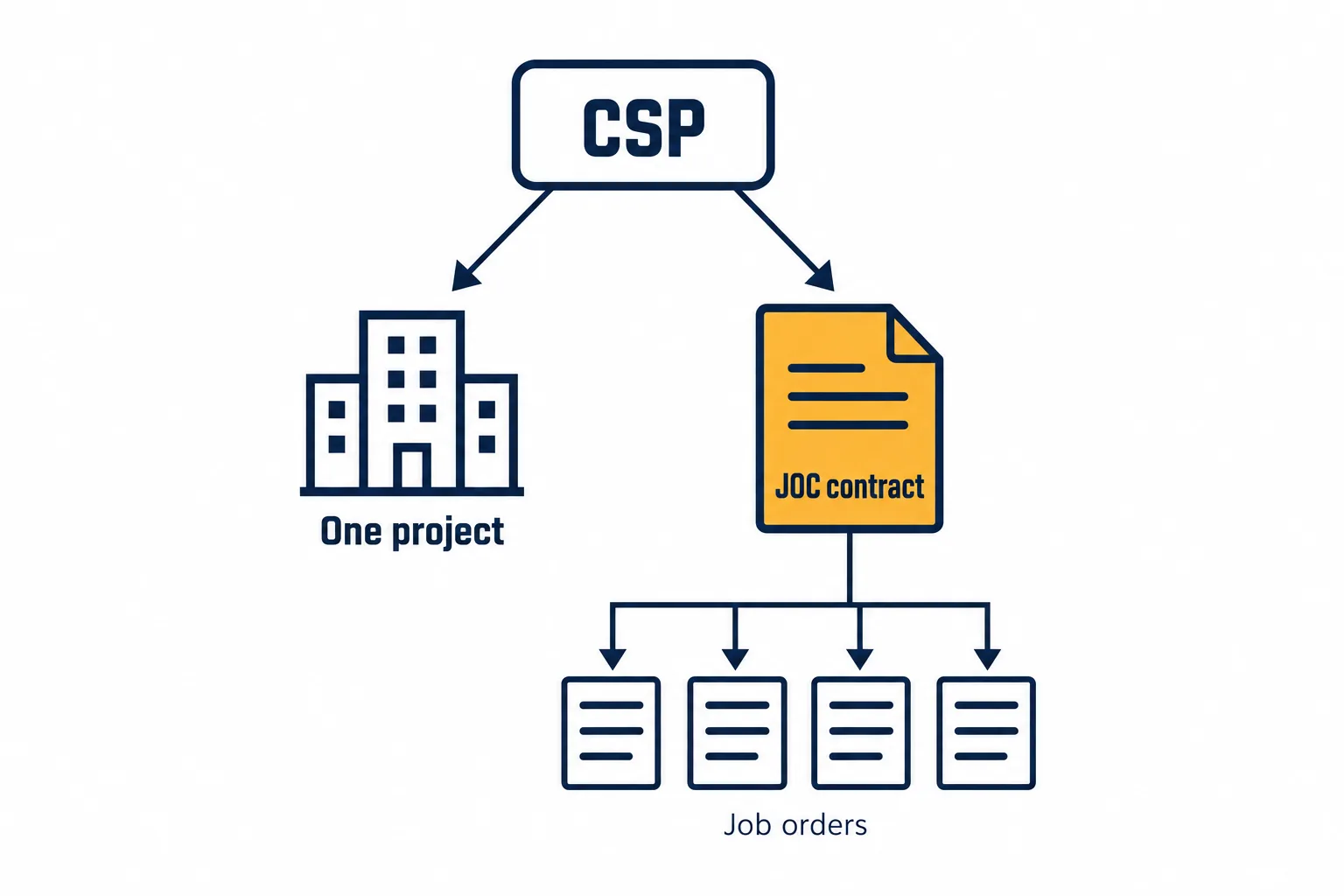
For one defined facility project, a project-specific CSP may fit. For recurring work that can be described through prepriced tasks, a JOC program may fit. The two are not always mutually exclusive because a JOC may itself be solicited through CSP.
This article provides general construction and procurement information. Public owners should confirm project-specific requirements with their procurement officials, architect or engineer, and legal counsel.
What Chapter 2269 Covers, and How JOC and CSP Relate
Texas Government Code Chapter 2269 applies to public work contracts made by governmental entities, including state agencies, counties, municipalities, school districts, public junior colleges, and other political subdivisions. The chapter identifies several construction procurement and delivery methods, including competitive bidding, competitive sealed proposals, construction manager-at-risk, construction manager-agent, design-build, and job order contracting.
Before advertising a construction method authorized by Chapter 2269 other than competitive bidding, the governing body must determine which method provides the best value. The governmental entity must also publish the evaluation criteria, weighted values, and scoring methodology that apply to the procurement. Read the current Texas Government Code Chapter 2269 before relying on a general summary.
Chapter 2269 does not automatically govern a private owner, REIT, or HOA simply because that owner uses a similar contract structure. Private owners may still use master agreements, unit pricing, or best-value selection, but their governing documents, funding sources, local requirements, grant terms, and contract rules may create separate obligations.
A cooperative purchasing program may be another route for an eligible public owner, but the owner should confirm that the solicitation and contract permit the intended use and that any interlocal agreement or other required authority is in place. BuyBoard’s Texas JOC resource provides one practical example of how a cooperative JOC program describes its process.
CSP Can Be Used to Award a Texas JOC
The most important relationship to understand is in Section 2269.405: a governmental entity may use the CSP method under Subchapter D for a job order contract. In other words, JOC describes the recurring-work contract structure, while CSP can describe the competitive proposal process used to award that contract.
That is different from using CSP to procure one project-specific roof replacement, recladding program, or waterproofing reconstruction. When comparing the two, first ask whether you are comparing a JOC program with job orders against a project-specific CSP, or comparing two parts of the same JOC procurement.
How JOC Works Under Texas Chapter 2269
Section 2269.401 defines job order contracting as a procurement method for maintenance, repair, alteration, renovation, remediation, or minor construction of a facility when the work is recurring but the delivery times, types, and quantities are indefinite. Section 2269.403 also requires the work to be awarded substantially based on predescribed and prepriced tasks.
A JOC begins with a competitively awarded master contract. The governmental entity then issues individual job orders as eligible needs arise. The entity must establish the maximum aggregate contract price when it advertises the proposal, and the governing body must approve each job, task, or purchase order above $500,000. The entity may award JOC contracts to one or more contractors under a solicitation.
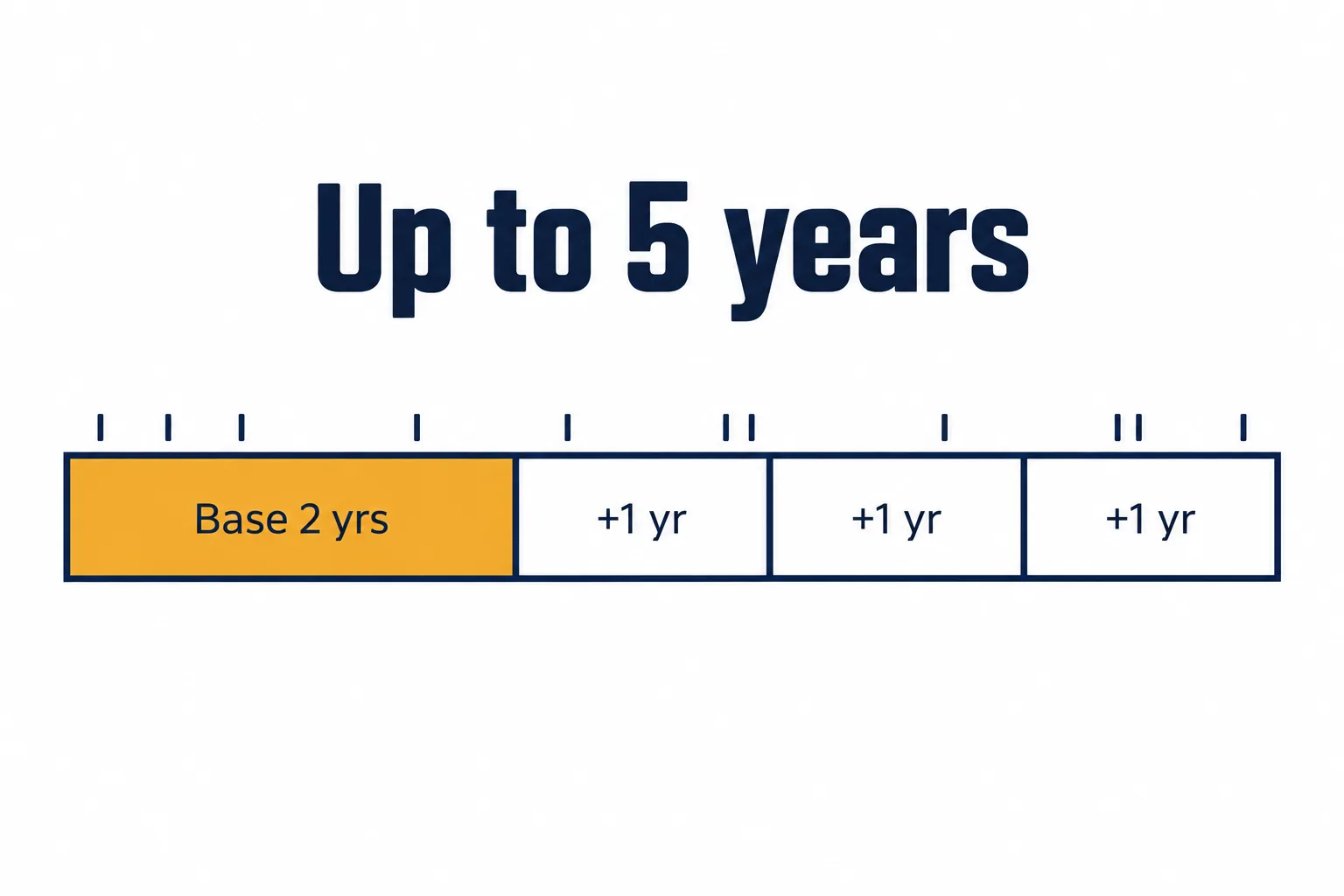
A base JOC term may not exceed two years, and the governmental entity may renew the contract annually for no more than three additional years. Possible fits include recurring facility repairs, repeat renovation scopes, remediation, and smaller projects spread across several public buildings. The specific solicitation still controls which work is eligible and how each order must be approved.
How Texas JOC Pricing Works: Unit Price Books, Coefficients, and Job Orders
A Texas JOC may use a published construction unit-price book or a list of prepriced work items. Offerors may submit one or more coefficients or multipliers that apply to the price book or prepriced tasks. The Texas Facilities Commission’s JOC information explains how its catalog, construction task items, and adjustment factor operate.
The coefficient does not have one universal meaning in every contract. What it includes depends on the solicitation and contract documents; an adjustment factor may account for items such as contractor overhead and profit. Review the definitions, inclusions, exclusions, location factors, and non-catalog procedures before assuming that a difficult-access or envelope scope is fully represented by a generic price book.
A job order may be structured as a fixed-price, lump-sum contract based substantially on unit pricing applied to estimated quantities, or as a unit-price order based on the quantities and line items delivered. That distinction matters when concealed conditions could change quantities or require additional work.
JOC Does Not Eliminate Design or Engineering Requirements
A JOC can simplify the procurement of eligible recurring work, but it does not automatically eliminate design or engineering responsibilities. If a JOC or job order requires architectural or engineering services that constitute the practice of architecture or engineering, Section 2269.408 requires the governmental entity to select or designate an architect or engineer to prepare the construction documents.
How a Project-Specific CSP Works
Under Section 2269.151, competitive sealed proposals are a procurement method in which a governmental entity requests proposals, ranks the offerors, negotiates as prescribed, and contracts with a general contractor for the construction, rehabilitation, alteration, or repair of a facility.
For a project-specific CSP, the request generally needs enough information for offerors to respond responsibly. Chapter 2269 identifies construction documents, selection criteria and their weighted values, estimated budget, project scope, estimated completion date, and other response information as part of the request. The governmental entity then publicly opens proposals, evaluates and ranks them against the published criteria, and first attempts to negotiate with the selected offeror.
A project-specific CSP may fit a defined capital scope such as a roof replacement, major waterproofing program, recladding project, or structural reconstruction when the owner has enough investigation, design, and performance information to compare proposals. The owner should still confirm whether another delivery method or local procurement rule applies.
JOC vs Project-Specific CSP: Side-by-Side
| Factor | JOC program or master contract | Project-specific CSP |
|---|---|---|
| Best fit | Recurring maintenance, repair, renovation, remediation, or minor construction with indefinite timing or quantities | One defined construction, rehabilitation, alteration, or repair project |
| Contract structure | A master contract followed by individual job orders | One procurement and contract for a defined project scope |
| Pricing | Prepriced tasks or a unit-price book, usually combined with a coefficient or multiplier | A proposal based on the project documents, scope, criteria, schedule, and pricing requirements |
| Scope certainty | The work categories are known, but the exact locations, quantities, and timing may arise later | The project is defined sufficiently for offerors to prepare comparable proposals |
| Timing | An existing JOC may avoid a new full solicitation for every eligible order, but actual timing depends on the contract, scope, approvals, and owner procedures | The owner must complete the applicable request, advertising, proposal, evaluation, ranking, and negotiation process |
| Design and engineering | Design or engineering may still be required for a particular order | Construction documents and the required architect or engineer must be addressed in the project procurement |
| Approval and limits | Check the maximum aggregate price, order-level limits, approval requirements, eligible work, and contract term | Check the project budget, published criteria, funding, schedule, and contract requirements |
| Change exposure | Line-item quantities, non-catalog work, concealed conditions, and contract procedures affect the final order | Changes are managed against the defined project scope and contract documents |
CSP may also be the solicitation and award route for a JOC. The table compares a JOC contract structure with a project-specific CSP; it does not suggest that the two can never appear in the same procurement.
Choosing the Procurement Path for Envelope Reconstruction
Building-envelope work can be difficult to price before the owner understands the source, extent, and depth of the problem. Water intrusion at one interior location may relate to a failed sealant joint, balcony substrate, roof-to-wall transition, window opening, or concealed sheathing damage elsewhere.
For public owners, Shepperd’s Texas municipal reconstruction services describe municipal building-envelope repairs, CapEx work, documentation, and coordination in occupied facilities. That construction context is useful when a facilities team is deciding how much investigation and scope definition should occur before procurement.
One possible sequence, subject to the solicitation, funding, owner procedures, and procurement requirements, is to use an eligible JOC order for defined investigation or stabilization work, then procure a larger capital repair under the method that fits that separate scope. Owners should not divide one project merely to avoid a threshold or required procurement procedure.
Investigative testing, moisture surveys, selective demolition, and condition documentation can help convert an uncertain envelope problem into a scope that contractors can price and the owner can evaluate. Procurement time, design coordination, occupied-building controls, and any compliance deadline should be included in the overall project schedule.
JOC or Project-Specific CSP for Common Envelope Scopes?
| Project condition | Possible procurement discussion |
|---|---|
| Repeated leak repairs across several public buildings | A JOC may fit if the work is eligible under the contract and can be represented through prepriced tasks. |
| Repairs across multiple school campuses | A JOC may support recurring work, subject to the solicitation, order rules, and the owner’s procedures. See Shepperd’s school district reconstruction services for related construction context. |
| One defined roof replacement | A project-specific CSP may be appropriate when the scope, design information, schedule, and evaluation criteria are ready. |
| Large recladding or facade reconstruction | A project-specific CSP or another authorized delivery method may warrant consideration after investigation and design. |
| Emergency stabilization | Follow the owner’s emergency procurement rules; do not assume that a JOC automatically applies. |
| Complex structural reconstruction | Plan for engineering, construction documents, scope definition, and procurement review before selecting the path. |
These are decision patterns, not automatic legal conclusions. The owner’s solicitation, contract, funding, local rules, and professional advice control.
Use Investigation to Make the Scope Procureable
Testing should answer practical questions before the owner commits to a large repair scope: Where is water entering? Which assemblies are affected? How extensive is the damage? What temporary protection is needed? Which work can be described with existing unit-price tasks, and which work requires project-specific design or pricing?
Shepperd’s invasive testing and reconstruction services identify testing and reconstruction work involving areas such as stucco, brick, stone, siding, windows, balconies, and roofs. A public owner should still define the testing scope, professional responsibilities, reporting requirements, and procurement authority for the specific project.
The goal is not to force every envelope problem into JOC or CSP. The goal is to give the owner enough reliable information to choose an eligible procurement path, compare proposals fairly, budget responsibly, and manage concealed-condition risk.
What This Means for Private Owners
Chapter 2269 does not automatically bind private owners, associations, or REITs. Its structure can still provide a useful comparison framework: a term agreement may support recurring repairs across a portfolio, while a best-value project procurement may fit one defined capital scope.
For private commercial properties, commercial building-envelope reconstruction may involve building owners, asset managers, REIT operators, property managers, engineers, or defect attorneys. The selection process should reflect the owner’s governing documents, funding, risk allocation, scope, and contract requirements rather than copying a public procurement method without review.
Public-Owner Pre-Solicitation Checklist
Before choosing a JOC, project-specific CSP, or another authorized method, a facilities team should organize:
- The entity’s procurement rules, funding source, applicable thresholds, and approval authority.
- The condition reports, maintenance history, known leak locations, testing results, and available drawings.
- A clear distinction between recurring work, one defined project, emergency stabilization, and investigative services.
- The expected scope, schedule, occupancy restrictions, site controls, access requirements, and performance expectations.
- The need for an architect, engineer, testing provider, or other professional service.
- For a JOC, the applicable unit-price book, coefficient rules, eligible work, non-catalog procedures, maximum aggregate price, order limits, and term.
- For a CSP, the construction documents, selection criteria, weighted values, budget, schedule, proposal requirements, and negotiation process.
- A written check that the work is not being divided to avoid a threshold or required procurement procedure.
Frequently asked questions
Is JOC the same as CSP in Texas?
Can CSP be used to award a Texas JOC?
When does JOC fit Texas building repairs?
How is a Texas JOC priced?
How long can a Texas JOC last?
Does JOC eliminate the need for an architect or engineer?
Can a public owner use JOC for envelope reconstruction?
Start With Scope, Then Choose the Procurement Path
The practical answer to job order contracting vs CSP in Texas depends on the owner, the scope, the level of uncertainty, the applicable solicitation, and the professional and procurement requirements. A JOC may support recurring work; a project-specific CSP may fit a defined capital repair; and CSP may also be used to award a JOC.
Shepperd Construction focuses on Texas reconstruction, building-envelope repair, invasive testing, cost-of-repair support, and aging-infrastructure work. Brett Grobarz, Vice President of Sales, brings more than 16 years of experience across construction, development, and building-envelope work and holds a Master’s Degree in Architecture.
If your team is defining a municipal, school, commercial, or envelope-reconstruction scope, contact Shepperd Construction to discuss the building condition, investigation needs, access, schedule, and construction requirements. Shepperd can support construction and preconstruction discussions; public owners should obtain procurement and legal advice from their designated professionals.